



New York Signs ‘Equity in Infrastructure Project’ Pledge
The pledge affirms the MTA will ensure participation on at least $1 billion of work by Minority- and Women-owned or Disadvantaged Business Enterprise firms every year and award larger contracts to small businesses.

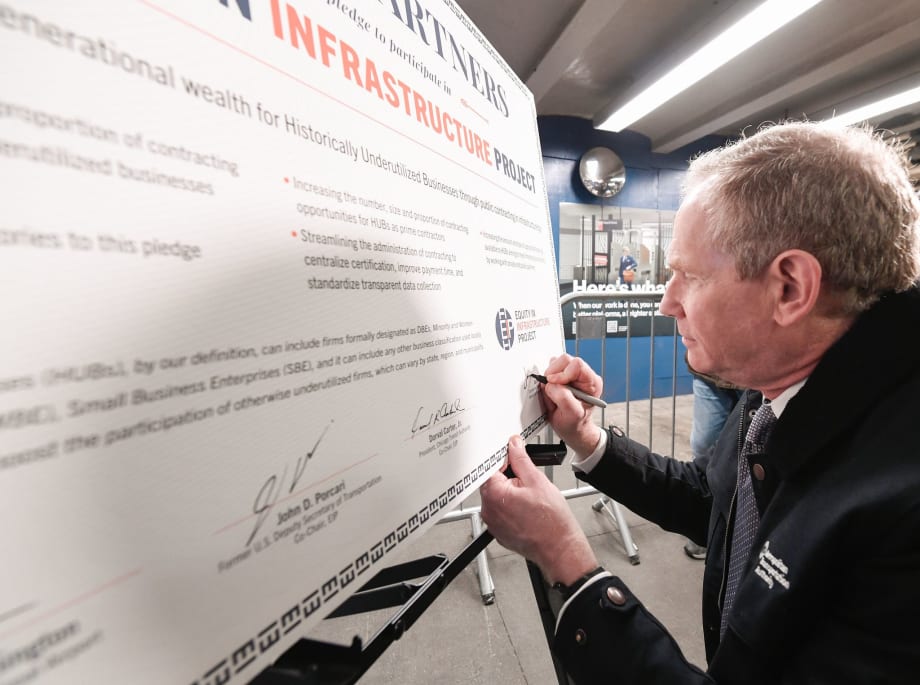
The MTA has been a consistent state leader in working with MWDBE firms.
Photo: Marc A. Hermann
The New York MTA signed the “Equity in Infrastructure Project” Pledge to further its commitment to inclusion when awarding contracts for construction projects.
The pledge affirms the MTA will ensure participation on at least $1 billion of work by Minority- and Women-owned (MWBE) or Disadvantaged Business Enterprise (DBE) firms every year and award larger contracts to small businesses, as well as expand the pool of MW/DBE firms the MTA works with and increase discretionary contracts for design and engineering MWBE firms by 20% over the next five years.
“Racism and inequity have played a significant role in paving the landscape of New York State, and our infrastructure is a stark reminder of that history,” said New York Gov. Kathy Hochul. “My commitment to equity, to expanding transit opportunities, and to Minority- and Women-owned Businesses is a commitment to building our state in a way that lifts up all New Yorkers.”
Building Equity
At the official signing, MTA officials were joined by “Equity in Infrastructure Project” (EIP) founders Phillip A. Washington and John D. Porcari, as well as Chicago Transit Authority (CTA) President Dorval R. Carter Jr., who also serves as EIP chair.
The station is currently undergoing upgrades to make the station accessible in accordance with the Americans with Disabilities Act (ADA). More than two dozen minority- or women-owned firms are working on this project, with over $45 million in contracts to those firms.
“I talk a lot about the transit system as New York’s engine of equity — it gives everybody access to jobs and education, and it’s one of the few things that makes this city affordable,” said MTA Chair/CEO Janno Lieber. “At the MTA, equity also features prominently. In 2023 almost 40% of all MTA contracts awarded went to MWBEs, accounting for over $800 million. Once we eliminate the final hurdles to congestion pricing, we intend to quickly rev the engine back up on vital State of Good Repair projects and we will look to MWBE firms to help complete that work.”
Continuing to Lead
The MTA has been a consistent state leader in working with MWDBE firms. Going back to 2020, the authority has surpassed the New York State MWBE goal of 30% participation every year, accounting for over $2.5 billion in contracts during that time.
The MTA ranks number one of all New York State agencies and public authorities in dollars paid to MWBE firms.
Last year, the MTA awarded over $813.5 million in contracts across more than 500 MWBE firms accounting for approximately 37% of overall contracts. That is in addition to the $392.3 million paid to DBE firms, and $16.7 million to service-disabled veteran-owned small businesses.
The MTA has also awarded nearly $70 million to small businesses through its Small Business Development Program.
More Management

Bringing Austin’s First Light Rail System to Life
Austin Transit Partnership CEO Greg Canally discusses the city's nearly 10-mile light rail project, its collaborative approach to project delivery, the importance of community engagement, and the milestones ahead as construction approaches in 2027.
Read More →
ETA CEO John Maglio on Transit Technology, Innovation, and Building Agency Trust
ETA founder and CEO John Maglio explores the evolution of transit technology, the importance of reliable systems, and how stronger partnerships can help agencies improve operations and the passenger experience.
Read More →
Metra Draft Plan Outlines Costs, Service Improvements for Regional Rail
The Systemwide Network Plan identifies infrastructure needs and potential investments to expand all-day, bidirectional rail service across the Chicago region.
Read More →
New Orleans RTA Names Augustine III as New CEO
In this edition, we also spotlight recent personnel moves at HDR, PATH, STV, and more, highlighting the people taking on new roles across the transportation industry.
Read More →
How Transit Agencies Are Using Free Rides to Improve Voting Access
Transit agencies are using fare-free service, trip-planning tools, and targeted rides to improve voting access. See what other agencies can learn from these efforts.
Read More →
Caltrain’s Electrification Drives a New Era of Ridership Growth
The railroad’s shift to electric service has brought more frequent trains, stronger customer satisfaction, and increased ridership, earning it APTA’s Outstanding Public Transportation System award.
Read More →
Chicago, Charlotte Transit Agencies Expand Rider Support Programs
CTA launched crisis intervention teams as CATS prepares to deploy fare ambassadors, expanding customer assistance and security efforts across both systems.
Read More →
New York MTA Launches Historic $1.9B Signal, Track Modernization Project
Funded in part by congestion pricing revenue, the project will replace nearly century-old signals along the A and C lines in Brooklyn and Queens.
Read More →
Brian Dickson on Building Stronger, More Resilient Transportation Organizations
Bus Business Consultants Founder Brian Dickson discusses the leadership principles, operational discipline, and strategic planning that separate transportation companies positioned for long-term success from those stuck in survival mode.
Read More →
LA Metro Breaks Ground on Vermont BRT Project
The 12.4-mile corridor is projected to serve 66,200 daily riders, reduce travel times by up to 24%, and create the nation's busiest bus rapid transit corridor.
Read More →