A Long-Awaited Link Reaches Seattle’s Northern Neighbor
Part of the largest transit expansion program in the country, Sound Transit’s transformative Lynnwood Link Extension opened at the end of August.
by Suze Parker
September 17, 2024
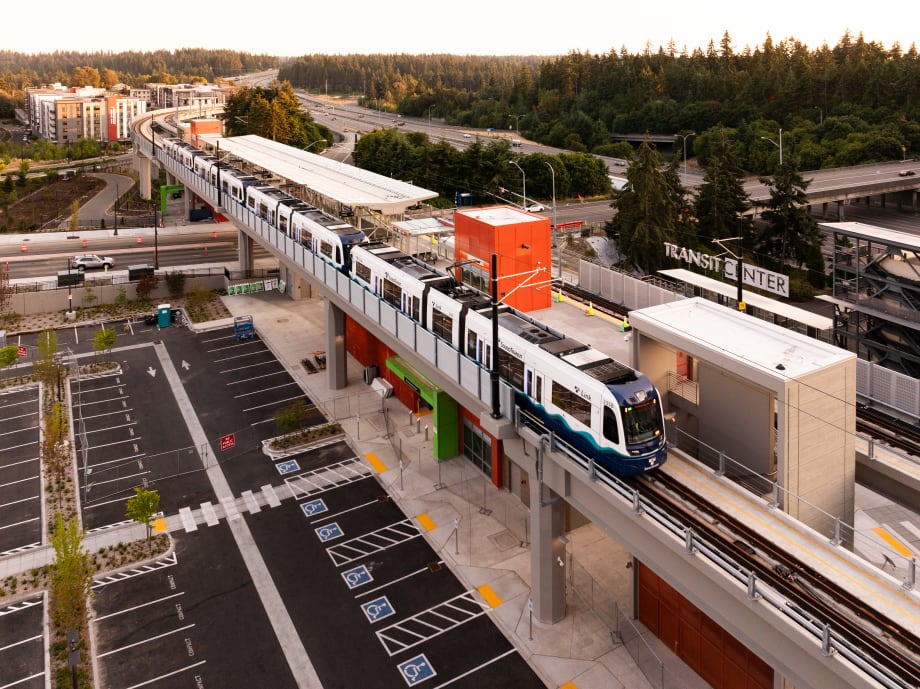
Sound Transit trains are expected at the stations every eight minutes at peak times and every 10 minutes in the evenings.
Photo: HNTB
5 min to read
Part of the largest transit expansion program in the country, Sound Transit’s transformative Lynnwood Link Extension opened at the end of August.
For the first time, the 8.5-mile project brings reliable, cost-efficient light rail into Snohomish County, one of three counties that encompass the Seattle metropolitan area.
Ad Loading...
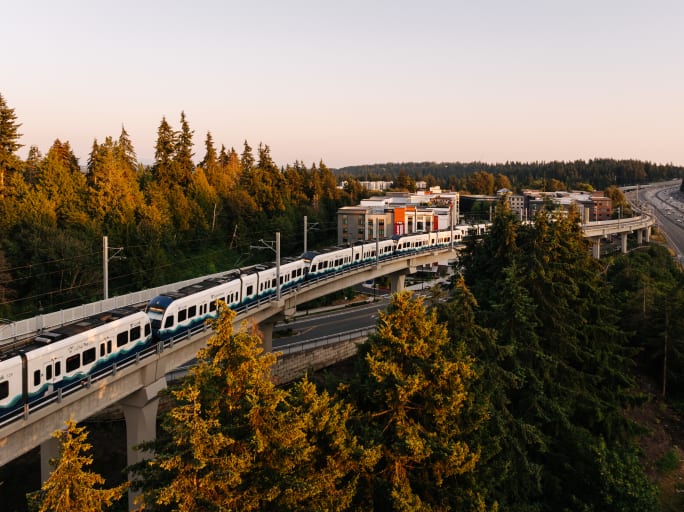
The new line serves three communities — Shoreline, Mountlake Terrace, and Lynnwood — connecting them directly to Seattle’s urban core, the Seattle-Tacoma International Airport and beyond.
“This new service marks the first time Sound Transit’s Link Light Rail System has extended into Snohomish County, broadening the range of the entire line and connecting communities across the region,” said Snohomish County Executive and Sound Transit Vice Chair Dave Somers. “The Lynnwood Link Extension will provide an efficient and sustainable transit option and bring numerous benefits to the region by enhancing daily commutes, reducing environmental impact and fostering economic development.”
HNTB served as project manager on all engineering and architectural aspects of the project design and provided construction support for the extensive, multiyear project, now called the “1 Line to Lynnwood,” which incorporates four new stations and three new parking garages.
Based on the culmination of innovative design and a collaborative partnership, the extension will improve regional mobility and significantly reduce commute times.
Based on the culmination of innovative design and a collaborative partnership, the extension will improve regional mobility and significantly reduce commute times.
Photo: HNTB
Minimizing Public Impact through Innovative Collaboration
The Lynnwood Link Extension delivers a fast, frequent, and reliable connection for riders through some of the most significant traffic congestion in Washington state.
Ad Loading...
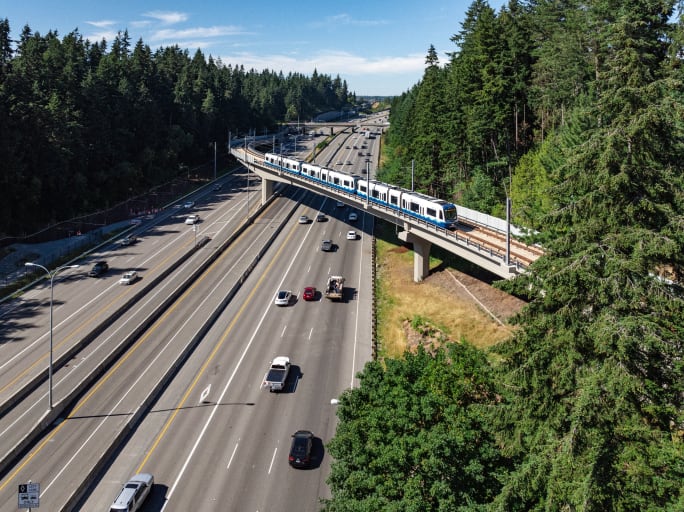
The light rail line runs parallel to Interstate 5, nestling into hillsides, crossing bridge structures, or passing through tunnels, never intersecting with traffic.
Tracing I-5, the Lynnwood Link alignment also minimized the line’s construction footprint and allowed gentle curvature on wide curves, permitting a maximum operating speed of 55 miles per hour.
By design, the project team worked to minimize traffic impacts during construction.
Where the extension crosses I-5 north of Mountlake Terrace, for example, the original design called for a cast-in-place, balanced-cantilever long-span bridge that would be built over the interstate.
The general contractor construction management contract model, which brings the contractor to the table at the late stages of design to provide feedback, was chosen for the project. This model delivered a cost-effective solution to construct the bridge and maintain traffic.
Ad Loading...
Ultimately, the team opted to use falsework to facilitate construction of a more conventional cast-in-place, box structure.
A section of the bridge was precast in Tacoma, Wash., while the other sections were poured in place due to the structure’s curved shape.
“It’s unusual to see falsework over I-5 in Washington,” said HNTB Project Manager Moein El-Aarag. “Making the new concept work effectively came from a thorough understanding of Washington Department of Transportation (WSDOT) requirements and what the contractor wanted to achieve and determining how to accommodate both. That revised approach resulted in cost savings without impacting the traveling public.”
HNTB served as project manager on all engineering and architectural aspects of the project design and provided construction support for the extensive, multiyear project, now called the “1 Line to Lynnwood,” which incorporates four new stations and three new parking garages.
Photo: HNTB
Aligning with Community Needs
With 1 Line traversing four city jurisdictions, a key challenge was building the light rail system consistent with both Sound Transit standards and the cities’ requirements.
Throughout the design process, the project team collaborated to address the unique concerns of each entity.
Ad Loading...
Existing structures and utilities in the heavily built-up corridor required detailed coordination, including underpinning existing bridge abutments, crossing busy road networks, working adjacent to existing walls and relocating major utilities.
The urban environment also drove creative designs at the stations to accommodate bus transit transfer facilities and parking garages.
“Our project management team, co-located with Sound Transit, has extensive experience working with the cities,” said Andrew Herten, HNTB design manager. “Even with intricate requirements that differed from city to city, we reviewed and resolved every comment in a timely manner.”
To ensure that design progressed during hold points in the project, the team closely collaborated with Sound Transit to devise innovative solutions that accelerated the design. Those included making scope revisions and delivering an early work package that allowed the contractor to begin utility relocations and demolition while the final design of stations and parking garages was still underway.
Design solutions prioritized community integration, ensuring each aspect of the project aligned with community needs and environmental standards.
Ad Loading...
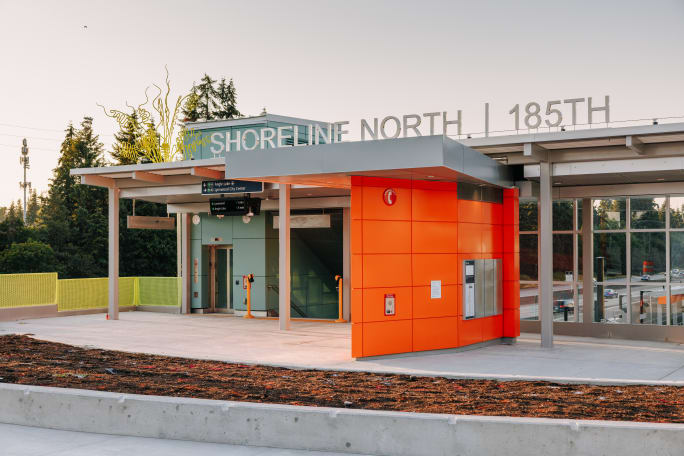
Based on community input, each Lynnwood Link station was designed with a customized plaza layout, its own color palette and original, signature artwork.
The new line serves three communities — Shoreline, Mountlake Terrace, and Lynnwood — connecting them directly to Seattle’s urban core, the Seattle-Tacoma International Airport and beyond.
Photo: HNTB
A New Era of Transportation
Beyond improving mobility, the new extension will enhance quality of life throughout the region.
It is expected to serve approximately 50,000 riders, providing a reliable mode of alternative transportation while creating access to services and economic opportunities and promoting sustainable urban growth.
Local transit agencies have added bus feeder networks at each station that will spread the benefits of light rail across a wider area.
The line’s four new stations — one each in Mountlake Terrace and Lynnwood, as well as north and south stations in Shoreline — already have spurred nearby transit-oriented development. Roughly 10,000 housing units have been added or are being developed near the four stations.
Ad Loading...
The cities also are introducing infrastructure upgrades, including new utilities, parks, and multimodal streets to accompany the new housing and the increasing number of riders.
Trains are expected at the stations every eight minutes at peak times and every 10 minutes in the evenings.
Sound Transit expects the schedule to drop to every four to six minutes once its 1 and 2 Lines are connected next year. In the next few years, Sound Transit plans to begin work on the line’s next phase, a 16-mile northward connection from Lynnwood to Everett.
“The Lynnwood Link Extension project stands as a testament to our ability to deliver complex infrastructure on time and on budget through effective collaboration and strong relationship management,” El-Aarag said. “Together, Sound Transit, WSDOT, the project team, and the cities of Lynnwood, Mountlake Terrace, Shoreline, and Seattle have achieved a significant milestone in enhancing our region’s transit infrastructure.”
About the Author: Suze Parker is a public relations consultant and writer who writes about transportation infrastructure.
Contract Four is the largest in the Second Avenue Subway Phase 2 project and includes construction of station infrastructure, tracks, and signals for the subway expansion, MTA officials said. Work on Contract Four will begin in 2027.
The Garden State Initiative analysis examines the roles of Amtrak infrastructure, fleet management, and agency operations while recommending a more performance-based approach to improving reliability.
Beginning in 2027, Stadler will provide on-site technical expertise, spare parts support, training, and obsolescence management to help extend the reliability and longevity of CapMetro’s GTW fleet.
In METRO's latest installment, we take a look at recent news from Complete Coach Works, Beep, FlixBus, and more partnerships making headlines across the transportation sector.
Pedestrian microsimulation is helping rail planners identify bottlenecks, test station designs, and prepare complex transit hubs for growing passenger volumes.
The privately developed project would offer a 15-minute trip between downtown and O’Hare’s Terminal 2, with trains operating every 15 minutes on a dedicated track. The service would use battery-electric trains and three existing freight rail rights-of-way.
The draft feasibility report identifies strategies to protect the coastal rail line for decades as the agency continues near-term stabilization and sand placement efforts.