



Michigan State, ADASTEC Team for Automated Bus Service
Beginning August 25, it will operate along a 5.12-mile route through central campus, providing a free, accessible, and sustainable mobility option for students, faculty, staff, visitors, and the surrounding community.

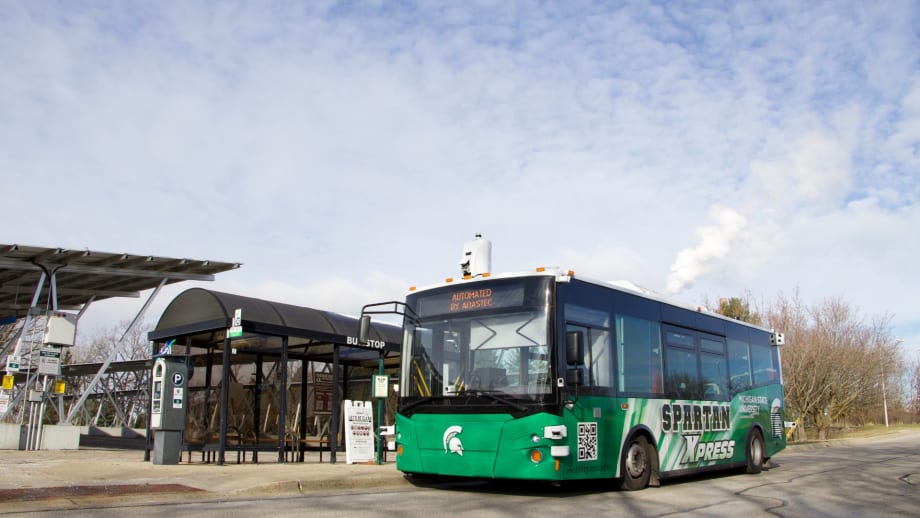
The bus meets both Federal Motor Vehicle Safety Standards and Americans with Disabilities Act requirements, making it the first SAE Level-4 automated bus with these certifications to operate in the U.S.
Photo: ADASTEC
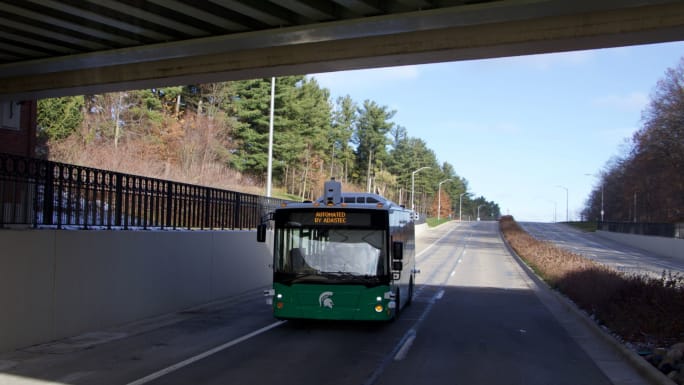
Named SpartanXpress through a campus-wide student contest, the bus will serve as a hands-on learning platform for students across multiple disciplines.
Photo: ADASTEC
A new full-size electric bus, automated by ADASTEC — a provider of SAE Level-4 automated driving software for full-size buses — is joining the Michigan State University campus transportation network.
Beginning August 25, it will operate along a 5.12-mile route through central campus, providing a free, accessible, and sustainable mobility option for students, faculty, staff, visitors, and the surrounding community.
The bus meets both Federal Motor Vehicle Safety Standards (FMVSS) and Americans with Disabilities Act (ADA) requirements, making it the first SAE Level-4 automated bus with these certifications to operate in the U.S.
Michigan State’s Autonomous Bus Project
The deployment is part of a new three-year research agreement with the university in which ADASTEC’s SAE Level-4 automated driving software platform, flowride.ai, will be central to developing and proving out connected and automated vehicle technologies in real-world conditions.
To enable advanced capabilities such as intersection-to-bus communication, ADASTEC’s system will integrate with nine newly installed C-V2X (cellular vehicle-to-everything) roadside units along the route. This connected vehicle infrastructure, seamlessly working with flowride.ai, will be a critical asset for deployment, ongoing testing, and the continuous advancement of ADASTEC’s automated driving solutions.
The new service takes Michigan State University’s campus mobility to an entirely new level, introducing a fully integrated passenger operation with advanced connected vehicle capabilities.
The bus enables a continuous flow of real-world data to support both operational excellence and advanced mobility research. This vehicle combines advanced automation with full regulatory compliance, setting a new benchmark for automated public transportation in the U.S.
The SpartanXpress
Named SpartanXpress through a campus-wide student contest, the bus will serve as a hands-on learning platform for students across multiple disciplines.
Through access to performance data and real operational scenarios, future engineers and researchers will gain direct insight into how ADASTEC’s SAE Level-4 automated driving software platform, flowride.ai, interacts with infrastructure, passengers, and varied traffic conditions, creating a living classroom that blends technology, education, and public service.
The FMVSS- and ADA-compliant bus is equipped with ADASTEC’s advanced sensor suite, including six LiDARs, six radars, eleven RGB cameras, a GNSS, and a C-V2X onboard unit. flowride.ai manages all driving functions from acceleration and braking to steering and decision-making on pre-mapped urban routes in mixed traffic that includes cyclists, pedestrians, cars, buses, and trucks.
The system communicates with surrounding infrastructure and other road users, intelligently adapting to dynamic traffic conditions while managing intersections, bus stops, and crosswalks without the need for human intervention.
Through vehicle-to-infrastructure connectivity, the system communicates with 13 traffic lights and roadside units for precise coordination at intersections and pedestrian crossings. Through C-V2X connectivity, the system also operates with continuous communication with traffic lights to ensure exact coordination.
The bus operates reliably in adverse weather conditions, including light snow, rain, and haze. It also features an automated accessibility ramp and ADA-compliant boarding, with real-time fleet monitoring and remote operation capabilities for enhanced safety.
The maximum speed limit for the route is 25 mph. This level of situational awareness ensures uninterrupted service and makes sustainable automated transportation a natural part of campus life at MSU.
More Technology

From Hardware to Digital Partner: Luminator Charts Its Next Chapter
CEO Magnus Friberg discusses Luminator’s shift toward becoming a digital partner, the growing importance of software and interoperability, and how AI can help agencies improve operations and passenger experience.
Read More →
Beyond the Checklist: A Structured Approach to Transit Maintenance
Reliability-Centered Maintenance helps transit agencies move beyond routine checklists to focus limited resources on the assets and failures that have the greatest impact on safety, reliability, and service.
Read More →
NJ TRANSIT Advances Bus Technology Upgrades Across Statewide Fleet
More than 1,500 buses now feature upgraded technology designed to improve arrival predictions and provide free Wi-Fi, with deployment expected to reach nearly 2,000 buses by the end of 2026.
Read More →

Building a Flexible Path to Transit Electrification
John Hroncich discusses BAE Systems’ modular and scalable approach, lessons learned from decades of real-world operations, and how agencies can identify electrification strategies that fit their fleets.
Read More →
Biz Briefs: Alstom Lands Canadian Contract, LYT to Supply California TSP, and More
In METRO's latest installment, we take a look at recent news from Complete Coach Works, Beep, FlixBus, and more partnerships making headlines across the transportation sector.
Read More →
From Legacy Silos to Conversational Intelligence
What if transit leaders could ask any operational question and get a trusted answer in seconds? Conversational AI is transforming how agencies use their data.
Read More →
USDOT Announces Rail Vehicle Replacement Grants, Chattanooga AV Shuttle Funding
More than $191 million in federal funding will help three transit agencies replace aging rail vehicles and support a new autonomous shuttle service in Chattanooga.
Read More →
Bus Tech Talk: Keeping Transit Technicians Ahead of the Technology Curve
LA Metro’s Obed Mejia discusses technician training, evolving maintenance technology, fleet replacement, and strategies for getting the most out of today’s transit fleets.
Read More →
Biz Briefs: RIPTA Unveils New Frontrunners, Clevland RTA Adds New Siemens, and More
In METRO's latest installment, we take a look at recent news from Siemens, Prevost, Dodge, and more partnerships making headlines across the transportation sector.
Read More →
Why Simulating Pedestrian Movement Has Become Essential for Modern Rail Stations
Pedestrian microsimulation is helping rail planners identify bottlenecks, test station designs, and prepare complex transit hubs for growing passenger volumes.
Read More →