



RELATED: 10 Steps for Transit Agencies Starting Travel Training Programs
NFTA, U. of Buffalo study challenges faced by riders with disabilities
“It’s our hope that our research findings will guide standards that will make buses more accessible to all,” says UB prof. Victor Paquet.
by By David J. Hill
October 23, 2017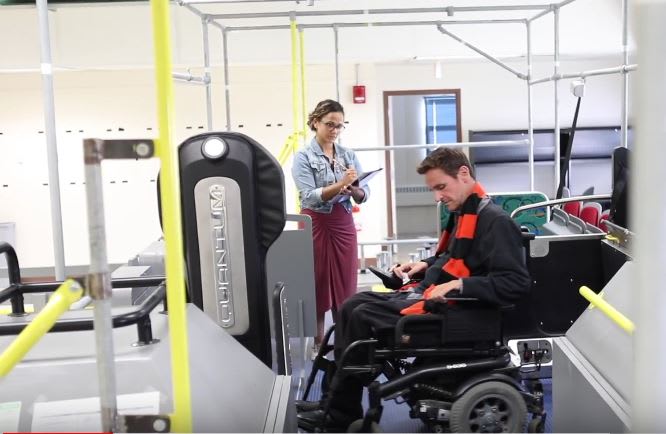
Brittany Perez (left) and Michael Rembis (right), an assistant professor of history at UB, test out wheelchair a securement system. Photo courtesy of the University of Buffalo.
7 min to read
Brittany Perez (left) and Michael Rembis (right), an assistant professor of history at UB, test out wheelchair a securement system. Photo courtesy of the University of Buffalo.
For many people who have a disability, taking public transportation is a necessity. But it can also be a nightmare.
The barriers abound. It can be extremely difficult to get up and down the stairs on the bus. Riders who use a wheelchair often feel undue attention drawn upon them as passengers sit and wait impatiently while the bus operator secures the wheelchair in place.
But a research partnership between the University at Buffalo and the Niagara Frontier Transportation Authority (NFTA) is working to dramatically improve the public transit experience for the region’s many riders who have some type of disability.
They’re taking what they’ve learned through lab simulations on the South Campus and applying the findings to the NFTA’s fleet of buses. Their results also have helped inform national standards for accessible public transportation.
The work being done by the NFTA and UB’s Center for Inclusive Design and Environmental Access (IDeA Center) is critical for public transit users like Andrew Marcum, program director for the Center for Self Advocacy, a Buffalo-based nonprofit organization that helps individuals with developmental disabilities lead independent, productive lives.
The center offers a travel training program that teaches anyone who has a disability how to use the region’s public transportation system.
“Access to reliable, accessible public transit is essential for people with disabilities to be able to live independent, full lives in the community,” says Marcum.
Informing national standards
In recent years, IDeA Center studies have helped inform national guidelines for accessible public transportation, including a recent ruling by the U.S. Access Board to change the ramp slope to make it easier for passengers who use a wheeled mobility device and others to board buses. Researchers there also have published several papers in peer-reviewed journals.
“It’s our hope that our research findings will guide standards that will make buses more accessible to all,” says Victor Paquet, professor of industrial and systems engineering in UB’s School of Engineering and Applied Sciences.
“We want our findings to be communicated not only in the scientific literature, but more importantly, to the people and transportation agencies that can greatly benefit from this information,” adds Paquet, one of numerous researchers from a range of fields at UB who collaborate with the IDeA Center, which is housed in the School of Architecture and Planning.
Other collaborators include James Lenker, associate professor of rehabilitation science in the School of Public Health and Health Professions, who has also worked on the bus studies.
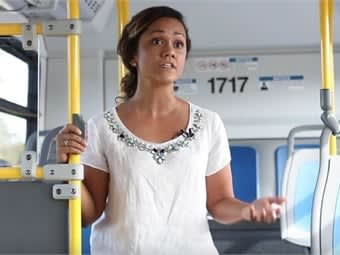
Brittany Perez is an occupational therapist and research associate in the IDeA Center who has led the bus studies. Photo courtesy of the University of Buffalo.
Testing wheelchair securement systems
The IDeA Center collaborated with community members who use a variety of wheeled mobility devices to conduct usability testing on three different types of wheelchair securement systems for buses.
Americans with Disabilities Act (ADA) regulations require transit authorities to have two wheelchair securement spaces.
While there are now several other types of securement systems available, the traditional system has been a four-point securement: two hooks for the front of the wheelchair and two for the rear, plus a lap or shoulder belt, all of which have to be attached by the bus driver.
But, says Brittany Perez, an occupational therapist and research associate in the IDeA Center who has led the bus studies, “There are a lot of challenges with this securement system. It’s time-consuming, the wheelchair user often feels that there is unwanted attention drawn to them, and there’s time pressure for the bus driver who is hurrying to stay on schedule.”
“As a result, passenger compliance with using wheelchair securement systems is extremely low,” adds Paquet. “The IDeA Center has been working to find creative ways to ensure that wheelchair users are safe, and that they are more likely to use the securement technologies available on the bus because they’re not as time-consuming or intrusive.”
Researchers began by examining the traditional, manual, four-point securement system that requires the bus driver’s assistance and compared that to two securement system alternatives:
A manual, three-point securement system (known by the brand name Q’Pod) that also requires the bus driver to hook the wheeled mobility device in place. Lab tests showed this system takes less time than the traditional four-point securement system. Community participants also rated it as easier to use.
An automated, rear-facing system (Quantum) that Perez says is “different than anything that has been available thus far in the securement industry.” In this system, the passenger backs into the securement space, which is equipped with a rear protective padding. The rider simply presses a button to initiate two telescoping arms that apply pressure to both sides of the wheelchair, securing it into place. “In our study, we found that this system significantly reduces securement time and increases independence, and our participants rated the automated system very highly,” Perez says.
Improving bus ramps
Before shifting focus toward wheelchair securement, the IDeA Center conducted a study examining the slope of a newer bus-ramp technology. The ramp unfolds after the bus door opens and allows passengers to board the vehicle, whether they are in a wheeled mobility device, use a cane or walker, or are a parent pushing a stroller.
Their study, like others, found that a 1 to 6 ramp — meaning a ratio of 1 inch in vertical rise to 6 inches of horizontal run — is safer and easier to use than the previous standard slope of 1 to 4 in transit vehicles.
The IDeA Center also reported that ramps are better than lifts. “The ramp allows riders to enter and exit the bus independently, whereas the use of a lift requires the full assistance of the bus driver,” Perez says. “The ramp can benefit all kinds of passengers.”
Last January, the U.S. Access Board issued a final ruling making the 1 to 6 ramp the maximum slope standard for transit vehicles when the ramp is deployed to the street level.
Jeffrey Sweet, an NFTA equipment engineer who has more than three decades of experience in public transportation, worked with researchers to develop best-in-class equipment for those with special needs.
“We’ve adopted the 1 to 6 ramp, and that’s just one of a number of improvements we have developed,” says Sweet, who is continuously looking at ways to meet and exceed regulations and requirements.
The IDeA Center’s studies on the wheelchair securement and ramp access were both funded through the Administration for Community Living’s Rehabilitation Engineering Research Centers (RERC) program.
Prior to the ramp and wheelchair securement studies, the IDeA Center, again through RERC funding, studied the interior design of the NFTA’s 40-foot buses. The research led to improvements in the turn space wheelchair users have when boarding the bus, as well as the positioning of the fare-collection box to make to make it more user friendly.
Partners in public transportation
The IDeA Center and NFTA began their partnership almost 10 years ago. The benefits are mutual. IDeA Center researchers get to take what they learned in the simulation lab and apply it to the real world using NFTA buses and riders who rely on accessible public transportation.
“One of the biggest benefits we have is being able to work with the NFTA and learn about the real-world challenges passengers with disabilities face when taking public transportation,” Perez says.
The IDeA Center has conducted some of its research in its former lab in an annex building on the South Campus, which houses a full scale, low-floor bus simulator that allows researchers to work in poor weather conditions or when an NFTA bus is not available. But the NFTA has also brought some of its 40-foot buses and its smaller Paratransit Access Line vehicles to campus.
“We could stay on campus in our simulator and be limited to what we learn in the lab, but having that open dialogue with the NFTA has been helpful in designing and implementing our research studies. Some of the conversations they’ve had around accessibility are very progressive for a transit authority their size,” Perez says.
Meanwhile, the NFTA is supplied with data from research studies, which the authority can use to inform changes that improve service for all NFTA users. In 2016, the NFTA’s system-wide Metro Bus and Rail services provided a total of 28.1 million rides.
“The IDeA Center really provided us with a tremendous amount of insight and valuable information,” says Sweet. “It helped us exceed regulations and improve our service, based on actual data.”
Metro has a fully accessible bus and rail system. But for passengers who can’t use regular Metro Bus or Metro Rail service due to a disability, the NFTA provides curb-to-curb transportation through its Paratransit Access Line.
More Paratransit
King County Metro Makes ADA Paratransit Easier to Navigate
METRO's Innovative Solutions Award winner replaces complex service-area descriptions with an accessible, interactive map that puts paratransit information directly in customers’ hands.
Read More →
Jacksonville’s NAVI Project Charts a New Course for Autonomous Public Transportation
Through its NAVI program, JTA is showing how autonomous vehicles, intelligent infrastructure, and coordinated operations can work together to deliver everyday public transportation.
Read More →
Driving Smarter Paratransit
John Hanlon shares how AlphaRoute is leveraging AI-powered technology to help paratransit providers optimize operations, support frontline staff, and enhance the rider experience.
Read More →
METRO Magazine Announces 2026 Innovative Solutions Awards Winners
Projects Recognized for Advancing Mobility Through Technology, Accessibility, Workforce Innovation, and Operational Excellence
Read More →
Biz Briefs: STV teams with Amtrak, Motorcoach Operators Boost Fleet and Land Contracts, and More
From manufacturers and suppliers to transit agencies and motorcoach operators, these updates offer a snapshot of the projects, partnerships and business moves driving the industry forward.
Read More →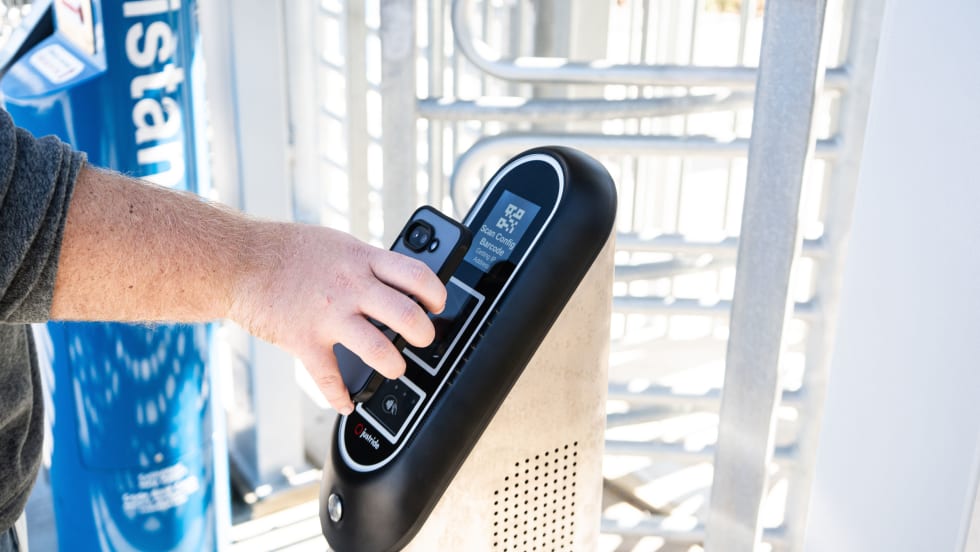
Biz Briefs: Masabi Teams with St. Louis Metro and More
In METRO's latest installment, we take a look at recent news from Transdev, Hitachi, and more partnerships making headlines across the transportation sector.
Read More →
New York MTA Leverages Zoning Program to Advance Station Accessibility
Accessibility enhancements at Nevins St Station will be financed through a development agreement tied to the MTA's Zoning for Accessibility initiative.
Read More →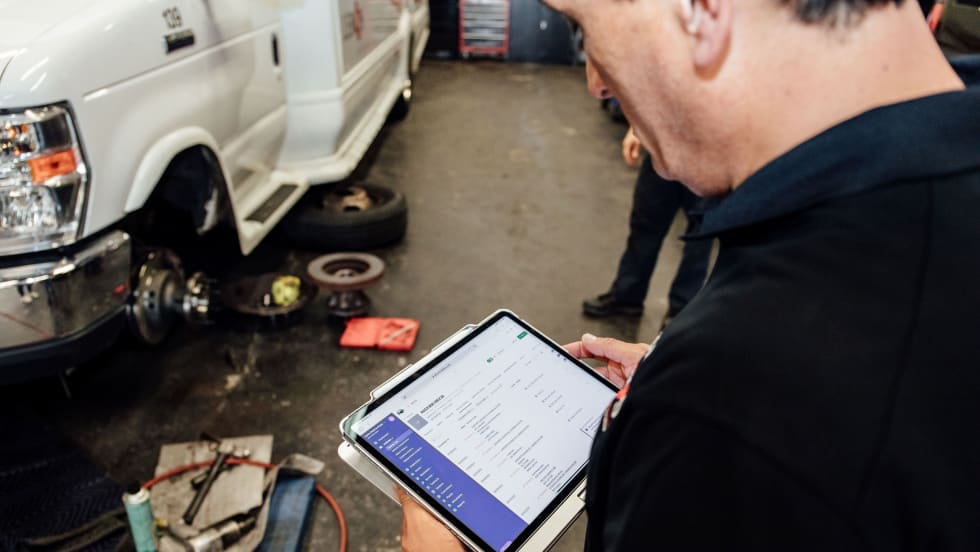
Reinventing Fleet Maintenance with Real-time Visibility and AI
Transit leaders need to know what needs fixing, where to look, who is responsible, when work is completed, and what it costs without having to chase information across disconnected systems.
Read More →
SamTrans Sets Priorities for Potential Connect Bay Area Revenue
The board-approved framework allocates future funding to maintaining service, rider improvements, equity initiatives, and infrastructure repairs.
Read More →
Chicago's NITA Act Moves Into Next Phase as Service Improvements Begin
Rider-focused improvements will begin rolling out across the system immediately as CTA, Metra, and Pace increase service this summer in the six-county region.
Read More →