



2014 Women In Transportation: Sallye Perrin
Sr. VP/Strategic Director, Public-Private Partnerships Parsons Brinckerhoff Baltimore
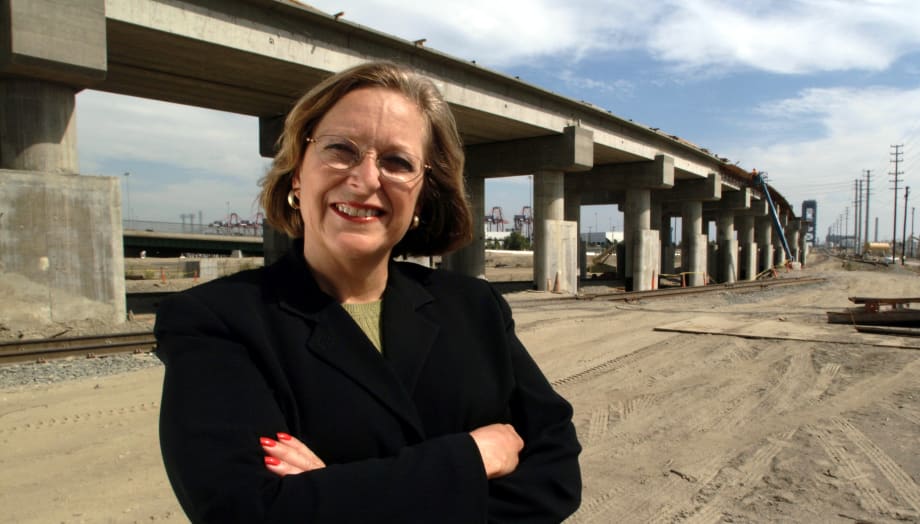
Perrin works with industry groups, speaks at conferences and develops materials to help in the advocacy for P3s through Parsons Brinckerhoff.

Perrin works with industry groups, speaks at conferences and develops materials to help in the advocacy for P3s through Parsons Brinckerhoff.
In her over 30-year career working on major transportation projects, Sallye Perrin developed a specialty in public-private partnerships, commonly referred to as P3s. A senior vice president of Parsons Brinckerhof (PB), Perrin also serves as the company’s P3 strategic director.
The market for P3s is expanding in the U.S. as President Barack Obama recently announced a new federal effort called the “Build American Investment Initiative.” The order is designed to bring more private-sector dollars into public transportation.
“Everybody wants to do things faster,” Perrin says of P3s. “The days of spending 20 years to develop and deliver a project are over — clients want to complete major projects in five or six years, and they’re interested in finding different ways of financing them so they don’t have to wait for funding to trickle in.”
Perrin helps coordinate PB’s approach to P3s. When she identifies an opportunity that might work for a municipality or state, she organizes a team to work on a proposal strategy — which can take up to a year to develop — and its delivery.
“I help motivate teams to break away from what they normally do to come up with innovative solutions,” Perrin says. “It’s challenging but also one of the most exciting aspects of a P3 development.”
She also works with industry groups, speaks at conferences and develops materials to help in the advocacy for P3s through PB.
“P3s are becoming a norm, and that’s an exciting time,” Perrin says. “I find it really thrilling to work on true integrated delivery where you’re looking at projects holistically.”
Perrin is currently working with a team of PB designers on a significant P3 project in Boston. It includes a major underground structure and related highway and transportation improvements. According to Perrin, the project is aiming for financial close this fall.
Previously, Perrin worked in Istanbul with the Turkish Ministry of Transportation on its light rail program. She served as environmental manager responsible for the assessment of transit alternatives for the existing system. Over the course of the project, she managed a group of 10 Turkish sub-consultants on the first environmental assessment of its kind in Turkey.
“All aspects of the project had impacts, and we evaluated the big picture,” Perrin says. “We were working together to come up with a solution that optimized the spirit of the project in conjunction with construction, design and maintenance.”
During a decade-long hiatus from PB from 1994 to 2004, Perrin helped implement P3s for the development of four new transit lines in Houston. And prior to that, she led the development team for Viva, a bus rapid transit service operating in York Region, Ontario, Canada. The line now connects York Region to northern Toronto, and the project was designed and built using a P3 model, with the province of Ontario as well as the federal government providing funding.
She aided in the planning, design, construction and bus integration of the Viva, which is notably successful.
“We ended up rebranding the service to be attractive and something different than the regular bus service,” she says.
Perrin graduated from the University of Virginia and was one of the first women to do so. She then went on to receive a master’s degree in civil engineering, joining PB in 1986. She was among the first to be hired for the company’s Baltimore office.
“I fell in love with transportation work and the planning that went into it,” says Perrin, who went on to work on the implementation of the Baltimore Metro extension to Johns Hopkins Hospital as well as the city’s new 22-mile light rail transit system.
“I value transit because it provides opportunities for mobility, shapes cities and makes important impacts on how these cities grow,” she says. “How do we create synergies and put together teams to build on our capabilities in pursuing public-private partnerships? That’s what I’m interested in answering.”
More Management

METRO Opens Submissions for 2026 Motorcoach Awards
Nominations are now being accepted for METRO Magazine’s Operator of the Year and Innovative Operator of the Year awards.
Read More →
New York MTA Advances Final Contract for Second Avenue Subway Expansion
Contract Four is the largest in the Second Avenue Subway Phase 2 project and includes construction of station infrastructure, tracks, and signals for the subway expansion, MTA officials said. Work on Contract Four will begin in 2027.
Read More →
Transit Agencies Highlight Safety Gains at National Summit
Leaders from 15 major transit systems shared crime-reduction results and safety initiatives while discussing the role of continued federal support.
Read More →

NITA Names New Leadership, Expands Reduced-Fare Program at First Board Meeting
The new regional transit authority appointed its first board chair and interim executive director while extending reduced fares across CTA, Metra, and Pace for eligible riders.
Read More →
Beyond the Checklist: A Structured Approach to Transit Maintenance
Reliability-Centered Maintenance helps transit agencies move beyond routine checklists to focus limited resources on the assets and failures that have the greatest impact on safety, reliability, and service.
Read More →
APTA 2026 Nominating Committee Selects Leadership Slate, Names Chair and Vice Chair Nominees
Leadership changes will help shape the association’s priorities and its representation of the transportation industry during the 2026–2027 term.
Read More →
DART Launches Major Security, Fare Enforcement Initiative
The 90-day demonstration will deploy coordinated security teams at five light rail stations while testing controlled access and gathering data to guide future investments.
Read More →
Advancing Fare Collection Through Technology and Innovation
Learn about delivering 1300 gates at 91 stations while managing fare evasion. Explore the large scale deployment, solution customization and real-world results that affect the region. Prepare for deployment in your region now.
Read More →
Game Day in Motion: Moving Millions During the 2026 World Cup
Between packed transit stations and team motorcoaches, see how agencies and operators across North America tackled the transportation demands of the 2026 FIFA World Cup.
Read More →
Surface Transportation Extension Averts Shutdown, Leaves Transit Funding Gap
The stopgap keeps federal transportation programs moving, but missing advance funding could complicate the transit and rail projects agencies are planning next.
Read More →