



2014 Women In Transportation: Vicki Woolridge
Government Affairs Manager South Florida Regional Transportation Authority Pompano Beach, Fla.
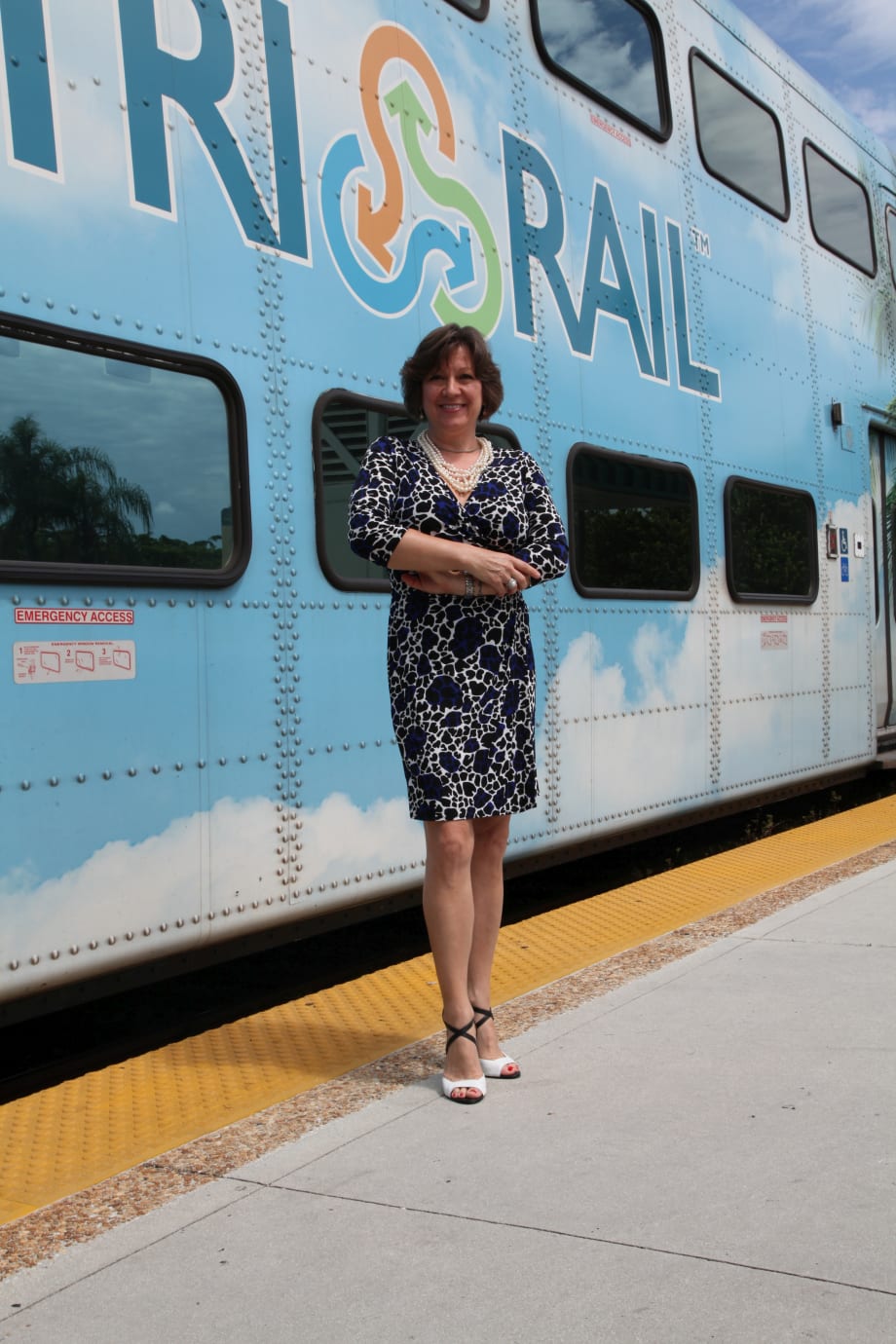
Wooldridge’s biggest responsibility at SFRTA is ensuring the future of the agency through her legislative consulting team at the federal, state and local levels.
Wooldridge’s biggest responsibility at SFRTA is ensuring the future of the agency through her legislative consulting team at the federal, state and local levels.
Working in governmental affairs was an unexpected career path for Vicki Wooldridge, a natural-born artist and art school attendee. However, soon after deeming commercial art a field too fickle to pursue professionally, she began looking for a job that could put food on the table and support what she calls a “bad shoe habit.” Impressively, high heels are a staple of Wooldridge’s wardrobe.
She found an administrative job for a university in central Florida. But government work still wasn’t on her radar until a close friend, who worked for Florida Sen. Bill Nelson (D-FL), made a suggestion.
“She told me ‘you’re such a people person, you’d do great in my line of work,’” Wooldridge recounts. “On the job, I’m an extrovert — I’m very passionate about what I do.”
Two days later, she saw an opening at the local state senator’s office and applied. Wooldridge didn’t get the job, but the office suggested she call Rep. Harry Goode, in Melbourne, Fla., who was in need of a house aide. “Goode said to me, ‘I hear you know someone in Bill Nelson’s office…if you’re good enough for him, you’re good enough for me,’ and that was all it took,” Wooldridge says.
She went on to spend nine years as a house aide before transitioning to a lobbying firm to work as a contract lobbyist. Everything she knew, she learned from experience.
“When it comes to lobbying, I’m a firm believer there’s no better education of the legislative process than your first session,” Wooldridge says.
It was in this position that Wooldridge was first exposed to the transportation industry. Tri-Rail, of the South Florida Regional Transportation Authority (SFRTA), was a client of her firm.
“I developed a good idea of what state transportation looked like because I was placed as liaison between the train agency and the firm,” she says. “I attended all their board meetings.”
Her intimate knowledge of the organization continued to grow, and in 2008, she received a phone call from Tri-Rail’s executive director asking if she’d be interested in coming on as staff. Historically, Tri-Rail had two separate state and federal affairs managers, but the decision was made to combine the roles, making Wooldridge the official government affairs manager of SFRTA.
“At that point, I had about 14 years of state experience, but Washington was a welcomed challenge,” Wooldridge said. “Executive Director Joe Giulietti, with over 40 years of experience at the federal level, taught me everything he knew.”
Wooldridge’s biggest responsibility is ensuring the future of the agency through her legislative consulting team at the federal, state and local levels. This includes not only substantive changes, but appropriations and the funding process as well. The smaller picture, according to Wooldridge, involves relationship building and educating those, including elected officials, who can really make a difference for SFRTA’s mission.
“When a legislative session comes along, you only get a two-minute sound bite,” Wooldridge says. “So, when elected officials are home in their district offices, that is the time to talk. When they think trains, I want them to think SFRTA.”
One of Wooldridge’s proudest accomplishments to date is changing SFRTA from a regional organization to a transportation authority through legislation.
“That was a big push, and now we oversee not just trains, but shuttle buses and more, ensuring the mobility of people,” she says. “It’s an ongoing challenge to ensure that everybody understands what we’re capable of doing.”
SFRTA is celebrating its 25th year in business with many new developments on the horizon. Projects include installing Wi-Fi on the trains within the next year, launching an upgraded website and mobile app with real-time information, and completing a $2 billion ground transportation hub at Miami International Airport.
“Where the agency’s heading is really exciting,” says Wooldridge. “To me, it’s a no-brainer to have good transportation available to folks who not only need it but want it.”
More Management

METRO Opens Submissions for 2026 Motorcoach Awards
Nominations are now being accepted for METRO Magazine’s Operator of the Year and Innovative Operator of the Year awards.
Read More →
New York MTA Advances Final Contract for Second Avenue Subway Expansion
Contract Four is the largest in the Second Avenue Subway Phase 2 project and includes construction of station infrastructure, tracks, and signals for the subway expansion, MTA officials said. Work on Contract Four will begin in 2027.
Read More →
Transit Agencies Highlight Safety Gains at National Summit
Leaders from 15 major transit systems shared crime-reduction results and safety initiatives while discussing the role of continued federal support.
Read More →

NITA Names New Leadership, Expands Reduced-Fare Program at First Board Meeting
The new regional transit authority appointed its first board chair and interim executive director while extending reduced fares across CTA, Metra, and Pace for eligible riders.
Read More →
Beyond the Checklist: A Structured Approach to Transit Maintenance
Reliability-Centered Maintenance helps transit agencies move beyond routine checklists to focus limited resources on the assets and failures that have the greatest impact on safety, reliability, and service.
Read More →
APTA 2026 Nominating Committee Selects Leadership Slate, Names Chair and Vice Chair Nominees
Leadership changes will help shape the association’s priorities and its representation of the transportation industry during the 2026–2027 term.
Read More →
DART Launches Major Security, Fare Enforcement Initiative
The 90-day demonstration will deploy coordinated security teams at five light rail stations while testing controlled access and gathering data to guide future investments.
Read More →
Advancing Fare Collection Through Technology and Innovation
Learn about delivering 1300 gates at 91 stations while managing fare evasion. Explore the large scale deployment, solution customization and real-world results that affect the region. Prepare for deployment in your region now.
Read More →
Game Day in Motion: Moving Millions During the 2026 World Cup
Between packed transit stations and team motorcoaches, see how agencies and operators across North America tackled the transportation demands of the 2026 FIFA World Cup.
Read More →
Surface Transportation Extension Averts Shutdown, Leaves Transit Funding Gap
The stopgap keeps federal transportation programs moving, but missing advance funding could complicate the transit and rail projects agencies are planning next.
Read More →