



RELATED: How to Maintain a State of Good Repair by Leveraging Asset Managment Tools
4 Ways Transit Agencies Can Amp Up Asset Management
Benefits include the prospect of ensuring quality, safety, and efficiency of their service through more confidence in budget projections, more formalized data collection, and efficient reporting procedures.
by Andreas Aeppli and Kyle Emge
May 7, 2018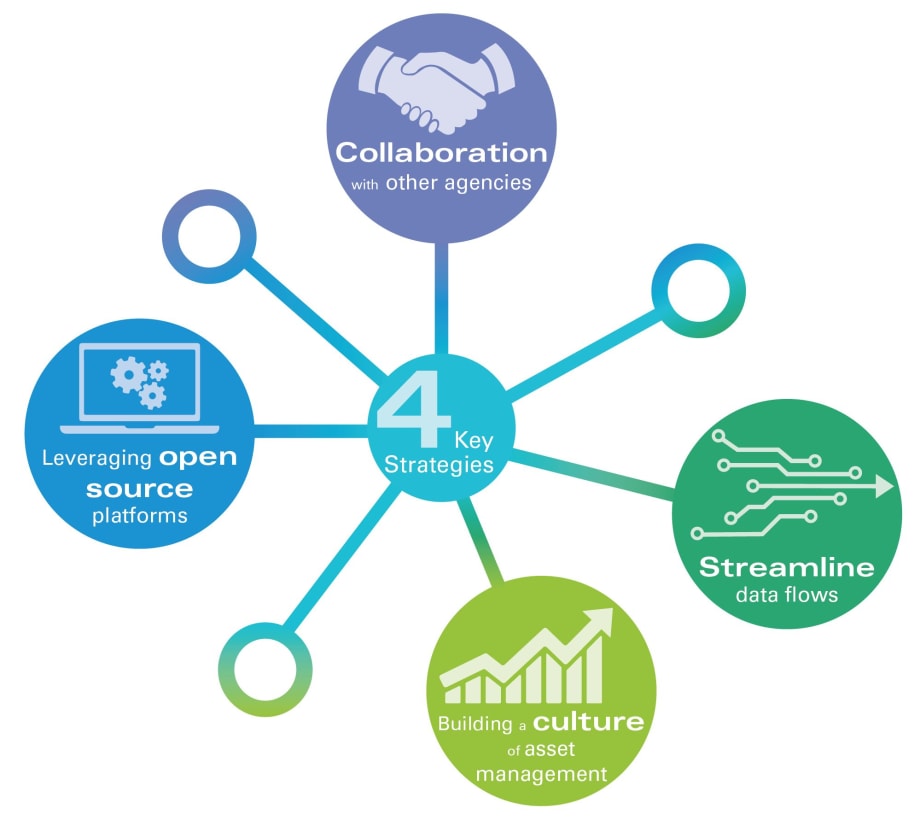
Cambridge Systematics
6 min to read
Cambridge Systematics
Many transportation agencies are eager to reap the benefits of systematizing their asset management. That’s because it offers the prospect of ensuring quality, safety, and efficiency of their service through more confidence in budget projections, more formalized data collection, and efficient reporting procedures. There are four key proactive strategies that transportation agencies can implement to expand the benefits of asset management: collaboration with other agencies, leveraging open-source platforms, streamlining data flows, and building a culture of asset management.
1. Collaboration with other agencies
Multiple methods exist for accomplishing interagency collaboration. One method is through mandated collaboration, where agencies must supply agency-specific information to receive funding. Voluntary collaboration occurs when agencies develop best practices for data, management, or policy requirements through working together, exchanging ideas, and leveraging resources.
Several benefits are associated with voluntary collaboration. First, agencies can share the costs of developing tools, systems, and applications to enhance performance. Second, they can share and coordinate knowledge and data to more efficiently accomplish tasks required to comply with federal and state regulations. Third, agencies can present a united front when seeking to direct policy. Voluntary collaboration also can be achieved through formal coordination, such as when a state Department of Transportation (DOT) works with transit operators collaboratively to streamline the processes and results for a specific statewide program.
A crucial component of collaboration is trust. There are valid concerns related to how data is shared, its interpretation, and comparisons with other agencies. One solution is for agencies to create procedures that allow only select data to be available to other agencies or to their state DOTs. Also, it is imperative for the collaboration to mutually benefit all involved. Here’s an example. When agencies and their state DOT work together, the DOT experiences enhanced efficiency and consistent information from the agencies. Meanwhile, because the DOT has access to the agency’s data, it makes it easier for the DOT to understand the agency’s needs and distribute appropriate funding for projects.
2. Leveraging open source tools
There are a variety of proprietary and open source software solutions that enable agencies (and other participants) to more effectively manage processes while supporting strategic and tactical decision making. While there are some advantages to working with a proprietary solution provider, the cost to incorporate all needed features and capabilities may be prohibitive. On the other hand, agencies are not required to pay a license fee to use open source software, nor are they locked into one particular vendor for hosting, maintenance, support, or customization. With open source software, agencies can switch vendors and still keep their platforms. Also, they can enhance platforms with new features as necessary.
One key benefit of open-source software is the ability to include multiple development paths for a particular solution. This means taking an existing platform and adapting it specifically to meet the requirements for one or more agencies. Precise adaptability isn’t always possible with proprietary software solutions. Another advantage is agencies can pool funds and resources to quickly and collectively set directions for developing cost-effective, tailored solutions. Open-source tools offer flexibility in integration and can stand alone or be complimentary to existing systems. Continued development of the software, such as adding new capabilities, is shared among the community of collaborating agencies.
3. Streamlining data flows
To achieve their visions and goals, agencies seek approaches that result in more efficient operations. One way to do this is to become more proactive in using data flows to optimize operations. It’s no secret that agencies produce enormous amounts of data, including from asset management activities such as maintenance, operations, and budget planning and forecasting. Asset management software assists agencies with the task of bringing this data together to make actionable decisions by forecasting asset condition and replacement cycles, quantifying capital needs, and developing and implementing state-of-good-repair policies.
Agencies can’t manage what they can’t measure. Collecting and structuring their data help agencies understand how assets and shared resources are being used and how they are performing. Then, they can tap into this data to optimize spending of resources. Using industry standard and best practice naming conventions can deliver a more effective and streamlined asset management platform. A good starting point for naming conventions is to use federal terminology where appropriate, as these are well-established and typically universally known.
4. Building a culture of asset management
Many agencies focus on how to assemble the data for purposes of reporting to their state DOT and the Federal Transit Administration (FTA). However, when there is a culture of asset management, there is a greater emphasis on leveraging that data to better manage assets. For this asset management culture to succeed, there also needs to be a motivated management team willing to leverage data collection and analytics. This requires agency leaders to focus on asset management, elevate its importance to agency staff, and work to create a plan to make asset management a priority. For instance, an agency might integrate its system with the chart of accounts to track capital costs. Then, if the agency is dedicated to an asset management culture, it uses the information to understand how much money is spent on their assets, accounting for additional characteristics such as types and amounts of usage, technical design, and maintenance.
Traditional asset management systems typically take a simplistic view of asset life, and do not incorporate performance and cost measures to assist asset managers in optimizing their capital strategies. For vehicles, this has taken the form of replacing them once they reach a certain age, such as standard transit buses every 12 years. With this approach, there is no accounting for the environment the asset was used in or community safety impacts related to keeping older vehicles in service. For this reason, it is possible that the bus being replaced at the 12-year interval may have had several operating years left. Or, it may have been long overdue for replacement due to the particular application that resulted in high mileage in comparison to the usage that is assumed for the standard replacement interval. When a culture of asset management exists in an agency, there is a motivation to better optimize asset replacement cycles, taking into account maintenance costs, reliability, safety, and other parameters. Processes can be implemented to track each individual vehicle to determine its optimal replacement cycle. This aspect of an asset management strategy leverages an agency’s resources without putting its service and reputation at risk by using unreliable assets.
Strategic asset management
Collaborating with other agencies to prepare asset management plans allows for resource and knowledge sharing. Leveraging open source platforms helps with managing and translating data into actionable plans. Building a culture of asset management will assist with creating an asset management plan that defines strategies, goals, and visions for the agency and puts into place the support infrastructure (data collection and analytical tools) to implement the plan. When agencies understand the purpose and benefits of asset management, they evolve from organizations that assemble data for the FTA and DOTs, to ones that employ data to successfully manage their assets.
Andreas Aeppli is a principal, and Kyle Emge is a software product line manager, at Cambridge Systematics ( www.camsys.com).
Subscribe to Our Newsletter
More Technology

From Hardware to Digital Partner: Luminator Charts Its Next Chapter
CEO Magnus Friberg discusses Luminator’s shift toward becoming a digital partner, the growing importance of software and interoperability, and how AI can help agencies improve operations and passenger experience.
Read More →
Beyond the Checklist: A Structured Approach to Transit Maintenance
Reliability-Centered Maintenance helps transit agencies move beyond routine checklists to focus limited resources on the assets and failures that have the greatest impact on safety, reliability, and service.
Read More →
NJ TRANSIT Advances Bus Technology Upgrades Across Statewide Fleet
More than 1,500 buses now feature upgraded technology designed to improve arrival predictions and provide free Wi-Fi, with deployment expected to reach nearly 2,000 buses by the end of 2026.
Read More →

Building a Flexible Path to Transit Electrification
John Hroncich discusses BAE Systems’ modular and scalable approach, lessons learned from decades of real-world operations, and how agencies can identify electrification strategies that fit their fleets.
Read More →
Biz Briefs: Alstom Lands Canadian Contract, LYT to Supply California TSP, and More
In METRO's latest installment, we take a look at recent news from Complete Coach Works, Beep, FlixBus, and more partnerships making headlines across the transportation sector.
Read More →
Sponsored•September 8, 2026
From Legacy Silos to Conversational Intelligence
What if transit leaders could ask any operational question and get a trusted answer in seconds? Conversational AI is transforming how agencies use their data.
Read More →
USDOT Announces Rail Vehicle Replacement Grants, Chattanooga AV Shuttle Funding
More than $191 million in federal funding will help three transit agencies replace aging rail vehicles and support a new autonomous shuttle service in Chattanooga.
Read More →
Bus Tech Talk: Keeping Transit Technicians Ahead of the Technology Curve
LA Metro’s Obed Mejia discusses technician training, evolving maintenance technology, fleet replacement, and strategies for getting the most out of today’s transit fleets.
Read More →
Biz Briefs: RIPTA Unveils New Frontrunners, Clevland RTA Adds New Siemens, and More
In METRO's latest installment, we take a look at recent news from Siemens, Prevost, Dodge, and more partnerships making headlines across the transportation sector.
Read More →
Why Simulating Pedestrian Movement Has Become Essential for Modern Rail Stations
Pedestrian microsimulation is helping rail planners identify bottlenecks, test station designs, and prepare complex transit hubs for growing passenger volumes.
Read More →