




RELATED: Optibus adds intelligent route planning capabilities
7 Things shuttle operators need to know about planning, scheduling
Good shifts and rosters can improve driver retention, cost reduction, and passenger service.
July 21, 2019
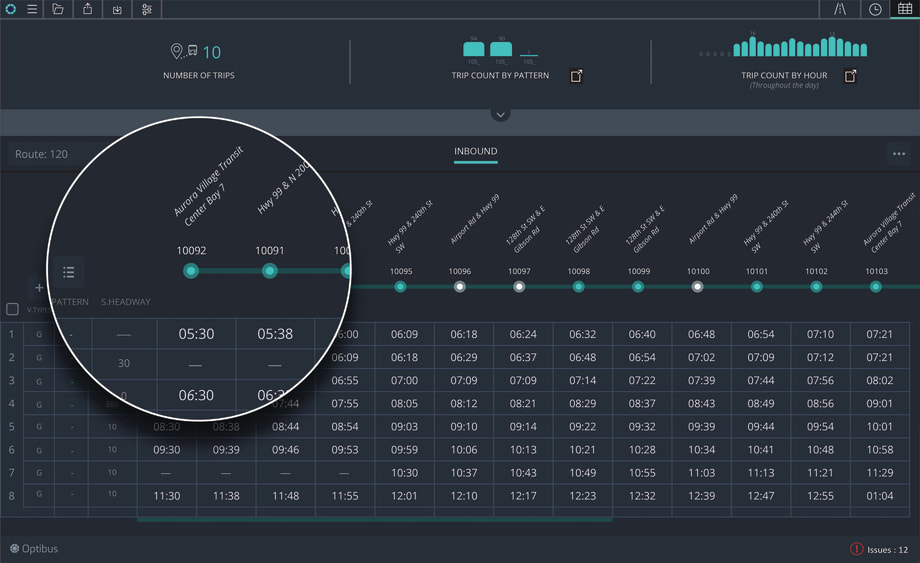
Planning for shuttle services can definitely benefit from the evolution of planning
for mass transit.
Optibus
5 min to read
Planning for shuttle services can definitely benefit from the evolution of planning
for mass transit.
Optibus
While some shuttle operations are run using spreadsheets or pen and paper, shuttle operators can take advantage of the emergence of next-generation planning and scheduling platforms for fixed-route operations.
Good shifts and rosters can improve driver retention, cost reduction, and passenger service. Operations need to be efficient and effective, as well as supported by the right technology.
The following are seven things shuttle operators need to know in order to use these innovative platforms to benefit shuttle operations:
1. Scheduling shuttle services is a lot like scheduling fixed-route services
Just like public transit operators, shuttle operators need to plan a route using a timetable (or headways), determine the fleet size and type, and assign vehicles to trips and drivers. Just as fixed-route operations harness technology to improve operations, shuttle operators can do the same, leading to improved on-time performance and rider experience.
Modern end-to-end planning and scheduling platforms can assist in every step of the process, from planning to timetables to vehicle and crew scheduling to rostering, with a user-friendly interface that is easy to learn, showing the planner/scheduler all relevant business metrics at each stage of the process.
2. The more vehicles you have, the greater the need for technology
When should you move from manual or spreadsheet-based scheduling to advanced technology? Don’t worry, there’s a magic number: 30 vehicles. That’s the tipping point where you’d be better off using technology, since the more vehicles you have, the more complex the scheduling will be and the less likely you are to reach optimal results with manual efforts.
Using a next-generation planning and scheduling platform will significantly reduce the amount of time it takes to create different scenarios and choose the best one. With potential savings of 5% to 15%, this isn’t a theoretical process — it has a real impact on the bottom line.
3. Artificial intelligence can help you comply with SLAs for shuttle service
All shuttle service contracts have a service level agreement (SLA) associated with them. Complying with SLAs is important, to avoid penalties and ensure future contract renewals.
Good schedules help operators comply with SLAs and understand the costs associated with improving their on-time performance metrics.
Using artificial intelligence, modern planning and scheduling systems can predict the likelihood that each trip will be on time. Once a threshold is set for on-time performance, the platform makes automatic scheduling suggestions to improve on-time performance while keeping costs low.
4. Up-to-date technology makes route planning simpler
Imagine that planning routes for shuttle services were as simple as planning a road trip with the assistance of visual tools and up-to-date maps. Now imagine that the process of route creation, for tenders, seasonal changes, and more, could be integrated with timetables. There you have it; that’s exactly what next-generation scheduling and planning systems do.
Next-generation platforms support simple visual route creation and quick timetable creation. Routes and timetables are then validated, to make sure they adhere to the rules and preferences in the system, and the data is transferred into the scheduling module.
High-quality route-planning software is visual, seamless, and precise, using maps, satellite images, street-level photos, and route data visualization, and it integrates with the timetable.
5. Efficient scheduling tools can help you submit the winning bid
Bidding for a tender requires coming up with many scenarios in a short period of time and picking the one that best suits your business goals. Often, tenders are the only way to win new business. Yet, inefficient scheduling tools can lead to bids that are too high or too low, posing a real risk of losing money.
Next-generation planning and scheduling platforms help you submit accurate and optimized bids in a fraction of the time. Different scenarios can be generated and evaluated in days instead of weeks, with behind-the-scenes algorithms helping planners determine price per revenue hour and profit margin, estimate the number of vehicles and the number of drivers required to operate the schedule, and project cost and revenue while complying with the different rules required.
6. Optimizing driver rosters saves money
Even when there isn’t much scheduling work, optimizing rosters is a golden opportunity to save costs.
“Low-quality rosters can lead either to an undersupply of drivers with a need to hire part-time drivers, or an oversupply of drivers with too much idle time, both implicating a loss of business,” a 2011 article on driver rostering in the journal Engineering Letters found. Those facts haven’t changed, but the methods of generating rosters have improved significantly in that time.
Drivers want better shifts and rosters (minimizing split shifts, enabling downtime, and more) and may be entitled to overtime. Such rules and preferences can be easily expressed by any scheduler (no programming required) in modern scheduling platforms, with resulting optimizations that reflect considerable savings as well as fully compliant schedules with no rule violations.
7. Better driver schedules can improve retention rates
Driver shortage is a major concern, and one way to improve retention is to improve driver work quality.
How do you do that? Next-generation planning and scheduling platforms create schedules that meet all the necessary rules and regulations, yet avoid unnecessary split shifts and other duties that make work difficult for drivers.
Schedulers and planners can easily set constraints related to day-off patterns, overtime, guaranteed work time, rest time between shifts, and more. In this way, you can comply with labor regulations, control costs, and retain drivers by providing them with better working conditions.
Taking the Leap
Planning for shuttle services can definitely benefit from the evolution of planning for mass transit. Utilizing the same advanced technological platforms as the backbone of operations can prove beneficial to shuttle operators of any size. Advanced planning and scheduling platforms offer a comprehensive work environment, which can take the scheduler from route planning to timetables to vehicle and crew scheduling, and all the way to rostering, offering a nimble, scalable operation that can easily be deployed at multiple sites or used to win new business through tenders.
Amos Haggiag is the co-founder and CEO of Optibus, which helps transit providers better run mass transportation through advanced artificial intelligence and optimization algorithms.
(This article originally appeared in the May 2019 issue of ShuttleOps)
Subscribe to Our Newsletter
More Technology

From Hardware to Digital Partner: Luminator Charts Its Next Chapter
CEO Magnus Friberg discusses Luminator’s shift toward becoming a digital partner, the growing importance of software and interoperability, and how AI can help agencies improve operations and passenger experience.
Read More →
Beyond the Checklist: A Structured Approach to Transit Maintenance
Reliability-Centered Maintenance helps transit agencies move beyond routine checklists to focus limited resources on the assets and failures that have the greatest impact on safety, reliability, and service.
Read More →
NJ TRANSIT Advances Bus Technology Upgrades Across Statewide Fleet
More than 1,500 buses now feature upgraded technology designed to improve arrival predictions and provide free Wi-Fi, with deployment expected to reach nearly 2,000 buses by the end of 2026.
Read More →

Building a Flexible Path to Transit Electrification
John Hroncich discusses BAE Systems’ modular and scalable approach, lessons learned from decades of real-world operations, and how agencies can identify electrification strategies that fit their fleets.
Read More →
Biz Briefs: Alstom Lands Canadian Contract, LYT to Supply California TSP, and More
In METRO's latest installment, we take a look at recent news from Complete Coach Works, Beep, FlixBus, and more partnerships making headlines across the transportation sector.
Read More →
Sponsored•September 8, 2026
From Legacy Silos to Conversational Intelligence
What if transit leaders could ask any operational question and get a trusted answer in seconds? Conversational AI is transforming how agencies use their data.
Read More →
USDOT Announces Rail Vehicle Replacement Grants, Chattanooga AV Shuttle Funding
More than $191 million in federal funding will help three transit agencies replace aging rail vehicles and support a new autonomous shuttle service in Chattanooga.
Read More →
Bus Tech Talk: Keeping Transit Technicians Ahead of the Technology Curve
LA Metro’s Obed Mejia discusses technician training, evolving maintenance technology, fleet replacement, and strategies for getting the most out of today’s transit fleets.
Read More →
Biz Briefs: RIPTA Unveils New Frontrunners, Clevland RTA Adds New Siemens, and More
In METRO's latest installment, we take a look at recent news from Siemens, Prevost, Dodge, and more partnerships making headlines across the transportation sector.
Read More →
Why Simulating Pedestrian Movement Has Become Essential for Modern Rail Stations
Pedestrian microsimulation is helping rail planners identify bottlenecks, test station designs, and prepare complex transit hubs for growing passenger volumes.
Read More →