



Consultant Q&A: AECOM's Diane Cowin on Planning, Innovation, and the Future of Transit
As Transit Market Leader for the Americas, she brings deep expertise in federal funding strategy, ESG-focused development, and equity-centered leadership.

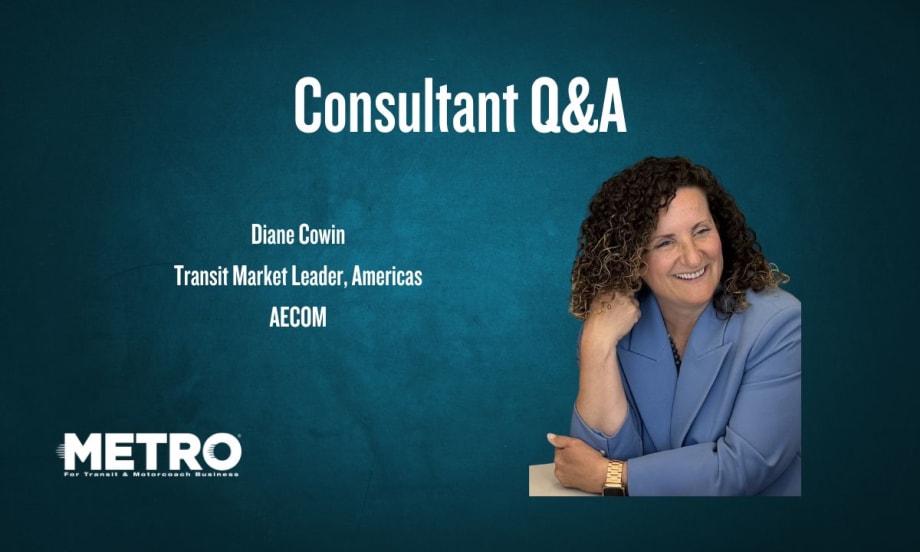
Diane Cowin is committed to advancing sustainable, resilient transportation and energy solutions across the Americas.
Photo: AECOM
- Diane Cowin serves as the Transit Market Leader for the Americas at AECOM.
- She specializes in strategies related to federal funding and ESG-focused development.
- Her leadership emphasizes equity-centered approaches in planning and innovation.
*Summarized by AI
Diane Cowin is AECOM's Transit Market Leader for the Americas. With deep expertise in federal transit funding, regulatory strategy, and ESG-driven market development, she is a trusted advisor to public- and private-sector clients.
Cowin brings a proven track record in profit-and-loss leadership, operational excellence, and equity-centered succession planning. In addition to her executive roles, she is an inclusive and creative board director with experience across nonprofit and corporate boards. She is committed to advancing sustainable, resilient transportation and energy solutions across the Americas.
METRO spoke with Cowin about the challenges transit projects face during the planning phase, as well as efficiency, accessibility, and other aspects of project execution.
Transit Project Hurdles and Execution
What are the biggest challenges you face during the planning phase of a transit project?
I started my transit career as a planner, so I don’t see challenges as much as the project's possibilities and potential at the initiation phase. Complex infrastructure planning is a dynamic and nuanced balance of securing an appropriately positioned champion, maintaining public and stakeholder interest and confidence, and defining the project that better serves the community it serves within a budget and schedule that leverages funding and financing from public and private sources.
Due to supply chain complexities, lengthy approvals, mid-design scope changes, increased demand for talent, and other macro- and microeconomic realities, transit project capital costs have risen significantly. This has resulted in a rise in cost-saving innovations, a focus on sustained support through continuous communication, complex compromise and informed consent, and a strategic approach to phasing and/or the project's financial stack.
What innovative design or engineering solutions have you implemented to enhance transit efficiency?
Increasing capital costs and competition for funding and financing drive innovation to deliver efficiencies across all phases of a project or program, including increased design automation with AI and the concept of design-to-cost.
During transit project development, AECOM focuses on cost-driven approaches, such as ‘design to cost,’ which drive prudent decision-making and scope management. This approach can also establish ‘minimal viable products’ to meet the budget and provide much-needed transit services in a phased approach. Computational design with AI for repeatable elements, such as bridges, saves design time and supports efficient decision-making while learning and improving with each new task.
These cost and funding constraints are also driving innovative, alternative approaches to improve capacity in existing infrastructure operations by reducing headways through advanced digital technology for train signaling systems.
How do you ensure that transit projects are designed with equity and accessibility in mind?
Early on, a significant shift in my career came about after I had worked on my first light rail (LRT) project for DART (Dallas Area Rapid Transit). I saw how the opportunities for community building and access to new jobs, healthcare, and affordable homes could redefine people’s lives.
However, to deliver a truly equitable and accessible service, a focused intention is required during every phase of a project. Providing meaningful opportunities for representation early and often during project definition and design is an essential first step; however, developing key performance indicators with the communities and representative groups holds agencies and project teams accountable.
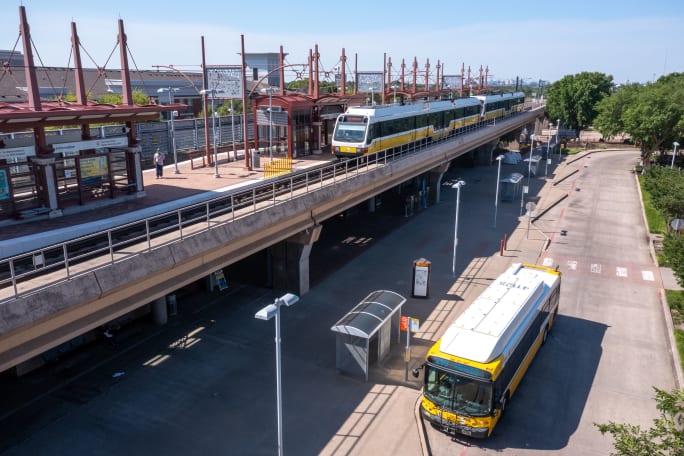
To deliver a truly equitable and accessible service, a focused intention is required during every phase of a project, Cowin says.
Photo: DART
The Future of Public Transportation
What does the future of public transit look like in 10 to 20 years?
The transit industry is primed to evolve in the next 10 to 20 years. I see the continued emergence of AI and automation in project development, improving operations, and customer service. Further development and enhancement of technology for customer information systems, ticketing, and payment systems will likely enhance passenger experience and confidence.
The energy transition and renewables will continue to advance, with innovations in everything from energy storage and management solutions to new renewable profiles for transit rolling stock and vehicles.
Vehicle technologies are evolving rapidly through automation, AI, and energy systems, which will allow customers greater flexibility but also challenge the transit industry to remain flexible and adaptable to take advantage of the rapidly changing landscape.
Quick Answers
Diane Cowin serves as the Transit Market Leader for the Americas at AECOM, where she focuses on aspects like federal funding strategy, ESG-focused development, and equity-centered leadership.
*Summarized by AI
More Management

METRO Opens Submissions for 2026 Motorcoach Awards
Nominations are now being accepted for METRO Magazine’s Operator of the Year and Innovative Operator of the Year awards.
Read More →
New York MTA Advances Final Contract for Second Avenue Subway Expansion
Contract Four is the largest in the Second Avenue Subway Phase 2 project and includes construction of station infrastructure, tracks, and signals for the subway expansion, MTA officials said. Work on Contract Four will begin in 2027.
Read More →
Transit Agencies Highlight Safety Gains at National Summit
Leaders from 15 major transit systems shared crime-reduction results and safety initiatives while discussing the role of continued federal support.
Read More →

NITA Names New Leadership, Expands Reduced-Fare Program at First Board Meeting
The new regional transit authority appointed its first board chair and interim executive director while extending reduced fares across CTA, Metra, and Pace for eligible riders.
Read More →
Beyond the Checklist: A Structured Approach to Transit Maintenance
Reliability-Centered Maintenance helps transit agencies move beyond routine checklists to focus limited resources on the assets and failures that have the greatest impact on safety, reliability, and service.
Read More →
APTA 2026 Nominating Committee Selects Leadership Slate, Names Chair and Vice Chair Nominees
Leadership changes will help shape the association’s priorities and its representation of the transportation industry during the 2026–2027 term.
Read More →
DART Launches Major Security, Fare Enforcement Initiative
The 90-day demonstration will deploy coordinated security teams at five light rail stations while testing controlled access and gathering data to guide future investments.
Read More →
Advancing Fare Collection Through Technology and Innovation
Learn about delivering 1300 gates at 91 stations while managing fare evasion. Explore the large scale deployment, solution customization and real-world results that affect the region. Prepare for deployment in your region now.
Read More →
Game Day in Motion: Moving Millions During the 2026 World Cup
Between packed transit stations and team motorcoaches, see how agencies and operators across North America tackled the transportation demands of the 2026 FIFA World Cup.
Read More →
Surface Transportation Extension Averts Shutdown, Leaves Transit Funding Gap
The stopgap keeps federal transportation programs moving, but missing advance funding could complicate the transit and rail projects agencies are planning next.
Read More →