



RELATED: Austin makes real-time transportation data available
Digital Signage Advances Help Deliver Info to Riders in Real Time
Improvements on tap include readability, customization, and solar-powered products, while passenger information display options range from service arrival times and weather updates to surveillance footage.
by Nancy Kirk, Assistant Editor
February 28, 2017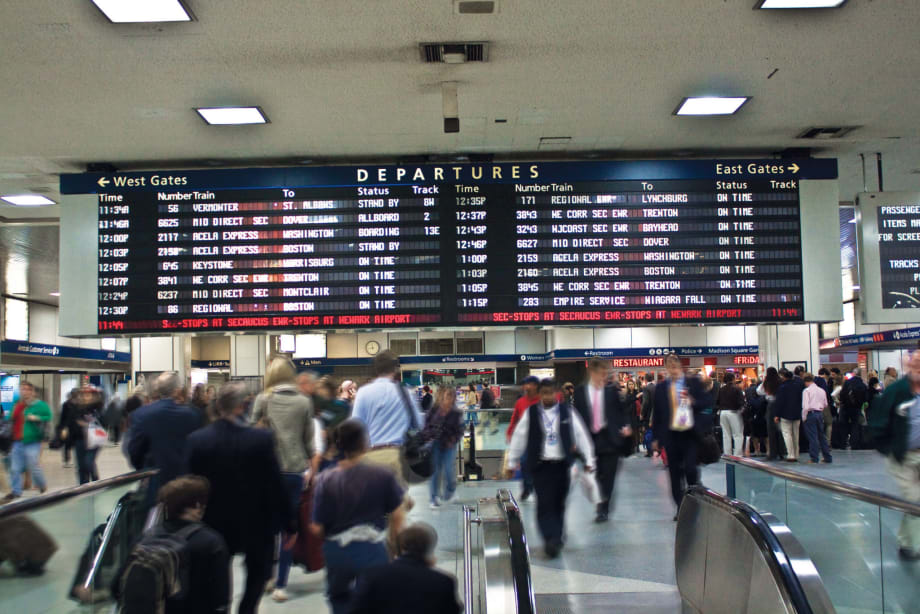
Via Amtrak
Penn Station’s iconic departure board was replaced by 40 LCD displays dispersed throughout the station.
6 min to read
Via Amtrak
Penn Station’s iconic departure board was replaced by 40 LCD displays dispersed throughout the station.
The comforting click-clack of New York’s Penn Station’s electromechanical passenger information board is no more, as nostalgia will consume those customers surprised to see modernized, digital signage in its antique predecessor’s place.
Amtrak removed the iconic passenger information board on Jan. 23, 2016 as part of a project to install 40 new LCD screens throughout the station, the two largest of which will update passengers at either end of the waiting room in hopes of minimizing foot traffic congestion. The LCD signage embraced by Penn Station is accompanied by synchronized audio and visual messaging for enhanced assistance. The boards will, not surprisingly, communicate train status and boarding information, but they will also be able to broadcast a myriad of customized messages, such as emergency alerts and weather forecasts.
But Amtrak is not alone in its journey to bolster customer information, as stations, bus shelters, and transit vehicles swap static signs for updated digital signage that is becoming the new norm in public transportation.
Real-Time Data
More and more cities are adopting initiatives to become “smart,” and public transportation will play an integral role in this plan. As LCD and LED technology advances and becomes more prevalent in public transportation settings, the appeal for riders to use public transit increases, according to Dale Storhaug Mass Transit Market Manager for Daktronics, a U.S.-based digital display manufacturer.
“The advanced technology is focused on making improvements to the delivery of real-time information,” Storhaug says. “These improvements in digital signage are more attractive and informative, which elevates riders’ satisfaction, and ultimately results in the continuation of increased ridership, reducing congestion on the roadways.”
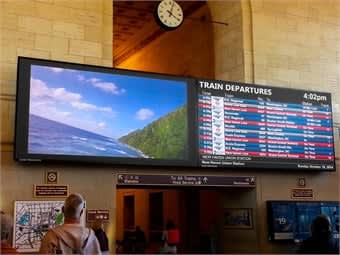
An LCD sign by Daktronics displays departure information alongside desirable imagery at New Haven, Conn.’s Union Station.
With full-color options, these signs are able to increase readability as well signify and match certain transit routes or lines. Many transit agencies utilize both LCD and LED signs, but the main thrust in the digital signage industry seems to lie in the advancement of LCD capabilities. When considering the different technologies, Storhaug stresses the importance of research.
“The advancement of LCD technology has been improving, and it seems to have gained more acceptance in the market,” Storhaug says. “There are pros and cons to both LCD and LED technologies. In terms of life expectancy, performance, and robustness, the strength is in LED, but if an agency prefers high-definition images, LCD meets that market expectation.”
With LCD signage, display options are endlessly diverse. Transit organizations can utilize their colorful, quality aesthetics to communicate arrival and departure times, as well as display emergency alerts, weather forecasts, and even provide in-transit entertainment (like Wi-Fi or TV shows). Additionally, advertisements can reduce the cost for agencies reluctant to invest in pricier technology, notes Luminator Technology Group’s VP, Sales and Marketing, Dan Kelleher.
“Advertising provides an opportunity for agencies to get some revenue back on LCD screens,” Kelleher says. “Some of our clients are using Return of Investment models where they see a four- to five-year payback.”
Costs can also be reduced when considering that changes of information are easily applied with digital signage. Where adjustments in print can be cumbersome and time consuming for the agencies (and confusing for riders), operators are able to immediately fix invalid or outdated screens, for both LCD and LED.
“With these screens, you can wirelessly update the information, so if there is an error or you need to put out an immediate alert, you have that instant ability,” Kelleher says.
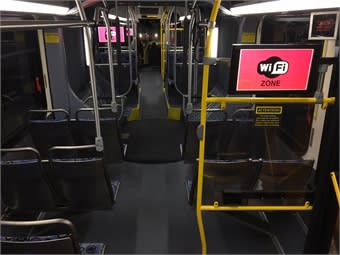
Luminator offers on-board LCD signage, which can display departure information, weather forecasts, advertisements, and more.
Enhanced Safety
But transforming unengaging and colorless signs into interactive, real-time reports will surpass the main purpose of convenience: New methods of LCD signage may also increase safety, says Kelleher. The screens can display video surveillance footage on buses so passengers can see themselves in real time. Luminator is currently deploying a mounted, on-board camera system for San Antonio’s VIA Metropolitan Transit.
“It’s definitely a crime deterrent. We have clients who’ve indicated that since they’ve piloted programs using our LCD screen showing camera images of passengers on board, they’ve seen a drop in the number of assaults on vehicles,” Kelleher says.
That’s in addition to other safety features, such as setting reminders for riders to stand behind designated lines, hold the rail, and watch their belongings. Rear-view cameras can also be mounted standalone on to the back of the vehicle or incorporated into a rear sign, so the rearview video stream can be displayed on the Multi-system Controller Unit’s (MCU) screen by the driver. The MCU eliminates the need for an additional display device saving cost and installation space.
“The Rear View Camera is a good safety option for our customers with a very low price. We introduced this product less than year ago and we already have orders for 500 of these systems,” Kelleher says.
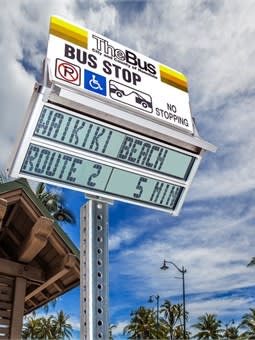
Waysine specializes in solar-powered digital signs that are low cost and easy to install on any perforated pole.
Solar-Powered Options
While digital signs have primarily been implemented indoors, the past couple of years have proven promising for the possibility of outdoor digital signage technology, according to CHK America’s CEO Rick Wood.
“It’s becoming possible to deploy digital signage outside because of screen technology and solar power, and public transportation is probably the biggest beneficiary that we see,” Wood says. “Because transportation involves effectively communicating complex and up-to-date service information, places like rail platforms and bus stops will really benefit from the outdoor usage of this product.”
It will be “liberating,” Wood says, because bus riders will be able to know the exact status of their bus: whether it will be on time, or if it is delayed for 20 minutes. “They will be able to go to the coffee shop around the corner, or make a phone call to say they’ll be late for dinner.”
This statement is further supported by Waysine, a start-up digital signage company with the primary focus of easy-installation, solar-powered, unibody signs for outdoor usage.
“The perceived wait time at bus stops and shelters is much lower than when riders are stuck wondering their arrival times,” says Waysine’s Business Development Manager AJ Harper. “We’ve significantly reduced, and want to continue to reduce, the cost of these solar-powered signs and their maintenance so the industry can increase their availability. We receive feedback from transit managers who tell us riders tend to have fewer complaints, which also makes the job satisfaction for drivers higher.”
Because of this, there are obvious benefits for both parties involved. “This whole thing is about benefitting the riders, but it has a positive impact on the agency too, because they have an increased ridership and happier customers,” says Wood.
Proper electrical infrastructure has been the main issue in the past for outdoor signage, but solar power and battery options are now able to compensate for areas that lack outlets or electricity.
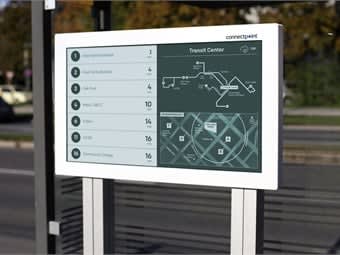
Solar power is increasing the possibility of outdoor digital signage, and companies like CHK America are working to implement interactive technology at bus stops and shelters.
Recently, CHK added another solar-powered product to its ConnectPoint digital product line called The SmartStop. This solar-powered totem combines an interactive tablet, like an iPad, with CHK’s Digital Bus Stop, which utilizes low-power E-Ink signage similar to that of a Kindle screen. It provides departure times and alerts as well as the ability to interact with the tablet regarding any query a customer might have, including trip planning. This new technology debuts March 2017 at the Valley Transportation Authority in Silicon Valley, Calif. CHK’s solar-powered Digital Bus Stops and stand-alone Interactive Kiosks are already deployed in Pittsburgh, Dallas, Las Vegas, and San Antonio, with several other agencies scheduled for deployment this summer.
“Being able to deliver real-time information to digital signage that does not require electricity is very powerful and there are stats that suggest people would be more inclined to use public transit if real time information was presented to them at the stop,” Wood says. “The usage figures for our products are off the charts. They’re very popular. We’re very excited.”
Subscribe to Our Newsletter
More Management

METRO Opens Submissions for 2026 Motorcoach Awards
Nominations are now being accepted for METRO Magazine’s Operator of the Year and Innovative Operator of the Year awards.
Read More →
New York MTA Advances Final Contract for Second Avenue Subway Expansion
Contract Four is the largest in the Second Avenue Subway Phase 2 project and includes construction of station infrastructure, tracks, and signals for the subway expansion, MTA officials said. Work on Contract Four will begin in 2027.
Read More →
Transit Agencies Highlight Safety Gains at National Summit
Leaders from 15 major transit systems shared crime-reduction results and safety initiatives while discussing the role of continued federal support.
Read More →

NITA Names New Leadership, Expands Reduced-Fare Program at First Board Meeting
The new regional transit authority appointed its first board chair and interim executive director while extending reduced fares across CTA, Metra, and Pace for eligible riders.
Read More →
Beyond the Checklist: A Structured Approach to Transit Maintenance
Reliability-Centered Maintenance helps transit agencies move beyond routine checklists to focus limited resources on the assets and failures that have the greatest impact on safety, reliability, and service.
Read More →
APTA 2026 Nominating Committee Selects Leadership Slate, Names Chair and Vice Chair Nominees
Leadership changes will help shape the association’s priorities and its representation of the transportation industry during the 2026–2027 term.
Read More →
DART Launches Major Security, Fare Enforcement Initiative
The 90-day demonstration will deploy coordinated security teams at five light rail stations while testing controlled access and gathering data to guide future investments.
Read More →
Sponsored•September 9, 2026
Advancing Fare Collection Through Technology and Innovation
Learn about delivering 1300 gates at 91 stations while managing fare evasion. Explore the large scale deployment, solution customization and real-world results that affect the region. Prepare for deployment in your region now.
Read More →
Game Day in Motion: Moving Millions During the 2026 World Cup
Between packed transit stations and team motorcoaches, see how agencies and operators across North America tackled the transportation demands of the 2026 FIFA World Cup.
Read More →
Surface Transportation Extension Averts Shutdown, Leaves Transit Funding Gap
The stopgap keeps federal transportation programs moving, but missing advance funding could complicate the transit and rail projects agencies are planning next.
Read More →