



Going Green in Rail Transport: Maximizing Rail Systems’ Electrical Energy Recovery
Using regenerative braking for rail vehicles can help transit agencies return energy to the system and save money. LTK's TrainOps software helps transit agencies determine how to implement these systems.
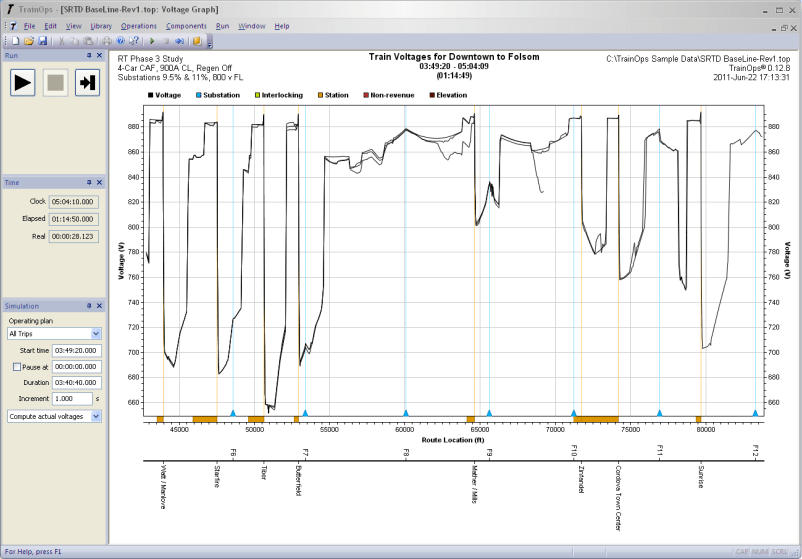
TrainOps overlay of multiple trains’ voltage experience along a rail line, allowing fast identification of system locations in need of traction powerreinforcement.
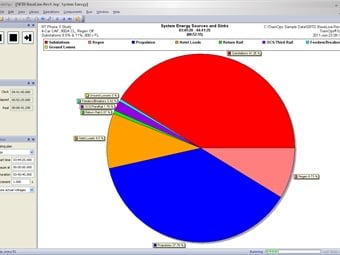
TrainOps’ computation of energy supply and consumption by category is updated dynamically during simulation. The dark red shows energy supplied by the utility and the light red shows energy productively recovered through regenerative braking.
Many of us are familiar with hybrid and all-electric automobiles that return electrical energy to their batteries when braking. But what about rail vehicles? Rail vehicle regenerative braking — returning electrical energy to the rail power distribution system or even back to the supplying utility — offers tremendous opportunities for electrified rail networks to “go green.”
How can system and vehicle characteristics be optimized to maximize the electrical energy being returned to the system through braking? Unlike the closed systems in an automobile, maximizing the environmental benefits of rail networks with regenerative braking requires careful analysis of equipment settings (both on the vehicles and on the wayside electrical equipment), driver behavior, and operating schedules. LTK Engineering Services’ TrainOps rail system simulation software allows rail systems to “tune” their regenerative braking to maximize environmental benefit. By making a rail system more receptive to regenerated energy, operators can lower utility costs, reduce emissions from the supplying utility, and operate their rail vehicles more efficiently.
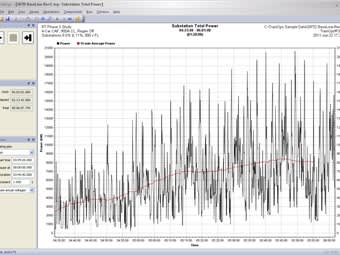
TrainOps dynamic (while the simulation runs) display of system-wide power demand (black) with 15-minute running average power demand for utility tariff computations (red).
What about a mix of regenerative braking-equipped and non-equipped trains? Rail systems often debate whether to concentrate all of their regenerative braking-equipped vehicles on one line or to distribute the equipped and non-equipped trains throughout their network. The TrainOps software can quickly compare these two scenarios virtually, identifying which one saves the most. The software's sophisticated algorithms support the optimization process to reduce the carbon footprint of electrified rail networks and optimize their energy saving and energy recovery characteristics.
Rail system electrical engineers know that by increasing the maximum system voltage, they can improve the receptivity of the system to accept regenerated energy. But decisions like this are never easy and require a complex trade-off analysis. In this case, higher voltages on the system may put some electrical components at risk of a reduced life. TrainOps can be used to determine the network energy savings from using higher voltage; the value of this energy savings can then be traded off with the cost of upgrading those electrical components to handle higher design voltages.
Rail systems’ electrical tariffs typically include both consumption and peak demand components. As the utilities’ cost of peak generation capacity increases, the tariffs increasingly weight peak demand in the overall electric bills paid by transit and rail networks. Maximizing regenerative braking offers the opportunity to “shave the peak” so that savings from reduced peak demand can be much greater than reduced consumption. Some utilities measure the peaks at individual supply points while others use the concept of “coincident demand,” looking at all of the rail network’s supply points at the same time.
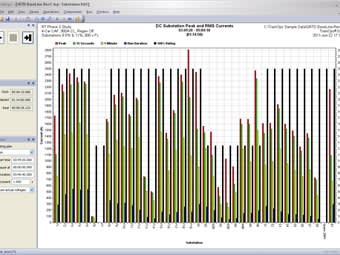
Peak and RMS currents shown for each substation in the system, along with 100% nameplate ratings, allow visual confirmation that all substations are properly sized for a new or reconfigured network.
Even where regenerative braking is used, rail networks may be overtaxing their traction power systems. Unique in the industry, TrainOps also has the ability to trade-off quality of service to rail passengers with controlling demands on the traction power system. For example, a large heavy rail system in the U.S. recently wanted to understand the reduced traction power system stress achieved by imposing downtown speed limits and/or throttle limits for its operators. “We were able to show the benefits in terms of reduced traction power system stress and the fact that travel times for the public would be minimally effected,” explained LTK’s VP for rail operations planning and simulation Bill Lipfert. “More importantly, TrainOps was able to quickly demonstrate the synergistic benefit of both the speed cap and throttle limit instead of invoking one or the other,” he explained. This temporary operating condition will be nearly imperceptible to the system’s passengers while State of Good Repair backlogs are addressed.
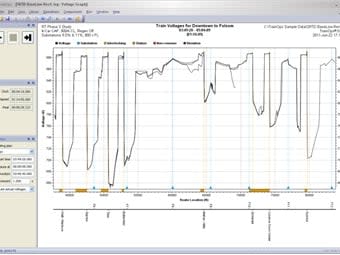
TrainOps overlay of multiple trains’ voltage experience along a rail line, allowing fast identification of system locations in need of traction powerreinforcement.
TrainOps was specifically developed to enable comprehensive modeling and studies of AC and DC-electrified railroad and transit train operation, as well as operations of fossil fuel-powered trains. The program provides user-friendly inputs (including the ability to “cut and paste” from spreadsheets and other external data sources) for all relevant system and rolling characteristics. These include route alignment data such as track gradients, horizontal alignment and speed restrictions (which can differ by train class) and passenger station locations.
TrainOps also has extensive vehicle libraries with attributes such as weight, dimensions, propulsion system characteristics, and braking system parameters. As an optional overlay, users can include system train control data, including wayside signaling, cab signaling and positive train control inputs, where applicable, with user-friendly “point and click” signal control line data entry. As an additional optional overlay, the electrical power supply system data can be included, comprising traction power supply substations and tie stations (circuit breaker houses) as well as the rail system’s electrical distribution network, such as overhead catenary, trolley wire system, or third rail system, and substation feeder cables. Finally, the software includes flexible input of operations data — either in the form of headway-based input or train schedules — including train make-up, train manipulations at terminals/yards, operating plan inputs, passenger station stopping pattern, train loadings, and station dwell times.
Natalie E. Cornell is Director, Business Development for LTK Engineering Services (www.ltk.com).
More Rail

New York MTA Advances Final Contract for Second Avenue Subway Expansion
Contract Four is the largest in the Second Avenue Subway Phase 2 project and includes construction of station infrastructure, tracks, and signals for the subway expansion, MTA officials said. Work on Contract Four will begin in 2027.
Read More →
San Diego MTS Breaks Monthly Trolley Ridership Record
Agency officials said July’s ridership indicates MTS’s continued recovery from the pandemic.
Read More →
Report Examines NJ TRANSIT Reliability, Funding Challenges
The Garden State Initiative analysis examines the roles of Amtrak infrastructure, fleet management, and agency operations while recommending a more performance-based approach to improving reliability.
Read More →
Stadler, CapMetro Sign Long-Term Rail Fleet Support Agreement
Beginning in 2027, Stadler will provide on-site technical expertise, spare parts support, training, and obsolescence management to help extend the reliability and longevity of CapMetro’s GTW fleet.
Read More →
Biz Briefs: Alstom Lands Canadian Contract, LYT to Supply California TSP, and More
In METRO's latest installment, we take a look at recent news from Complete Coach Works, Beep, FlixBus, and more partnerships making headlines across the transportation sector.
Read More →
CATS Gold Line Marks 5 Years of Service, 2.8M Passenger Trips
With a six-mile expansion planned, the Charlotte streetcar is positioned to connect more neighborhoods and major transit hubs across the region.
Read More →
Why Simulating Pedestrian Movement Has Become Essential for Modern Rail Stations
Pedestrian microsimulation is helping rail planners identify bottlenecks, test station designs, and prepare complex transit hubs for growing passenger volumes.
Read More →
Amtrak Begins Major Construction at New York’s Sunnyside Yard
The new maintenance facility will support Amtrak’s Airo trainsets while improving maintenance efficiency and turnaround times in New York.
Read More →
Chicago Leaders Unveil Plans for O’Hare Airport Express Train
The privately developed project would offer a 15-minute trip between downtown and O’Hare’s Terminal 2, with trains operating every 15 minutes on a dedicated track. The service would use battery-electric trains and three existing freight rail rights-of-way.
Read More →
OCTA Maps Out 30-Year Strategy to Protect Coastal Rail Corridor
The draft feasibility report identifies strategies to protect the coastal rail line for decades as the agency continues near-term stabilization and sand placement efforts.
Read More →