



Innovative Operator Profile: Employing Technology for Efficient Motorcoach Maintenance
America Charters LTD (ACL) originally began as a bus transportation service for textile employees and citizens of Gaston County, N.C. In 1977, when the city took over the services, ACL became strictly a charter bus company.

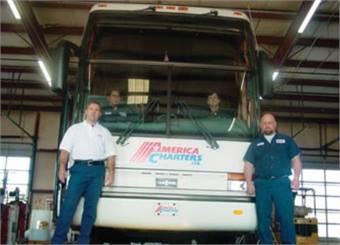
America Charters LTD (ACL) originally began as a bus transportation service for textile employees and citizens of Gaston County, N.C. In 1977, when the city took over the services, ACL became strictly a charter bus company.
Despite being purchased by Coach USA in 1997, ACL, which now operates as a subsidiary of Coach America, has remained a family-oriented business thanks to Billy Ray Rhyne, grandson of its original founder, still serving as president of the operation.
“We have been able to maintain the same family-style ‘look and feel’ that originally existed from the inception of the business,” says Doug Woodie, maintenance director. “As a result, a majority of people in the office have been here for what feels like forever.”
For his part, Woodie has been with ACL off and on for nearly 20 years. He says that maintaining this family atmosphere, along with small perks such as flexible scheduling, makes it a pleasurable place to work. Woodie also believes it is the primary reason that ACL has created a top-notch maintenance program, with some of their vehicles continuously running since 1994.
“The bus business is a disease. It gets in your blood, and for some of us that’s all we know,” he says. “We have been lucky to end up with these guys that really dig the bus. A majority of our mechanic staff has now been together for more than a decade.”
One new addition that is helping ACL increase its maintenance efficiency is the FleetAnywhere software program provided by Coach America, which helps with record keeping and cost analysis, making everything transparent from top to bottom. Each individual affiliated company has the capability to view and analyze each others’ records, inventories, costs and more.
“The ability to determine the operating cost of each individual piece of equipment is paramount. This program makes that determination obvious,” says Woodie. “It really does more than we will ever use it for. Compared to our antiquated pen and paper system, it’s the cat’s meow.”
Woodie adds that the program has been especially helpful in tracking the service records of vehicles, giving the garage the ability to see if any problems they are experiencing are persistent enough to warrant a closer look.
Recent changes in the garage include new mandates to shut down to reduce unnecessary idling and a reduced top speed of 65 mph for all coaches. The latter added time to many of ACL’s trips and posed a learning curve for the entire operation that Woodie says is now firmly under control.
To keep its maintenance department sharp, ACL provides its staff with all the tools and training available to perform their individual tasks in as safe and efficient a manner as possible. To do this, the operation sends staff members to take part in many of its vehicle supplier’s (ABC Companies) in-house training classes. Now that ACL has a larger corporate backing, it is also able to request that some suppliers send their staff out to its headquarters in Charlotte to hold classes, adds Woodie, who also credits his staff’s desire to learn about cutting-edge technologies as bus manufacturers continue to add them to their motorcoaches.
“We are very fortunate that these guys are hungry to do this stuff, they want to learn, and are, therefore, very interested all the time,” he says. “Especially since the manufacturers are always adding new and innovative features to their coaches. Their attitudes are really a plus for us.”
MOTORCOACHES: 65
FLEET MIX: Van Hool T800s, T900s, T2145s and C2045s
EMPLOYEES: 36
DRIVERS: 138
SERVICE AREA: U.S. and Canada
SERVICES OFFERED: charter, tour, athletic and corporate commuter
YEAR STARTED: 1937
AVERAGE ANNUAL MILEAGE: 2.6 million
PRESIDENT: Billy Ray Rhyne
More Management

LIT Marks 10-Year Milestone at Annual Summit
Hosted by the COTA from September 10 to 13, the Summit carried the theme “Celebrating 10 Years of Excellence, Leadership, and Impact,” with every part of the program honoring the people, agencies, and partners who built LIT over its first decade.
Read More →
People Movement: Dan Dipert Coaches Adds Third-Generation Leader, Keolis Names New Valley Metro VP/GM, and More
In this edition, we also cover recent appointments and announcements at the Wabtec, SilverRide, HNTB, and more, showcasing the individuals helping to shape the future of transportation.
Read More →
METRO Opens Submissions for 2026 Motorcoach Awards
Nominations are now being accepted for METRO Magazine’s Operator of the Year and Innovative Operator of the Year awards.
Read More →

New York MTA Advances Final Contract for Second Avenue Subway Expansion
Contract Four is the largest in the Second Avenue Subway Phase 2 project and includes construction of station infrastructure, tracks, and signals for the subway expansion, MTA officials said. Work on Contract Four will begin in 2027.
Read More →
Transit Agencies Highlight Safety Gains at National Summit
Leaders from 15 major transit systems shared crime-reduction results and safety initiatives while discussing the role of continued federal support.
Read More →
NITA Names New Leadership, Expands Reduced-Fare Program at First Board Meeting
The new regional transit authority appointed its first board chair and interim executive director while extending reduced fares across CTA, Metra, and Pace for eligible riders.
Read More →
Beyond the Checklist: A Structured Approach to Transit Maintenance
Reliability-Centered Maintenance helps transit agencies move beyond routine checklists to focus limited resources on the assets and failures that have the greatest impact on safety, reliability, and service.
Read More →
APTA 2026 Nominating Committee Selects Leadership Slate, Names Chair and Vice Chair Nominees
Leadership changes will help shape the association’s priorities and its representation of the transportation industry during the 2026–2027 term.
Read More →
DART Launches Major Security, Fare Enforcement Initiative
The 90-day demonstration will deploy coordinated security teams at five light rail stations while testing controlled access and gathering data to guide future investments.
Read More →
Advancing Fare Collection Through Technology and Innovation
Learn about delivering 1300 gates at 91 stations while managing fare evasion. Explore the large scale deployment, solution customization and real-world results that affect the region. Prepare for deployment in your region now.
Read More →