



Innovative Operator Profile: Safety First, Passenger Comfort Foremost
To help modernize their fleet, cut down on maintenance costs and attract customers, Tai Pan Tours recently invested $5 million in 10 brand new Setra S417s

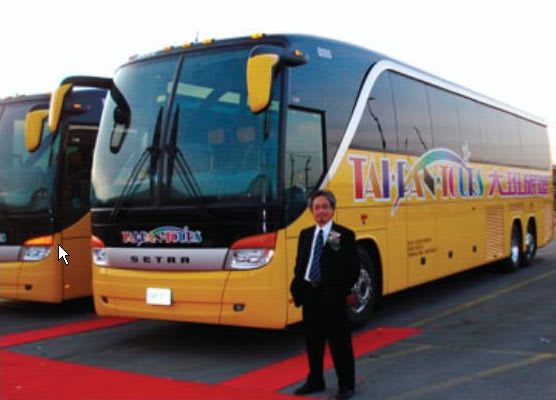
Danny W.L. Tang pictured in front of his Tai Pan Tours motorcoach.
Danny W.L. Tang pictured in front of his Tai Pan Tours motorcoach.
To help modernize their fleet, cut down on maintenance costs and attract customers, Tai Pan Tours recently invested $5 million in 10 brand new Setra S417s. The company hopes the new additions will help their aspirations of “the art of living, respecting the uniqueness of people and places, and the appreciation of life.”
“The European brand has a big appeal to a majority of our customer base,” says Danny W.L. Tang, vice president, finance and operations. “It was definitely the right time to move to more innovative coaches.”
Tai Pan’s new Setras feature the Top Sky roof — a favorite among its customers — scenic view cameras, leather headrests and Nimbus seats with magazine nets. What Tai Pan really likes about its new coaches, however, are the reduced emissions, HVAC system and multiplex electrical system with self diagnostics, which help them extend maintenance intervals and show their commitment to being environmentally aware.
The operation uses its new Setras for its Casino Rama runs, which runs 50 routes 24/7, with pickup locations throughout the greater Toronto area. To help increase that arm of its already successful business, the operation recently ran a well received “Ride 5 Get 1 Free” campaign. Tang says that promotions such as these are important because of the area’s large Asian population, who have a culture of searching for value. Still, Tang adds that his operation’s client base is about 50/50, so that search for value is universal, especially during the current, difficult economic times.
Aside from its luxury coaches, Tai Pan also boasts a strong commitment to safety training and was recently awarded an Outstanding Achievement Certificate from the Transportation Health & Safety Association of Ontario for attaining a higher safety standard among other companies of its same kind over a three year period.
“Safety training is embedded into our whole philosophy, policies and procedures,” says Tang, who adds that there are still many obstacles that Tai Pan faces, including declining business during the cold Toronto winters.
“It’s not an easy business, it’s very tough, and the reason is because you don’t have a smooth demand throughout the whole year. So, you have to smooth out your capacity and take advantage of the busy months to help get you through the slower ones,” he says.
To help increase business during the cold months, Tai Pan is concentrating on ski trips and staying competitive with its pricing, while also opening its garage to service trucks and coaches from other local businesses.
But, the operations’ biggest challenge, Tang says, is retaining mechanics and drivers during these slower months and building a succession plan should these skilled laborers leave. To help remedy that issue, Tai Pan keeps all of its mechanics and drivers well trained, so that if somebody does leave, there is somebody fully capable available to step in.
“If one or two of your drivers or mechanics leave, it could really cause a lot of chaos,” he explains. “That’s why you develop training programs and a succession plan to fill those positions, because those people are so important. As long as you have fully staffed and certified personnel, you’ll always be fine.”
MOTORCOACHES: 49
FLEET MIX: Prevost and Setra
EMPLOYEES: 32
DRIVERS: 100 (80 full time, 20 part time)
SERVICE AREA: Ontario, Quebec, the Maritimes, and Northeastern & Southeastern U.S.
SERVICES OFFERED: charter, shuttle, tour, airport and local transfer
YEAR STARTED: 1998
AVERAGE ANNUAL MILEAGE: 4.5 million (estimate)
VICE PRESIDENT: Danny W.L. Tang
More Management

LIT Marks 10-Year Milestone at Annual Summit
Hosted by the COTA from September 10 to 13, the Summit carried the theme “Celebrating 10 Years of Excellence, Leadership, and Impact,” with every part of the program honoring the people, agencies, and partners who built LIT over its first decade.
Read More →
People Movement: Dan Dipert Coaches Adds Third-Generation Leader, Keolis Names New Valley Metro VP/GM, and More
In this edition, we also cover recent appointments and announcements at the Wabtec, SilverRide, HNTB, and more, showcasing the individuals helping to shape the future of transportation.
Read More →
METRO Opens Submissions for 2026 Motorcoach Awards
Nominations are now being accepted for METRO Magazine’s Operator of the Year and Innovative Operator of the Year awards.
Read More →

New York MTA Advances Final Contract for Second Avenue Subway Expansion
Contract Four is the largest in the Second Avenue Subway Phase 2 project and includes construction of station infrastructure, tracks, and signals for the subway expansion, MTA officials said. Work on Contract Four will begin in 2027.
Read More →
Transit Agencies Highlight Safety Gains at National Summit
Leaders from 15 major transit systems shared crime-reduction results and safety initiatives while discussing the role of continued federal support.
Read More →
NITA Names New Leadership, Expands Reduced-Fare Program at First Board Meeting
The new regional transit authority appointed its first board chair and interim executive director while extending reduced fares across CTA, Metra, and Pace for eligible riders.
Read More →
Beyond the Checklist: A Structured Approach to Transit Maintenance
Reliability-Centered Maintenance helps transit agencies move beyond routine checklists to focus limited resources on the assets and failures that have the greatest impact on safety, reliability, and service.
Read More →
APTA 2026 Nominating Committee Selects Leadership Slate, Names Chair and Vice Chair Nominees
Leadership changes will help shape the association’s priorities and its representation of the transportation industry during the 2026–2027 term.
Read More →
DART Launches Major Security, Fare Enforcement Initiative
The 90-day demonstration will deploy coordinated security teams at five light rail stations while testing controlled access and gathering data to guide future investments.
Read More →
Advancing Fare Collection Through Technology and Innovation
Learn about delivering 1300 gates at 91 stations while managing fare evasion. Explore the large scale deployment, solution customization and real-world results that affect the region. Prepare for deployment in your region now.
Read More →