



RELATED: Streetcar design, tech advances gives owners greater flexibility in alignments
Kansas City's Starter Streetcar Line is Sustainable, 'Smart' Endeavor
Since voters green-lit the project by approving its major funding source in 2012, some $1.7 billion in economic development has initiated around the 2.2-mile streetcar line.
by By Jennifer Schwaller and Christopher Kinzel
December 6, 2017
Photos: HDR
4 min to read
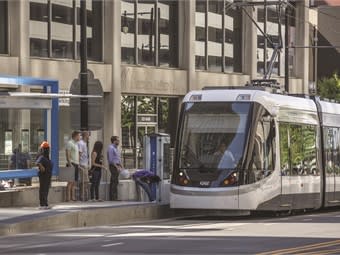
Photos: HDR
For any transit project to thrive, it must be sustainable for the long term. To be sustainable, it must be the right project.
That means the right mode of transit in the right location, implemented the right way. What makes each of these items right varies as widely as does the character of cities. In short, there is no one-size-fits-all approach to designing and building sustainable transit. Nevertheless, the broad strategies by which the right project is developed can be applied universally. Kansas City recently demonstrated some of these strategies with its successful starter streetcar line.
Kansas City’s recipe for the right project has been an initial smash success and has all the earmarks of a sustainable endeavor that will truly thrive. Since revenue service started in May 2016, more than half a million riders have boarded its accessible-for-all vehicles. On Aug. 5 alone, 13,080 riders used the streetcar during the monthly “First Friday” event in the renowned Crossroads Arts District.
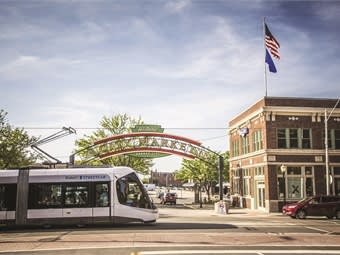
Since voters green-lit the project by approving its major funding source in 2012, some $1.7 billion in economic development has initiated around the 2.2-mile streetcar line, nearly a quarter of which has been publicly credited (at least in part) to this new transit amenity that now travels north and south through some of the busiest and oldest parts of the city.
Maximizing Sustainability
Kansas City’s codified commitment to sustainability is well documented. Among its adopted regulations are: a policy directing city departments to incorporate green solutions into projects and programs; an ordinance requiring building projects to achieve LEED Gold rating (at a minimum); requisite sustainability efforts for projects receiving financial support from the city; and a goal to reduce greenhouse gas emissions by 30% between 2000 and 2020.
Clearly, the city’s policies informed the design of Kansas City Streetcar. But beyond mere compliance, the city’s stance pushed the project to achieve more.
For example, one of its transportation-specific sustainability ordinances established a Bicycle and Pedestrian Advisory Committee charged with making recommendations to promote cycling and walking. This longstanding commitment to walkability and bike-ability is reflected in KC Streetcar’s design and integration with its urban surroundings: level boarding allows pedestrians and cyclists to easily board, and the streetcar’s alignment deliberately encourages walking and biking through downtown. The level-boarding and 100% low-floor vehicles also allow equal mobility for wheelchairs and strollers. A fully integrated source of transit, the streetcar offers connections to bike-share stations, regional bus routes and Amtrak.
‘Smart City’ Elements
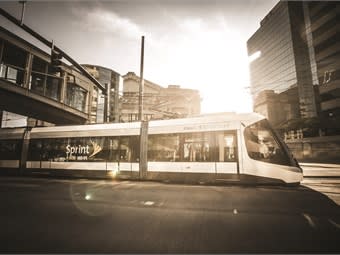
The city combined the streetcar project with elements of “smart city” implementation. These included energy-saving, pedestrian-detecting streetlights and intersections, and kiosks to keep passengers informed of the next vehicle’s location and ETA. Passengers also enjoy free Wi-Fi along the streetcar route thanks to the city’s partnership with Sprint. These additional amenities are designed to support the city’s focus on Main Street as a key corridor for sustainable economic development, and to foster a sense of community and identity.
Prior to, and during, construction, the city worked extremely diligently with utility providers to ensure no interference in either direction between utility access and streetcar operations. That element of the project’s long-term sustainability was taken another step when the city opted to replace century-old, underground water and sewer lines beneath the alignment.
Stakeholder Collaboration
Project development started in 2011 with an alternatives analysis for what was then a to-be-decided downtown corridor, premium-service transit project. The project’s public participation plan included among its outreach efforts many public meetings and a dedicated website. Social media and regular emails broadcast public updates as the project progressed. The project team published and distributed educational materials and invited public comment.
Stakeholders really were able to have a voice in the planning and design of the line. Each of the streetcar’s 16 stops was moved at least once during the planning and design phases in response to direct stakeholder feedback. A citizens’ committee oversaw the aesthetics of the stops themselves so that each one integrated into the urban fabric of each district. More broadly, a technical advisory committee of stakeholders gave crucial input on all aspects of design decisions, meeting weekly for more than a year.
The community determined its future in a very hands-on way. Feedback was received via electronic and hard-copy sources but the best and biggest source of feedback was face-to-face via public meetings. These were held from block to block in the area surrounding what would become the streetcar corridor. The project team held countless individual stakeholder meetings. More than anything, this direct engagement with community members shaped the project’s alignment, technology and aesthetics.
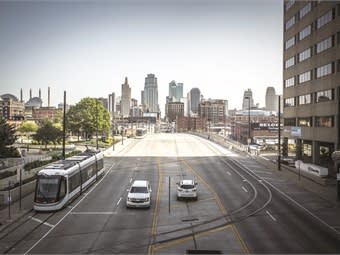
In early September, the Institute for Sustainable Infrastructure announced that the Kansas City Streetcar had achieved Envision Platinum verification, becoming the first transit project in the U.S. to earn this distinction -- and the first streetcar anywhere.
Through extensive collaboration, the city had laid the foundation for perhaps the most important aspect of sustainability. It had fostered enthusiasm and support for the successful 2012 referendum to create a Transportation Development District (TDD) surrounding the adopted alignment. Once passed, this tax vehicle made sustainable funding possible.
At that point, the path was cleared for final design and the city had taken the first, and biggest, step toward realizing this sustainable transit project. Its strong commitment to sustainability could then inform decisions going forward to ensure maximum impact.
Jennifer Schwaller is a Senior Transportation Planner and Christopher Kinzel is a Traffic & Planning Leader with HDR (www.hdrinc.com). This story originally appeared in Transit Focus.
Subscribe to Our Newsletter
More New Mobility

From Hardware to Digital Partner: Luminator Charts Its Next Chapter
CEO Magnus Friberg discusses Luminator’s shift toward becoming a digital partner, the growing importance of software and interoperability, and how AI can help agencies improve operations and passenger experience.
Read More →
Biz Briefs: Alstom Lands Canadian Contract, LYT to Supply California TSP, and More
In METRO's latest installment, we take a look at recent news from Complete Coach Works, Beep, FlixBus, and more partnerships making headlines across the transportation sector.
Read More →
CharterUP’s Armir Harris on Technology, AI, and the Future of Group Mobility
In a recent episode of METROspectives, CharterUP Founder/CEO Armir Harris discussed the company’s evolution from an online charter bus marketplace into a technology platform supporting public- and private-sector mobility and much more.
Read More →
Jacksonville’s NAVI Project Charts a New Course for Autonomous Public Transportation
Through its NAVI program, JTA is showing how autonomous vehicles, intelligent infrastructure, and coordinated operations can work together to deliver everyday public transportation.
Read More →
Biz Briefs: Luminator Marks Milestone and More
From manufacturers and suppliers to transit agencies and motorcoach operators, these updates offer a snapshot of the projects, partnerships and business moves driving the industry forward.
Read More →
New Tricks for Old Bureaucracies: Joshua Schank on Making Transit Innovation Stick
Former LA Metro Chief Innovation Officer Joshua Schank discusses why good ideas aren't enough, how transit agencies can overcome resistance to change, and why today's challenges demand more innovation.
Read More →
How DART's GoPass Is Redefining Regional Mobility
Serving 14 transit agencies, GoPass simplifies multimodal travel by allowing riders to plan, pay for, and manage an entire trip through one app.
Read More →
Biz Briefs: OCTA Taps Clean Energy for Hydrogen Station, Stadler to Supply Via Rail Vehicles, and More
From manufacturers and suppliers to transit agencies and motorcoach operators, these updates offer a snapshot of the projects, partnerships and business moves driving the industry forward.
Read More →CharterUP Expands Into New Mobility and Autonomous Transportation
Vice President of New Mobility Stephen Joos discusses how CharterUP is leveraging its nationwide transportation network, technology platform, and autonomous vehicle partnerships to expand into workforce mobility, campus shuttles, and transit solutions.
Read More →
METRO Magazine Announces 2026 Innovative Solutions Awards Winners
Projects Recognized for Advancing Mobility Through Technology, Accessibility, Workforce Innovation, and Operational Excellence
Read More →