



L.A. Metro conducts safety crackdown on Blue Line
On March 24, officers from the Los Angeles Sheriff's Department and the Los Angeles Police Department wrote citations to motorists and pedestrians who ignored safety warnings near the Blue Line in downtown L.A.
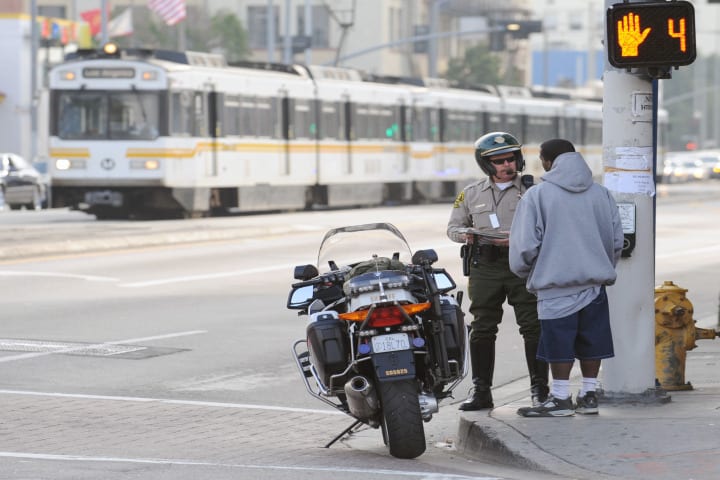
Courtesy Juan Ocampo
[IMAGE]LA.jpg[/IMAGE]As part of an intensive safety campaign focusing on reducing accidents along the 22-mile Los Angeles County Metropolitan Transportation Authority (Metro) Blue Line, dozens of Los Angeles Sheriff's Department and Los Angeles Police Department motorcycle officers issued 295 citations and impounded 34 vehicles in an operation to enforce traffic laws along the streets of downtown Los Angeles.
The safety efforts, which took place on March 24, focused on enforcing traffic laws; catching jaywalkers; and citing drivers for running red lights, making illegal left turns, and using cell phones or texting while driving between 7th/Metro Center and Washington stations.
The safety crackdown was conducted in response to the fact that the rate of pedestrian accidents has remained stagnant, even while there has been a steady decline in train versus vehicle accidents on the Metro Blue Line.
The Blue Line was singled out for the safety campaign because the other Metro light rail lines — the Green Line and the Gold Line — have not had any fatalities due to accidents, according to Metro officials.
"The Blue Line was the first one we opened and doesn't have all the safety measures that the Gold line has. So, we tried to come out with campaigns and engineering that will improve the safety of the line," said Jose Ubaldo, senior communications officer.
Metro's program of "Education, Engineering and Enforcement" targets illegal left turns and running red lights as the primary causes of train-vehicle accidents with the Metro Blue Line. With pedestrians, the top causes of accidents in the gated segment of the Metro Blue Line alignment are illegally crossing the tracks against active warning signs, including flashing lights, bells and lowered gate arms indicating approaching trains.
Ubaldo said that this was the second in a series of safety campaigns. The first took place at Washington Boulevard and Los Angeles Street in downtown Los Angeles in February, and the third, planned for May, will take place in Long Beach.
"We are finding out that all the efforts [are] working on the motorist side, but [with] pedestrians, we're trying to find out how to keep [accidents] down," Ubaldo said.
Metro published a four-part series of posts on its blog, The Source (http://thesource.metro.net/), to update the public on the campaign. In the series, author Steve Hymon said that "Of the three light rail lines that Metro operates, [the Blue Line] is the most heavily ridden and is one of the busier light rail lines in the United States."
Since the Blue Line opened in 1990, 26 motorists have been killed in collisions with Blue Line trains and 51 pedestrians have also been struck and killed by trains. Altogether, there have been 99 fatalities involving the Blue Line, according to the blog.
Metro has made several safety improvements to the Blue Line since it opened, including the installation of four-quadrant crossing gates at six intersections; reducing the height of fencing along the tracks so that train operators have a better view of cross-traffic; installing a "cyclops" light on trains to improve their visibility and adding pedestrian gates at several crossings; and installing LED "TRAIN" signs to deter motorists from making illegal left turns in front of the train and running red lights.
Despite these efforts, pedestrian deaths and suicides on the Blue Line have not declined in the past decade. In one of Metro's blog posts, Hymon wrote that there were 33 pedestrian deaths from 1990 through 1999 and 39 from 2000 through 2009.
In attempts to reduce pedestrian accidents, Metro contracts with the Los Angeles Sheriff's Department for five officers to patrol the Blue Line corridor and run periodic sweeps of the line with additional officers, and is looking into whether there is space on sidewalks to accommodate pedestrian swing gates at 27 more locations.
Metro will also put two "Rail Safety Ambassadors" on the Blue Line for the next few months.
The agency also offers safety education videos for children to community groups and schools.
Still, Ubaldo said the all these efforts require the cooperation of the public to be effective. "They are the ones who make the decision on safety. There is so much we can do with technology, engineering, law enforcement, but...we need [people] to pay attention."
More Rail
FRA Announces $5.3B in Rail Investments, Including $2B for Amtrak
Funding will support grade-crossing improvements, infrastructure upgrades, and new Amtrak equipment in 23 states.
Read More →
Finding the ‘Happy Medium’: Optimizing Maintenance Without Sacrificing Reliability
The key to maintenance optimization isn’t doing less work—it’s doing the right work at the right time on the right assets.
Read More →
OKC Streetcar Makes Zero-Fare Service Permanent
Ridership increased an average of 71% compared with the same period a year earlier during the fare-free pilot.
Read More →
DART Customer Satisfaction Reaches Six-Year High
Overall satisfaction rose to 74.9%, while the agency’s Net Promoter Score reached a record 33.7.
Read More →
How DART's GoPass Is Redefining Regional Mobility
Serving 14 transit agencies, GoPass simplifies multimodal travel by allowing riders to plan, pay for, and manage an entire trip through one app.
Read More →
Amtrak Board Advances Plan to Restructure Organization, Seeks Public Input
The proposal, developed by Amtrak management and approved by the board for further consideration, is intended to modernize the organization's structure while improving accountability, operational efficiency, and customer service.
Read More →
Biz Briefs: STV teams with Amtrak, Motorcoach Operators Boost Fleet and Land Contracts, and More
From manufacturers and suppliers to transit agencies and motorcoach operators, these updates offer a snapshot of the projects, partnerships and business moves driving the industry forward.
Read More →
Metra Celebrates 100 Years of Electric Rail, Looks to the Future
The event was also a celebration of recent reforms to public transportation in the Chicago area, changes that could be as transformative in the future as the major civic achievement a century ago, said officials.
Read More →
LA Metro Marks Banner Year, Sets Ambitious Goals for New Fiscal Year
Incoming LA Metro Board Chair and Los Angeles Mayor Karen Bass joined outgoing Board Chair Fernando Dutra and LA Metro CEO Stephanie Wiggins to review accomplishments from fiscal year 2026, which included the opening of new rail extensions, advancement of major transit projects, expanded safety programs, and new rider amenities.
Read More →
DART Taps Nathaniel P. Ford Sr. as Next President/CEO
Since 2012, Ford has served as the CEO of the Jacksonville Transportation Authority
Read More →