

In all facets of safe passenger transportation, the most important factor is the leadership provided. Unfortunately, most leaders have received little to no leadership training and have to rely on their own past experiences. There is now an innovative new training course available aimed specifically at all levels of leadership in the transportation industry.
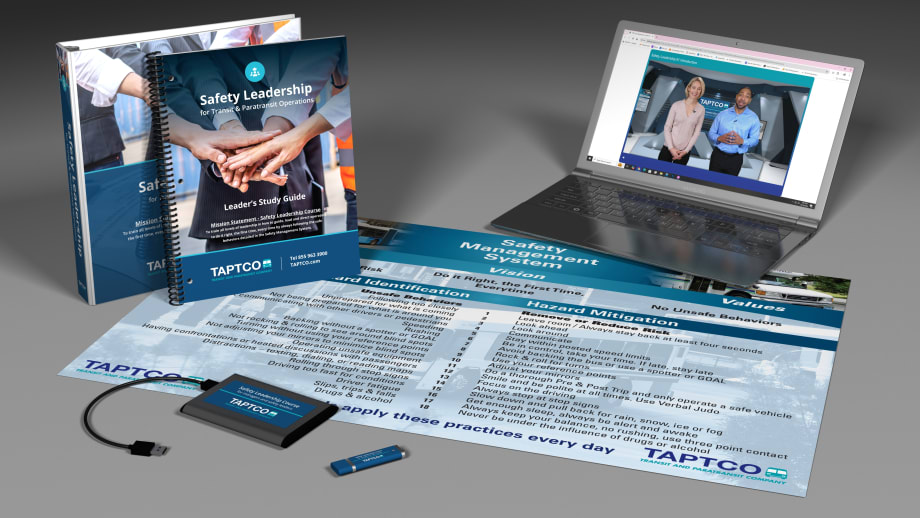
This new course starts by focusing on the outcomes desired by the leadership, being safe passenger transportation. To achieve safe passenger transportation, we need to remove or reduce risk in all facets of operating a transportation vehicle. There are 22 behaviors that potentially involve risk and 22 reciprocal behaviors that remove or reduce these risks. These 22 behaviors are detailed on this poster.
Leadership
When all drivers are persuaded to always follow the 22 safe practices detailed on this poster, automatically, as a NORM, you will have removed or reduced the risks, and as such, be operating as safely as possible. It really is that simple. If drivers always stay back at least four seconds, they reduce the risk of a rear end collision. If drivers never back up the vehicle, they will have removed the risk of a backing accident. The 22 risky behaviors and the reciprocal safe or safer behaviors are detailed on this poster.

So, to operate safely, we need to persuade drivers to always practice these 22 safe behaviors, as a NORM.
So, who decides how to instill these safe behaviors into the drivers and how do they do this. It is all down to the location leadership. The new Safety Leadership Course teaches all levels of leadership how to use antecedents to shape the drivers’ behaviors. Behavior theory teaches the ABC of influencing driver behaviors.
Antecedents lead to Behaviors to achieve Consequences.
Each day, we are faced with dozens of antecedents that affect our behaviors. A speed limit sign causes us to slow down, as we want to be safe and not get a speeding ticket. A red light is an antecedent, kids waiting at a stop is an antecedent.
The Safety Leadership Course presents many antecedents that leaders can use to instill the desired behavior into drivers and achieve the desired consequences.
Antecedents
When an applicant first contacts your location to apply for a job, before going through the hiring process, share a copy of the poster with them and explain that if they join your operation, they will be required to always follow these 22 safety practices. Request their agreement, before you proceed with the hiring process.
Tell them that following these 22 safe behaviors is a condition of employment, a requirement of the job. By doing this at the very first contact, you make a great first impression and the applicant will start to understand the importance of these practices.After completing the hiring process, before passing on to the trainer, present the new trainee with a copy of the poster and require them to sign their agreement.
Once the applicant is passed to the trainer, the trainer should provide the trainee with a copy of the study guide and show them there is a copy of the poster on the back of the guide. The trainer explains that all the training they will go through will be to instill these desired behaviors into the trainee as a NORM.
Ongoing antecedents will include safety messages, posters, trainer guidance to continually persuade the drivers to adopt the 22 desired behaviors.
Let’s go back to what we are trying to achieve. That the drivers reduce or remove risk in all their actions. Following these 22 safe behaviors is what achieves this. Again, it really is that simple.
KSA/MPV
The use of the effective antecedents is one of the most important parts of Safety Leadership, but the course includes many additional practices to instill a safety culture. The course explains how understanding a trainees KSA (knowledge, Skills and Abilities and MVP (Motivations Values and Personality) can be allowed for in the leadership practices.
This course can be used to train all levels of leadership, including the location manager, supervisors, trainers and dispatchers, to all be working together in the same direction to operate as safely as possible.
This article reflects the views of TAPTCO and does not necessarily represent the views of METRO or Bobit Business Media.