



Siemens Mobility President/CEO Talks Tech and More
Marc Buncher discusses Siemens current direction, the state of high-speed rail in America, and much more.


Marc Buncher, President/CEO for Siemens Mobility Inc.
Photo: Siemens
Siemens showcased its S70 low-floor streetcar, built for California’s Orange County Streetcar system, at this year’s APTA TRANSform & EXPO.
But as Marc Buncher, president/CEO at Siemens Mobility Inc., explained from the show floor, there is much more going on at the company these days than just rail vehicles.
Can you talk a bit about what you have going on at APTA’s EXPO, as well as what’s new with the company?
Well, here at EXPO, we have OCTA’s streetcar vehicles, which has one of the cooler paint schemes that I’ve seen on a light rail vehicle. With this vehicle as the showcase, people have been coming by our booth throughout EXPO, which has given us the chance to talk to them about all of the other technologies Siemens offers.
As a company, we have made over a billion dollars in investments and acquisitions of software companies over the past few years, so we have been showcasing those products throughout the show. In addition to that, we also sell our products to many other OEMS in the industry, so we have drive and gear components on other vehicles in cities like Chicago and New York.
So, we don’t only have a rolling stock business, which is maybe what we are most known for, but we also have a service and aftermarket business that has really been growing, especially with the digitalization that has been going on in the industry. We also have our rail infrastructure business, which basically focuses around signaling. All of the products we offer meet the Buy America criteria and have for many, many years now.
It seems as if Siemens is moving toward being able to offer agencies a complete suite of products that fit hand in hand with your rolling stock offerings. Is that correct?
We will do projects where we take our systems plus a third-party’s software through our open architecture, which we call our Xcelerator. We have been selling those packages quite a bit lately. We have some really cool projects that we are doing with VIA Rail in Canada, where we will handle all their systems and include third-party applications. We are also doing similar work for Brightline here in Florida, which is really one of the coolest systems in the world, not just because they use our trains but because the business concept is really cutting edge. One of the projects we are doing with Brightline, right now, is implementing a ticketing and reservation system like you would see for an airlines, where they are able to adapt the pricing based on seating availability.
We also have a couple of projects in California that will be really cool once they are implemented, where the agency will be able to see where their trains are when they go into tunnels for the first time using some cutting-edge technology that we will put on the vehicles. We have also been testing many technologies on the Atlanta Streetcar. Overall, we have spent a ton of money testing products to see how well they can work. In Europe, for example, we have a fully automated system that has both LIDAR and radar on it, so you can predict when people are
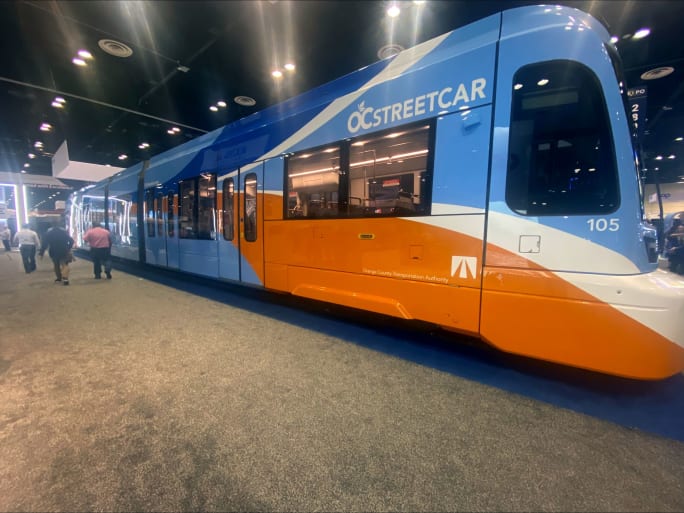
Siemens showcased its S70 low-floor streetcar, built for California’s Orange County Streetcar system, at this year’s APTA TRANSform & EXPO.
Photo: METRO Magazine
going to be around the train, which in essence functions similar to how autonomous vehicles work.
European transit systems have always been perceived as being five years ahead of their U.S. peers technologically. Speaking to folks at APTA EXPO, I hear that is shrinking a bit — is that something you are seeing at Siemens?
We are seeing two things currently. First, Europe has much more passenger rail then here in the U.S., therefore, they have all the latest technologies being implemented on their systems. The acceleration there is a great benefit to a company like Siemens, because rather than charging a customer $100 million to develop a software product, we can just take a product to the next customer and save them money while providing them a chance to upgrade their system to the latest technologies available. So, we can develop technologies around the globe and bring them here to the North American market once they have been tested, proven, and most times, already upgraded from the initial concept.
Secondly, in the U.S. specifically, we are seeing a big convergence between freight and passenger rail, because the country has the largest network of freight rail track in the world. Because of that, we can take all the things that we've developed for passengers and take it to the freight rail network and vice versa, which means the U.S. has some very advanced technologies operating on its freight rail network.
Overall, though, I wouldn’t say there’s a three- to five-year lag technologically. The big lag here in the U.S. would be the adaptation of high-speed rail, which is one of our key focus areas, especially in California with Brightline West. Once we do get high-speed rail implemented here, then all of the technologies that are necessary, such as signaling systems, will be tested and ready to go because they are being matured in Europe and other areas around the world. Of course, the high-speed train we are trying to bring here to the U.S. will use all of the latest technologies that we have available. We have been testing it in Europe where it hit a speed record of 360 kilometers per hour (about 223 miles per hour). So, I don’t think there’s that large of a technological lag anymore, the real lag is in the adaptation of high-speed rail.
What would you say is the biggest lag in getting high-speed rail up and running here in the U.S.?
I think California has finally got it figured out. We have been working closely with our customer there for a long time and were one of the two preferred suppliers in the last round of contracts. With the Infrastructure Investment and Jobs Act that came out a couple years ago now, there is money available for the California High-Speed Rail system, as well as for Brightline West’s line to Las Vegas. That federal funding component has been the missing link to this point, but it’s coming and will really be a big step in getting these projects to finally becoming a reality.
More Rail

New York MTA Advances Final Contract for Second Avenue Subway Expansion
Contract Four is the largest in the Second Avenue Subway Phase 2 project and includes construction of station infrastructure, tracks, and signals for the subway expansion, MTA officials said. Work on Contract Four will begin in 2027.
Read More →
San Diego MTS Breaks Monthly Trolley Ridership Record
Agency officials said July’s ridership indicates MTS’s continued recovery from the pandemic.
Read More →
Report Examines NJ TRANSIT Reliability, Funding Challenges
The Garden State Initiative analysis examines the roles of Amtrak infrastructure, fleet management, and agency operations while recommending a more performance-based approach to improving reliability.
Read More →
Stadler, CapMetro Sign Long-Term Rail Fleet Support Agreement
Beginning in 2027, Stadler will provide on-site technical expertise, spare parts support, training, and obsolescence management to help extend the reliability and longevity of CapMetro’s GTW fleet.
Read More →
Biz Briefs: Alstom Lands Canadian Contract, LYT to Supply California TSP, and More
In METRO's latest installment, we take a look at recent news from Complete Coach Works, Beep, FlixBus, and more partnerships making headlines across the transportation sector.
Read More →
CATS Gold Line Marks 5 Years of Service, 2.8M Passenger Trips
With a six-mile expansion planned, the Charlotte streetcar is positioned to connect more neighborhoods and major transit hubs across the region.
Read More →
Why Simulating Pedestrian Movement Has Become Essential for Modern Rail Stations
Pedestrian microsimulation is helping rail planners identify bottlenecks, test station designs, and prepare complex transit hubs for growing passenger volumes.
Read More →
Amtrak Begins Major Construction at New York’s Sunnyside Yard
The new maintenance facility will support Amtrak’s Airo trainsets while improving maintenance efficiency and turnaround times in New York.
Read More →
Chicago Leaders Unveil Plans for O’Hare Airport Express Train
The privately developed project would offer a 15-minute trip between downtown and O’Hare’s Terminal 2, with trains operating every 15 minutes on a dedicated track. The service would use battery-electric trains and three existing freight rail rights-of-way.
Read More →
OCTA Maps Out 30-Year Strategy to Protect Coastal Rail Corridor
The draft feasibility report identifies strategies to protect the coastal rail line for decades as the agency continues near-term stabilization and sand placement efforts.
Read More →