



Tech Talk: How to Make Public Transportation Safer and Healthier
As moving vehicles operate most of the waking hours and open their doors for travelers to get on and off at different stops, public transportation exposes people to various harmful airborne particles from indoor and outdoor environments.
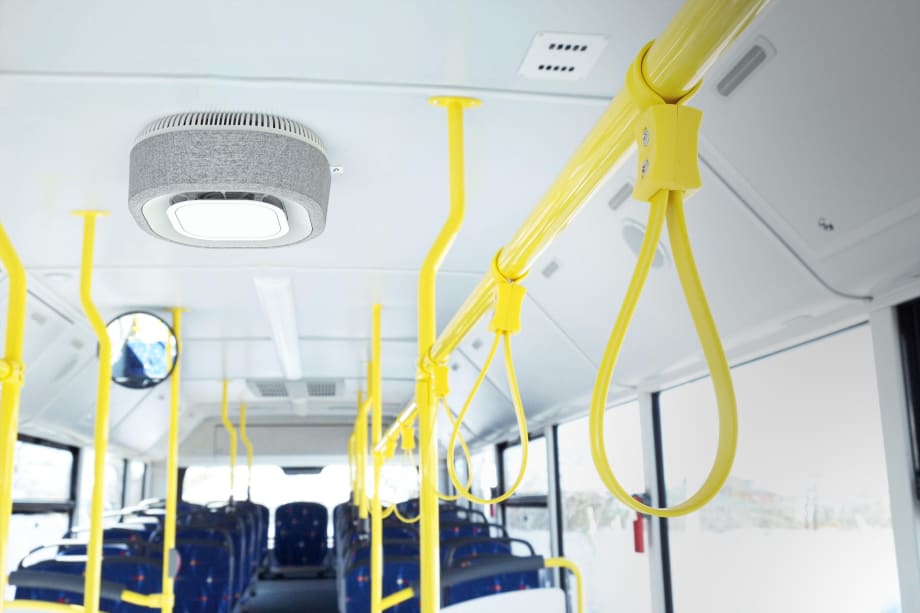
The need to filter indoor air and maintain a healthy space within public transportation has several obstacles that derive from its unique features and functions.
Photo: Aura Air
The transportation industry faces many challenges when protecting passengers and employees from different health threats, especially those connected to air quality. As moving vehicles operate most of the waking hours and open their doors for travelers to get on and off at different stops, public transportation exposes people to various harmful airborne particles from indoor and outdoor environments.
According to the EPA, transportation emits air pollution that contributes to poor air quality and smog, negatively impacting U.S. citizens' health and welfare. Pollutants that contribute to poor air quality include particulate matter (PM), nitrogen oxides (NOx), and volatile organic compounds (VOCs).
The need to filter indoor air and maintain a healthy space within public transportation has several obstacles that derive from its unique features and functions. The small and often dense area can suffer from insufficient ventilation and circulate viruses between passengers, creating a fertile ground for spreading diseases.
COVID-19 has made things even more complicated during the first wave of the pandemic. It wasn't clear how the virus spreads, so major concerns were raised regarding the health and safety of public transportation. Many people depend on it every day to get to work and support their families.
Even when COVID-19 eventually becomes endemic, the public’s renewed awareness of air quality will stay for much longer. Passengers still need to consider air pollution, bacteria, mold, and other harmful airborne particles when riding a bus, train, or airplane. What can we do about it? Of course, wearing masks and maintaining proper ventilation are important, but those are not always available, so a long-term solution is required.
Aura Air and Delos teamed up to find a new way to maintain the health and safety of passengers and employees with an all-in-one air quality solution. The two companies launched a study reviewing Aura Air’s smart air technology on ComfortDelGro Corporation’s (CDC) public transport buses. The study’s primary goals focused on restoring public confidence in public transport buses and the industry in general, improving workplaces with safer and healthier working conditions, and enhancing public health and safety by installing advanced air filtration in 2500 buses.
A pilot was conducted on two CDC city buses, one of which was fitted with an Aura Air unit. The two buses were provided with similar conditions, drove the same route, and were cleaned at the same frequency each day. Aura Air’s system measured the following parameters: VOC, PM2.5, PM10, temperature, humidity, and Air Quality Index (AGI). Bus #1 was a CDC bus with no Aura Air units, and Bus #2 was a CDC bus with 2 Aura Air units installed.
The results showed that the most significant effect was a reduction of VOC levels in the air. On Bus #1, the average VOC level was 4023 ppb, whereas VOC levels on Bus #2 were 1015 ppb, a 75% decrease on average. Aura Air units were also able to prevent VOC high-level peaks from reaching high values; maximum values at Bus #1 reached more than 50k ppb, whereas, on Bus #2, the VOC levels did not surpass the 16k ppb bar.
Looking at PM 10 values, a 12.2% reduction lowered levels from an average of 9.8 ppb to an average of 8.6 ppb. More importantly, we see a reduction in peak duration and, therefore, a decrease in exposure time to pollutant substances. A similar trend can be spotted in the PM 2.5 parameters with a reduction in average levels of PM 2.5 of 12%, from 8.3 ppb on Bus #1 to 7.3 ppb on Bus #2.
The overall AQI on Bus #2 (with Aura Air) has a significantly lower pollution baseline. In the absolute majority of the time, the AQI on Bus #2 is better by 54% than the AQI on Bus #1. The study also demonstrates that on Bus #2, the number of hazardous conditions peaks is significantly lower. Not only does Aura Air clean the air, but it is also a risk-mitigation tool that alerts transit operators to dangerous in-cabin conditions.
Indoor air quality is essential in order to maintain the health and safety of passengers and employees on public transportation. By choosing an advanced air quality solution, the transportation industry can ensure the health and safety of passengers, drivers, and operators over the long term.
Roei Friedberg is CEO of Aura Air Americas.
More Technology

From Hardware to Digital Partner: Luminator Charts Its Next Chapter
CEO Magnus Friberg discusses Luminator’s shift toward becoming a digital partner, the growing importance of software and interoperability, and how AI can help agencies improve operations and passenger experience.
Read More →
Beyond the Checklist: A Structured Approach to Transit Maintenance
Reliability-Centered Maintenance helps transit agencies move beyond routine checklists to focus limited resources on the assets and failures that have the greatest impact on safety, reliability, and service.
Read More →
NJ TRANSIT Advances Bus Technology Upgrades Across Statewide Fleet
More than 1,500 buses now feature upgraded technology designed to improve arrival predictions and provide free Wi-Fi, with deployment expected to reach nearly 2,000 buses by the end of 2026.
Read More →

Building a Flexible Path to Transit Electrification
John Hroncich discusses BAE Systems’ modular and scalable approach, lessons learned from decades of real-world operations, and how agencies can identify electrification strategies that fit their fleets.
Read More →
Biz Briefs: Alstom Lands Canadian Contract, LYT to Supply California TSP, and More
In METRO's latest installment, we take a look at recent news from Complete Coach Works, Beep, FlixBus, and more partnerships making headlines across the transportation sector.
Read More →
From Legacy Silos to Conversational Intelligence
What if transit leaders could ask any operational question and get a trusted answer in seconds? Conversational AI is transforming how agencies use their data.
Read More →
USDOT Announces Rail Vehicle Replacement Grants, Chattanooga AV Shuttle Funding
More than $191 million in federal funding will help three transit agencies replace aging rail vehicles and support a new autonomous shuttle service in Chattanooga.
Read More →
Bus Tech Talk: Keeping Transit Technicians Ahead of the Technology Curve
LA Metro’s Obed Mejia discusses technician training, evolving maintenance technology, fleet replacement, and strategies for getting the most out of today’s transit fleets.
Read More →
Biz Briefs: RIPTA Unveils New Frontrunners, Clevland RTA Adds New Siemens, and More
In METRO's latest installment, we take a look at recent news from Siemens, Prevost, Dodge, and more partnerships making headlines across the transportation sector.
Read More →
Why Simulating Pedestrian Movement Has Become Essential for Modern Rail Stations
Pedestrian microsimulation is helping rail planners identify bottlenecks, test station designs, and prepare complex transit hubs for growing passenger volumes.
Read More →