



Training key to controlling costs
Travel trainers teach disabled and older persons to use local public transportation fixed-route services safely and independently
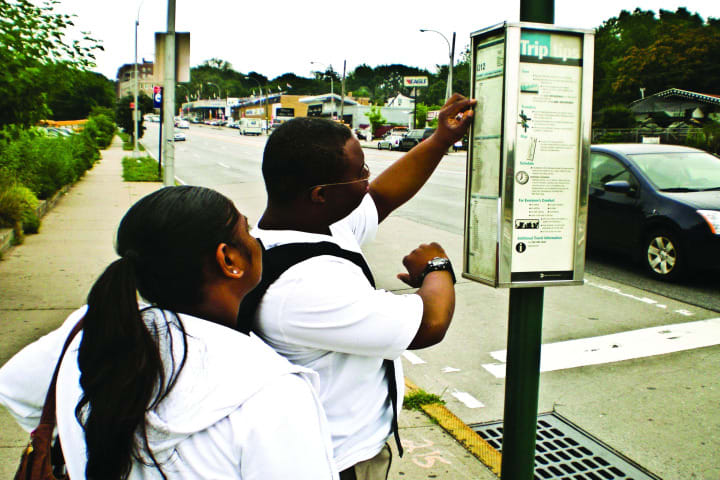
Developmentally disabled student Derren is learning how to read and understand an NYC bus schedule, with the help of NYC Department of Education travel trainer Naressa Guevara.
[IMAGE]paratransit-3.jpg[/IMAGE]The high cost of providing ADA paratransit services to persons with disabilities who are unable to use fixed-route public transportation services is easily documented. While providing service toward the development of New York City's Coordinated Public Transit-Human Services Transportation Plan in 2008, I learned that the average cost-per-trip for New York City's Access-A-Ride ADA paratransit service had grown to $55 per trip in 2005, and that "this trend is forecast to continue." Indeed, recent local media reports indicate that Access-A-Ride costs have increased as predicted.
Slashing paratransit services is not the answer but offering a fixed-route travel training option to some current paratransit users and future applicants can help public transportation agencies control paratransit costs. One method to get started is to either hire a travel trainer, or to assign travel training responsibilities to the agency's customer service department or its ADA coordinator.
Trainer involvement
The critical next step is to involve the travel trainer in ADA paratransit certification and re-certification processes. Why? The first action a travel trainer takes is to assess the individual's ability to learn to use local fixed-route bus or rail service safely and independently. Currently, many transportation properties utilize physical, occupational or recreation therapists to conduct in-office assessments, but other travel trainers believe that this initial assessment should take place in the environment.
Perhaps the best practice might be to do both — if the customer shows interest in travel training during an initial paratransit certification interview, conduct a more thorough assessment in the community and on the local bus or rail system.
Nothing rings more true about the importance of community assessment than a film clip of a young, recently travel-trained wheelchair user slowly but surely pushing himself up two steep city blocks to reach his home from his bus stop. It was probably during his assessment that his travel trainer first recognized his student's determination.
School district partnering
Another relatively new best practice in travel training is the importance of public transportation agencies partnering with their local school districts. In August of 2006, the U.S. Department of Education issued a final regulation in which it clarified that travel training is a part of special education programs and that travel training should be included in a student's Individualized Education Plan.
In this regulation, travel training is defined as "providing instruction, as appropriate, to children with significant cognitive disabilities, and any other children with disabilities who require this instruction, to enable them to (i) develop an awareness of the environment in which they live; and (ii) learn the skills necessary to move effectively and safely from place to place within that environment (e.g., in school, in the home, at work and in the community)." This regulation has led to the growth of travel training services available to students, particularly those students in transition programs, whether such training is provided directly by the school district or through a contract with a local travel training agency.
Begin dialogue now
If students with disabilities have not learned safe and independent travel skills and behaviors before they transition out of high school, they may never do so. Transportation agencies of all sizes should begin a dialogue now with local school officials to ensure that special education students learn how to use the bus on their own.
It is important to emphasize that many resources for travel training that did not exist 10 years ago are now available to transportation agencies, school districts and individuals with disabilities.
The nonprofit Association of Travel Instruction (ATI), www.travelinstruction.org, was incorporated in 2001 to provide professional development opportunities for travel trainers. ATI provides a quarterly print newsletter and a monthly e-newsletter to its members and any other interested persons. Its Website includes a travel training Code of Ethics, presentations from previous conferences and a registry of travel trainers in North America.
Also visit the Easter Seals Project ACTION Website, http://projectaction.easterseals.com. Go to their online store and you will find free multimedia materials about competencies for travel trainers, travel training in school settings, bus stop accessibility and determining paratransit eligibility.
Terence J. Moakley is past-president of the Association of Travel Instruction. Moakley also serves as chairman of the Board of Directors of VetsFirst, and as a Board of Directors member of United Spinal Association, located in Jackson Heights, N.Y.
More Paratransit

People Movement: Dan Dipert Coaches Adds Third-Generation Leader, Keolis Names New Valley Metro VP/GM, and More
In this edition, we also cover recent appointments and announcements at the Wabtec, SilverRide, HNTB, and more, showcasing the individuals helping to shape the future of transportation.
Read More →
Biz Briefs: RIPTA Unveils New Frontrunners, Clevland RTA Adds New Siemens, and More
In METRO's latest installment, we take a look at recent news from Siemens, Prevost, Dodge, and more partnerships making headlines across the transportation sector.
Read More →
King County Metro Makes ADA Paratransit Easier to Navigate
METRO's Innovative Solutions Award winner replaces complex service-area descriptions with an accessible, interactive map that puts paratransit information directly in customers’ hands.
Read More →
Jacksonville’s NAVI Project Charts a New Course for Autonomous Public Transportation
Through its NAVI program, JTA is showing how autonomous vehicles, intelligent infrastructure, and coordinated operations can work together to deliver everyday public transportation.
Read More →
Driving Smarter Paratransit
John Hanlon shares how AlphaRoute is leveraging AI-powered technology to help paratransit providers optimize operations, support frontline staff, and enhance the rider experience.
Read More →
METRO Magazine Announces 2026 Innovative Solutions Awards Winners
Projects Recognized for Advancing Mobility Through Technology, Accessibility, Workforce Innovation, and Operational Excellence
Read More →
Biz Briefs: STV teams with Amtrak, Motorcoach Operators Boost Fleet and Land Contracts, and More
From manufacturers and suppliers to transit agencies and motorcoach operators, these updates offer a snapshot of the projects, partnerships and business moves driving the industry forward.
Read More →
Biz Briefs: Masabi Teams with St. Louis Metro and More
In METRO's latest installment, we take a look at recent news from Transdev, Hitachi, and more partnerships making headlines across the transportation sector.
Read More →
New York MTA Leverages Zoning Program to Advance Station Accessibility
Accessibility enhancements at Nevins St Station will be financed through a development agreement tied to the MTA's Zoning for Accessibility initiative.
Read More →
Reinventing Fleet Maintenance with Real-time Visibility and AI
Transit leaders need to know what needs fixing, where to look, who is responsible, when work is completed, and what it costs without having to chase information across disconnected systems.
Read More →