



RELATED: APTA names Houston Metro chief as top transpo manager
Women in Transportation: Kimberly Williams
A look at the career of Houston Metro's chief innovation officer.
by METRO Staff
September 19, 2018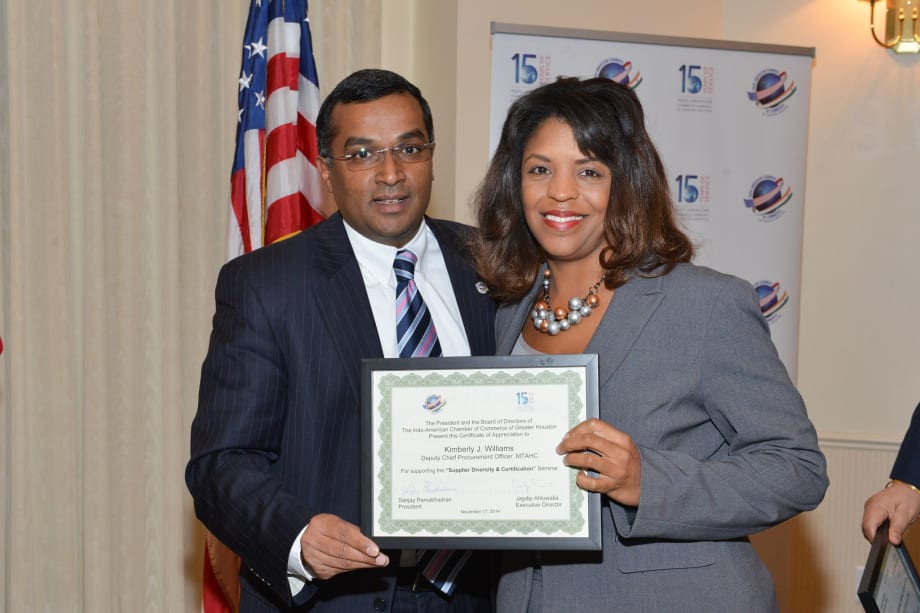
4 min to read
Grew up: Detroit, Mich.
Studies: I have a BA in Economics from Howard University and a law degree from Wayne State University Law School.
Career aspirations: I grew up wanting to be a judge, but later became fascinated by the labor movement that was happening in Detroit during that time. I went off to college seeking to get a Ph.D. in Labor Economics.
Influences: When I graduated from undergrad, there were few positions for economists. I took an internship as a Legislative Correspondent on Capitol Hill. It came about through a Congressional internship program, and I was able to work for my hometown Congresswoman. The role involved responding to constituent concerns on legislation, policy issues and helping them work with federal agencies. It specifically involved working with committee staff on transportation issues. I caught the political bug and changed from economics to law. I knew I wanted to continue in public policy and most of my colleagues at that time were lawyers. I saw a law degree as proving the opportunity to continue working on policy and economics. While my path has changed a bit since then, I’ve used my law background in every position — from contract administration in the procurement field, higher education, to looking at the numerous policies that are developing in the innovation space. When you look at the regulation of autonomous vehicles and the related areas of data and safety, they all have legal implications. That internship changed the whole trajectory of my career and provided me with a background that has served me in numerous ways.
Intro. to transportation industry: My first boss was a U.S. Congresswoman who served on the House Transportation Committee. That was my first exposure to the world of transportation. I was a legislative assistant in her office and helping to develop and write legislation and regulations on issues related to transportation and women. We also helped constituents maneuver through the legislative process or federal agencies to address their concerns. I also worked a lot in the community and learned the importance of the role of government in people’s lives in terms of access to transportation and education. After law school, I had the opportunity to work in higher education administration. I worked closely with Houston METRO on grant opportunities that allowed the university and Houston METRO to partner on transportation research projects. We also worked together on the early stages of Houston’s light rail expansion as it involved the campus. Based on the positive working relationship I had with the agency, it was a logical transition for me to join the rail expansion team. Ten years later, it continues to be a great experience especially when I can see the rail expansion come to fruition.
Early role: Prior to the role of chief innovation officer, I served as the deputy chief procurement officer. The role involved managing procurement, contracting and small business in the $75 to $125 million range.
Current role: My current role is managing the strategic planning function for the regional public transit agency in the nation’s fourth largest city. My responsibilities include researching emerging technology, operating METRO’s pilot and unsolicited proposal programs, project manager of METRO’s Autonomous Proving Ground and its representative on the Houston Innovation District, Transportation for America Smart Cities Collaborative, and the Texas Innovation Alliance as Chair of Team Houston.
Accomplishments: I’m equally proud of developing METRO’s Business Assistance program, which has been modeled successfully by other cities, and my work leading METRO’s award-winning Small Business program. The Business Assistance and Small Business program are part of that positive impact that transit agencies can have on the community.
Challenging/rewarding: The most challenging part of my job is incorporating the benefits of emerging technology while managing the financial constraints that we operate in. The most rewarding part is knowing our team is playing a key role in bringing emerging technology and services to create a more responsive, safer, and robust transit system.
Skills: I consider myself a life-long learner, which has helped me prepare for each new role I’ve had. Being flexible definitely helps as I’ve learned to focus on accomplishing the goal and adapting to the changes that may be required to get there.
Projects: We’re currently developing a pilot for Houston’s first autonomous vehicle project. It’s called the University District Project and will provide an autonomous circulator shuttle service, initially on the campus of Texas Southern University, and later moving to University of Houston. It will later connect to the nearby rail line and park-and-ride. Upcoming projects include additional AV pilots and formulating the agency’s strategic plan.
Profound moment: The most profound moment of my career was my internship after college working on Capitol Hill. That opportunity introduced me to an entire new industry. The experience changed my career path and has led me to roles that meet my interests and passions.
Inspiration: My mother, who raised me as a single working mother, and made it look easy. Now that I’m a working mother, I realize how hard it is and I stand in awe of how she did it all with such grace.
Favorite pastimes: I’m all about experiences. I love to try new things, events, music, food, and definitely locations.
Subscribe to Our Newsletter
More New Mobility

From Hardware to Digital Partner: Luminator Charts Its Next Chapter
CEO Magnus Friberg discusses Luminator’s shift toward becoming a digital partner, the growing importance of software and interoperability, and how AI can help agencies improve operations and passenger experience.
Read More →
Biz Briefs: Alstom Lands Canadian Contract, LYT to Supply California TSP, and More
In METRO's latest installment, we take a look at recent news from Complete Coach Works, Beep, FlixBus, and more partnerships making headlines across the transportation sector.
Read More →
CharterUP’s Armir Harris on Technology, AI, and the Future of Group Mobility
In a recent episode of METROspectives, CharterUP Founder/CEO Armir Harris discussed the company’s evolution from an online charter bus marketplace into a technology platform supporting public- and private-sector mobility and much more.
Read More →
Jacksonville’s NAVI Project Charts a New Course for Autonomous Public Transportation
Through its NAVI program, JTA is showing how autonomous vehicles, intelligent infrastructure, and coordinated operations can work together to deliver everyday public transportation.
Read More →
Biz Briefs: Luminator Marks Milestone and More
From manufacturers and suppliers to transit agencies and motorcoach operators, these updates offer a snapshot of the projects, partnerships and business moves driving the industry forward.
Read More →
New Tricks for Old Bureaucracies: Joshua Schank on Making Transit Innovation Stick
Former LA Metro Chief Innovation Officer Joshua Schank discusses why good ideas aren't enough, how transit agencies can overcome resistance to change, and why today's challenges demand more innovation.
Read More →
How DART's GoPass Is Redefining Regional Mobility
Serving 14 transit agencies, GoPass simplifies multimodal travel by allowing riders to plan, pay for, and manage an entire trip through one app.
Read More →
Biz Briefs: OCTA Taps Clean Energy for Hydrogen Station, Stadler to Supply Via Rail Vehicles, and More
From manufacturers and suppliers to transit agencies and motorcoach operators, these updates offer a snapshot of the projects, partnerships and business moves driving the industry forward.
Read More →CharterUP Expands Into New Mobility and Autonomous Transportation
Vice President of New Mobility Stephen Joos discusses how CharterUP is leveraging its nationwide transportation network, technology platform, and autonomous vehicle partnerships to expand into workforce mobility, campus shuttles, and transit solutions.
Read More →
METRO Magazine Announces 2026 Innovative Solutions Awards Winners
Projects Recognized for Advancing Mobility Through Technology, Accessibility, Workforce Innovation, and Operational Excellence
Read More →