



Related: Diverse fleet helps Yale service navigate urban routes
Yale Turns to Hybrid Tech to Meet Sustainability Goals
Recently, Yale University’s 23rd president, Peter Salovey, instituted a first-ever pilot program to put a price tag on the use of carbon, with prominent campus buildings and the university’s vehicle fleet playing a role in the intra-department carbon tax implementation.
by Alex Roman, Managing Editor
August 15, 2016
Yale/Michael Marsland
5 min to read

Yale/Michael Marsland
Recently, Yale University’s 23rd president, Peter Salovey, instituted a first-ever pilot program to put a price tag on the use of carbon, with prominent campus buildings and the university’s vehicle fleet playing a role in the intra-department carbon tax implementation.
“The idea came about that Yale would set a baseline for emissions,” says Ron Gitelman, fleet administrator for Yale. “Our president wanted to find a way to reduce carbon emissions, but also make people sensitive and aware of the carbon emissions they are putting out, whether it is from lights, air conditioning or vehicle use. The idea was to set the baseline and monitor it over time.”
Gitelman adds that if the baseline is exceeded, the university charges the department a carbon tax based on the social costs of emissions, according to the EPA.
Experimentation
Yale’s foray into sustainability, however, isn’t a new one. In 2011, the university began exploring the use of alternative fuels through the introduction of biodiesel, but experienced issues with the vehicles and didn’t quite find the reduction in emissions it was hoping for.
In 2012, the university introduced compressed natural gas (CNG).
“We started with the MV-1 and soon added a couple of our large transit buses and 24-passenger cutaway buses, which brought us to seven vehicles with CNG,” Gitelman explains. “The issue, then, became infrastructure. We don’t have any fueling areas on campus, and the nearest place was about five miles away in West Haven, [Conn.]. It really became a productivity issue, but we were willing to live with it because of the savings on regeneration and the environmental savings.”
Yale again changed course, Gitelman says, after gasoline prices dropped below CNG fuel prices, thus eliminating the cost benefit the university was experiencing.
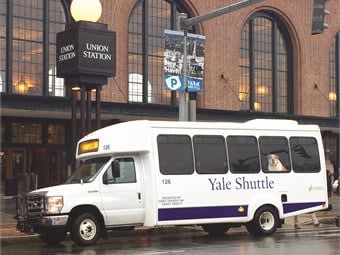
In 2015, Yale’s next step was the addition of three Goshen Coach 24-passenger shuttles, built on the Ford E450 platform and upfitted with XL Hybrids’ XL3 Hybrid Electric Drive System.
The shuttles transport students, faculty and Yale visitors around the campus and metropolitan New Haven area.
“Your standard university tends to be a self-contained campus, but Yale isn’t that. We’re about three miles in length and about a half-mile wide, including our medical school,” says Gitelman. “Our local transit authority doesn’t have the capability to meet the needs of the Yale students and people who use the shuttle system, nor can they provide it on the timeframes that are needed, because you may need to get somebody from one end of campus to the other in 20 to 25 minutes. Only through the shuttle system that we operate are we able to meet their needs.”
Performance
Since implementation, Yale has seen over a 23% increase in fuel economy, while exceeding its expectations for CO2 emissions reduction and fuel savings. Most importantly, it is helping the fleet department meet the goals set by the university’s carbon tax program. Gitelman adds there have also been some additional side benefits as well.
“From what I hear, our maintenance is also being reduced,” he says. “We outsource operations, but the contractor has also told us that the drivers like the XL vehicles quite a bit as well.”
XL’s hybrid technology transforms an original equipment manufacturers (OEM) vehicle into a hybrid vehicle by adding an electric motor, an advanced lithium-ion battery pack, and control software to the vehicle without making significant vehicle modifications or modifying the internal combustion engine or transmission. The installation generally takes about a day after the vehicle is delivered to an authorized facility to be upfitted, explains David Breault, business development manager, fleet and commercial sales.
“We don’t cut, drill, weld or anything like that, so we’re able to maintain the OEM warranty, which most everyone likes. This way vehicles with the hybrid system can still receive OEM warranty service as usual,” he adds.
The XL3 Hybrid Electric Drive System saves fuel through regenerative braking, a process by which the electric motor helps slow the vehicle during braking, to charge the hybrid battery. Then, when the driver accelerates, the hybrid battery releases the stored energy to the electric motor, helping to propel the vehicle in a process that is seamless to both the driver and passengers, according to the company.
Although it takes somewhere between 80,000 and 100,000 miles to see a return on investment, Breault explains that the user experiences the sustainability efforts from day one. He adds that the XL system also qualifies for FTA funding.
To help track key performance indicators, such things as fuel usage, idle time and carbon emissions, Yale is also using XL’s cloud-based analytics system XL Link to help compare the data it is gathering on its own.
“As an engineering tool, we’ve always used Link to capture info on our whole fleet of customers, so we can better map out how the electric motor engages or disengages. Also, when we run software updates on the vehicles it allows us to push them out wirelessly,” says Breault. “Now, we’ve begun to turn some of that data over to our fleet managers, and Ron was one of the first five people to beta test what the web portal looks like. For somebody like him who’s in a lot of meetings and gets asked a lot of questions, the Link system allows him to log in and see how many metric tons his department has saved using our vehicles.”
The Future
The success of the first three vehicles has led to Yale adding four more vehicles upfitted with the XL Hybrids system this year, with the university already looking to add more vehicles in the next fiscal year.
“I would expect that we will continue to increase our purchases of the XL Hybrids system as long as it continues to perform as well as it has,” says Gitelman, who adds that the university is still exploring other alternative propulsion systems with an open mind.
“If I had any advice for somebody exploring alternative fuels, it would be to do your research, make sure you go with a reliable vendor and be willing to try new technology,” Gitelman says. “There are great programs out there that can truly be helpful to your operation if you just give them a shot.”
Subscribe to Our Newsletter
More Bus
Biz Briefs: New Flyer Delivers in Columbus, Houston, Beep and Freebee Merge, and More
In this edition of Biz Briefs, we spotlight the latest developments shaping the future of mobility.
Read More →
People Movement: Dan Dipert Coaches Adds Third-Generation Leader, Keolis Names New Valley Metro VP/GM, and More
In this edition, we also cover recent appointments and announcements at the Wabtec, SilverRide, HNTB, and more, showcasing the individuals helping to shape the future of transportation.
Read More →
New York MTA Plans Largest Bus Fleet Upgrade in More Than a Decade
The agency is seeking manufacturers for 650 new CNG buses to replace aging vehicles, improve reliability, and advance its broader fleet modernization strategy.
Read More →
Building a Flexible Path to Transit Electrification
John Hroncich discusses BAE Systems’ modular and scalable approach, lessons learned from decades of real-world operations, and how agencies can identify electrification strategies that fit their fleets.
Read More →
Bus Tech Talk: Keeping Transit Technicians Ahead of the Technology Curve
LA Metro’s Obed Mejia discusses technician training, evolving maintenance technology, fleet replacement, and strategies for getting the most out of today’s transit fleets.
Read More →
Biz Briefs: RIPTA Unveils New Frontrunners, Clevland RTA Adds New Siemens, and More
In METRO's latest installment, we take a look at recent news from Siemens, Prevost, Dodge, and more partnerships making headlines across the transportation sector.
Read More →
People Movement: Holly Arnold Joins Transdev and More
In this edition, we also cover recent appointments and announcements at Pace, CamTran, MCI, and more, showcasing the individuals helping to shape the future of transportation.
Read More →
The High Cost of Transit Buses: Industry Leaders Look to Procurement Reform
Transit leaders and policymakers examine how standardized bus designs, streamlined procurement, and predictable funding could help agencies stretch budgets and deliver better service.
Read More →
The Business Voice Behind Public Transportation
As chair of APTA’s Business Members Board of Governors, Ray Melleady explains how more than 850 business members are partnering with transit agencies to advance funding, innovation, and industry-wide collaboration.
Read More →
From Surviving to Thriving: Building Stronger Transportation Organizations
Bus Business Consultants founder Brian Dickson shares lessons on leadership, organizational health, and creating options for long-term success in a changing transportation industry.
Read More →