



$26.5 million transit center opens in Indianapolis
The 14,000-square-foot building has free Wi-Fi, public restrooms and real-time bus information. A partnership between IndyGo and the Arts Council of Indianapolis will bring live music and spoken word and performance art to the transit center, as well as at bus stops and on the buses themselves.

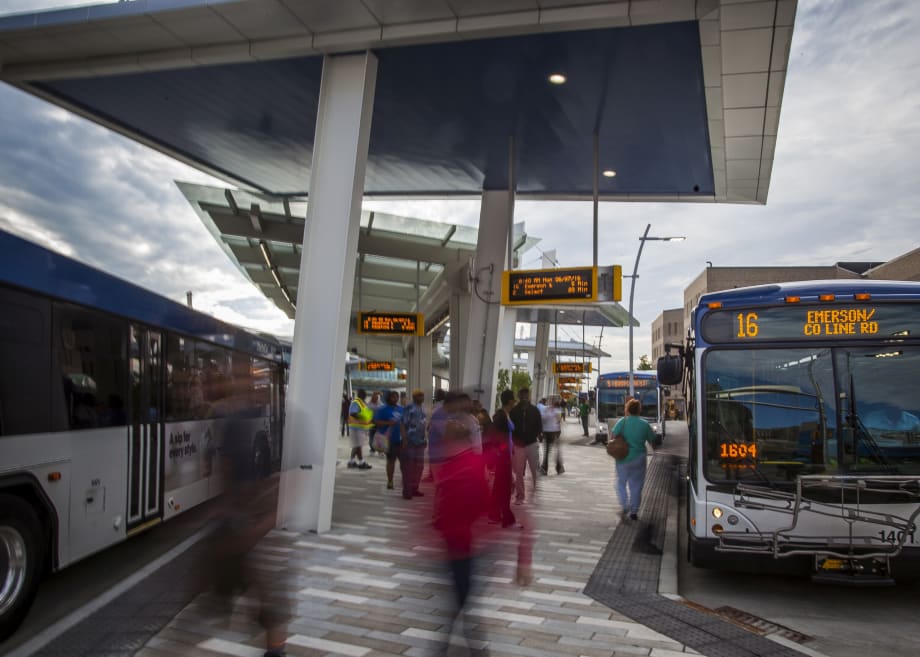
Indianapolis Transit Center. Photos: Axis Architecture and Interiors
Indianapolis Transit Center. Photos: Axis Architecture and Interiors
The Julia M. Carson Transit Center, located in Indianapolis, is more than a bus station. It is a center for riders, cyclists, pedestrians, and passersby, and is the city’s first transportation hub.
Before the $26.5 million transit center opened on June 26, four streets in downtown Indianapolis served as the city’s “hub.” Buses would drive around the “loop,” picking up passengers who were exposed to the elements. Without a transit center, it also was hard for non-riders to view the IndyGo bus system as a viable form of transportation. What the city needed was a place that provided dignity to riders and functioned as a day-to-day piece of the urban environment.
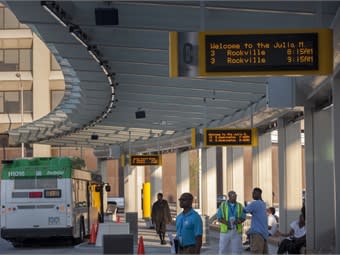
Indianapolis Transit Center. Photos: Axis Architecture and Interiors
Axis Architecture and Interiors designed the transit center — named for U.S. Rep. Julia M. Carson — and collaborated with IndyGo, the mayor’s office, and the former director of the Department of Metropolitan Development for the City of Indianapolis.
“We wanted to promote and enhance the entire experience of a rider,” said Drew White, co-founder of Axis. “[We] had to ensure that a person was never going to be in the elements.”
To protect riders from rain, snow, and sun, Axis constructed canopies over the 19 bus bays. The entire site is also fully accessible by way of ADA-accessible curb ramps, bridges, and flush-finished flooring, which allow for a seamless transition between the interior and exterior spaces.
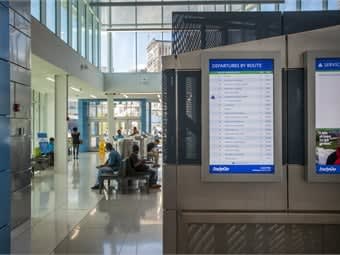
Indianapolis Transit Center. Photos: Axis Architecture and Interiors
The 14,000-square-foot building also has free Wi-Fi and public restrooms — amenities that are often taken for granted. Real-time bus information reduces the number of times a rider asks, “When is my bus going to get here?” And a partnership between IndyGo and the Arts Council of Indianapolis will bring live music and spoken word and performance art to the transit center, as well as at bus stops and on the buses themselves.
On the second floor, there is meeting space for IndyGo, a call center, and a conference room that overlooks the waiting area and the comings and goings of the city’s residents.
“Architecturally, we wanted to make something sculptural, with a lot of natural light,” said White, who described the transit center as “a glass box that rests lightly on the landscape.”
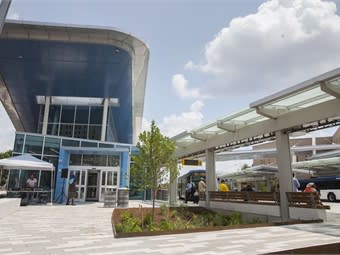
Indianapolis Transit Center. Photos: Axis Architecture and Interiors
The amount of natural light on both the main and upper levels of the transit center reduces the overall need for electricity. Other environmentally friendly features Axis included in their design are solar panels, LED lighting, and the large roof overhang that reduces solar heat gain. High albedo (light-colored) paving and white thermoplastic roofing also reduce the urban “heat island” effect. And recycled materials are used throughout the building, which will be LEED Silver Certified.
The building’s sleek construction — which has been compared to the Indianapolis International Airport — complements the outdoor areas, which include curbside rain gardens, planted trees, and views of the Indianapolis skyline. Like the airport, the transit center serves as a portal to the city. Those who are traveling west on Washington Street are greeted by the transit center’s swooping canopies and modern architecture. In other words, it’s a gateway to downtown, and an amenity that provides an improved mass-transit experience for the people of Indianapolis.
More Bus

New York MTA Plans Largest Bus Fleet Upgrade in More Than a Decade
The agency is seeking manufacturers for 650 new CNG buses to replace aging vehicles, improve reliability, and advance its broader fleet modernization strategy.
Read More →
Building a Flexible Path to Transit Electrification
John Hroncich discusses BAE Systems’ modular and scalable approach, lessons learned from decades of real-world operations, and how agencies can identify electrification strategies that fit their fleets.
Read More →
Bus Tech Talk: Keeping Transit Technicians Ahead of the Technology Curve
LA Metro’s Obed Mejia discusses technician training, evolving maintenance technology, fleet replacement, and strategies for getting the most out of today’s transit fleets.
Read More →
Biz Briefs: RIPTA Unveils New Frontrunners, Clevland RTA Adds New Siemens, and More
In METRO's latest installment, we take a look at recent news from Siemens, Prevost, Dodge, and more partnerships making headlines across the transportation sector.
Read More →
People Movement: Holly Arnold Joins Transdev and More
In this edition, we also cover recent appointments and announcements at Pace, CamTran, MCI, and more, showcasing the individuals helping to shape the future of transportation.
Read More →
The High Cost of Transit Buses: Industry Leaders Look to Procurement Reform
Transit leaders and policymakers examine how standardized bus designs, streamlined procurement, and predictable funding could help agencies stretch budgets and deliver better service.
Read More →
The Business Voice Behind Public Transportation
As chair of APTA’s Business Members Board of Governors, Ray Melleady explains how more than 850 business members are partnering with transit agencies to advance funding, innovation, and industry-wide collaboration.
Read More →
From Surviving to Thriving: Building Stronger Transportation Organizations
Bus Business Consultants founder Brian Dickson shares lessons on leadership, organizational health, and creating options for long-term success in a changing transportation industry.
Read More →
Finding the ‘Happy Medium’: Optimizing Maintenance Without Sacrificing Reliability
The key to maintenance optimization isn’t doing less work—it’s doing the right work at the right time on the right assets.
Read More →
LA Metro, City of West Hollywood, and Partners Advance Smarter Bus Lane Enforcement
The award-winning partnership combines AI-powered detection with human oversight to improve bus reliability, accessibility, and enforcement efficiency.
Read More →