




RELATED: University Transportation Roundtable
Albuquerque Rapid Transit, university partner to upgrade venerable tree grove
As part of the project, the northeast corner of University Boulevard and Central Avenue NE in Albuquerque was redesigned and will be home to ART’s University Station, anticipated to be one of the busiest stations when Albuquerque’s BRT line opens.
May 4, 2017
3 min to read
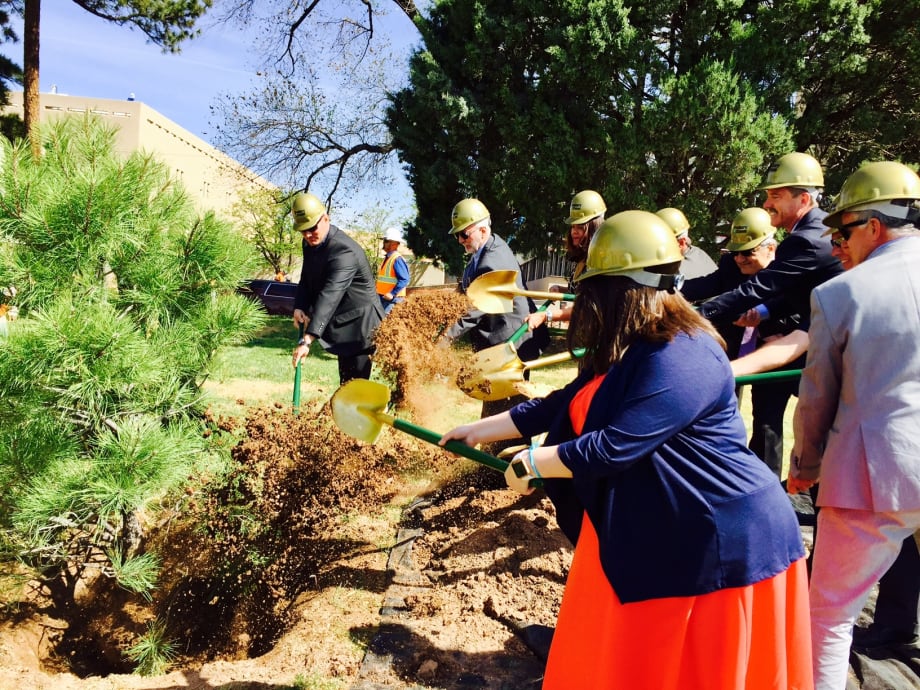
The City of Albuquerque leadership, the Albuquerque Rapid Transit (ART) team, and University of New Mexico’s Acting President Chaouki T. Abdallah threw shovelfuls of soil on the final tree as the historic Tight Grove at the University of New Mexico reopened.
As part of the ART project, the northeast corner of University Boulevard and Central Avenue NE in Albuquerque was redesigned and will be home to ART’s University Station, anticipated to be one of the busiest stations when Albuquerque’s bus rapid transit line opens later this year.
Tight Grove is named after the University of New Mexico’s third president, William G. Tight. In 1903, under his leadership, Tight planted 30 evergreen trees, which are still there today, in the grove that bears his name.
Albuquerque Rapid Transit, via the university and Cornell stations will give university students and faculty another way to get to and from the university and avoid some of the parking challenges many face.
“The ART team worked diligently to design a project that honored the unique aesthetic of each neighborhood while creating beautiful cohesive landscaping that stretches across the city,” commented Mayor Richard Berry. “This station pays homage to our flagship university, establishing an iconic gateway to the campus with easier access for students, facility and visitors to take part in our Lobo pride.”
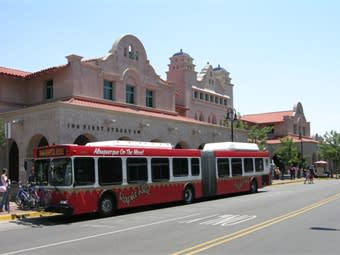
As part of its ongoing, longtime partnership with the University of New Mexico, the City of Albuquerque was also given permission to widen its access for the ART project into university property on westbound Central Avenue NE, approaching University Boulevard. To do so required rebuilding a retaining wall that at some point had reached heights of up to 15 feet. The new setup is actually a series of landscaped terraces that also allows passing motorists and bus passengers to more easily admire the beauty of Tight Grove.
The redesign of the historic Grove is just one of a number of joint projects the City of Albuquerque and the University of New Mexico have collaborated on in recent years. Most recently, the university broke ground on Innovate ABQ in July, 2016. It’s a planned technology and research development hub at Central Avenue NE and Broadway Boulevard.
The $35 million, 160,000 square-foot facility will house the University of New Mexico’s tech-transfer office and Innovation Academy, along with startups and partners designed to bring a bustling, high-tech business zone to the heart of Albuquerque.
The university acquired the property from the former First Baptist Church in 2014 for $6.5 million. It will also house Innovate New Mexico, which includes the state’s research universities and national labs. A 2,000 square-foot space will also be reserved for the Air Force Research Laboratory to open a tech-transfer office.
The project is the centerpiece of what is expected to be a flourishing Downtown Albuquerque, with a huge entertainment center being built nearby and Albuquerque Rapid Transit expected to be a driving force in the redevelopment of the area.
More Bus

New York MTA Plans Largest Bus Fleet Upgrade in More Than a Decade
The agency is seeking manufacturers for 650 new CNG buses to replace aging vehicles, improve reliability, and advance its broader fleet modernization strategy.
Read More →
Building a Flexible Path to Transit Electrification
John Hroncich discusses BAE Systems’ modular and scalable approach, lessons learned from decades of real-world operations, and how agencies can identify electrification strategies that fit their fleets.
Read More →
Bus Tech Talk: Keeping Transit Technicians Ahead of the Technology Curve
LA Metro’s Obed Mejia discusses technician training, evolving maintenance technology, fleet replacement, and strategies for getting the most out of today’s transit fleets.
Read More →
Biz Briefs: RIPTA Unveils New Frontrunners, Clevland RTA Adds New Siemens, and More
In METRO's latest installment, we take a look at recent news from Siemens, Prevost, Dodge, and more partnerships making headlines across the transportation sector.
Read More →
People Movement: Holly Arnold Joins Transdev and More
In this edition, we also cover recent appointments and announcements at Pace, CamTran, MCI, and more, showcasing the individuals helping to shape the future of transportation.
Read More →
The High Cost of Transit Buses: Industry Leaders Look to Procurement Reform
Transit leaders and policymakers examine how standardized bus designs, streamlined procurement, and predictable funding could help agencies stretch budgets and deliver better service.
Read More →
The Business Voice Behind Public Transportation
As chair of APTA’s Business Members Board of Governors, Ray Melleady explains how more than 850 business members are partnering with transit agencies to advance funding, innovation, and industry-wide collaboration.
Read More →
From Surviving to Thriving: Building Stronger Transportation Organizations
Bus Business Consultants founder Brian Dickson shares lessons on leadership, organizational health, and creating options for long-term success in a changing transportation industry.
Read More →
Finding the ‘Happy Medium’: Optimizing Maintenance Without Sacrificing Reliability
The key to maintenance optimization isn’t doing less work—it’s doing the right work at the right time on the right assets.
Read More →
LA Metro, City of West Hollywood, and Partners Advance Smarter Bus Lane Enforcement
The award-winning partnership combines AI-powered detection with human oversight to improve bus reliability, accessibility, and enforcement efficiency.
Read More →