




RELATED: Alstom Revamps LRVs to Meet Evolving Mobility Needs
Alstom inaugurates first Citadis with new charging technology in Nice
Alstom has also commissioned its SRS ground-based static charging technology coupled with the Citadis Ecopack energy storage system.
July 2, 2018
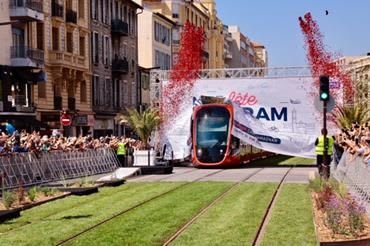
Alstom's Citadis X05 for Métropole Nice Côte d’Azur. Photo: Ville de Nice
2 min to read
Alstom's Citadis X05 for Métropole Nice Côte d’Azur. Photo: Ville de Nice
Alstom commissioned its new-generation tram Citadis X05, complete with its innovative SRS charging system, for the first time on June 30th on the Cadam-Magnan section of new tramway line 2 for the Métropole Nice Côte d’Azur.
The first passengers were able to discover the design, created by Ora Ïto, as well as the travel comfort provided by this new generation of 44-metre-long Citadis trams: 40% window surface, LEDs for soft, homogenous lighting, large individual seats, travel information on extra-wide screens and improved accessibility with double-doors along the entire length of the tram. The innovations of the Citadis X05 also make it easier to operate: passenger capacity has been increased by 10%, with a 20% increase in the passenger exchange rate at stations and a reduction of over 20% in preventive maintenance costs.
For the first time ever, Alstom has also commissioned its SRS ground-based static charging technology coupled with the Citadis Ecopack energy storage system. This system allows the tram to circulate without overhead contact lines throughout the entire journey. SRS automatically charges the tram when stopped at the station during passenger exchange (under 20 seconds), in complete safety. Electricity is stored in the onboard Citadis Ecopack devices, guaranteeing the tram’s autonomy between two charging points. SRS builds on the technical and safety principles of the proven APS solution (trams of Bordeaux, Reims, Dubai).
“A new generation of trams, a new charging system, the Nice tram will also be the first connected tram as of Spring 2019 with a tram-to-ground Wi-Fi communication system,” said Jean-Baptiste Eyméoud, President of Alstom France.
Nine of Alstom's twelve French sites are involved in the design and manufacture of tramway line 2 for the Métropole Nice Côte d’Azur: La Rochelle (studies and tram assembly), Le Creusot (bogies), Ornans (motors), Valenciennes (interior layout), Villeurbanne (on-board electronics, passenger information, tram-to-ground Wi-Fi communication), Aix-en-Provence (speed measurement), Tarbes (traction), Vitrolles (SRS energy charging system) and Saint-Ouen (design coordination, electrical substations).
In total, more than 2,500 Citadis trams have been sold to more than 50 cities in 20 countries.
More Rail

New York MTA Advances Final Contract for Second Avenue Subway Expansion
Contract Four is the largest in the Second Avenue Subway Phase 2 project and includes construction of station infrastructure, tracks, and signals for the subway expansion, MTA officials said. Work on Contract Four will begin in 2027.
Read More →
San Diego MTS Breaks Monthly Trolley Ridership Record
Agency officials said July’s ridership indicates MTS’s continued recovery from the pandemic.
Read More →
Report Examines NJ TRANSIT Reliability, Funding Challenges
The Garden State Initiative analysis examines the roles of Amtrak infrastructure, fleet management, and agency operations while recommending a more performance-based approach to improving reliability.
Read More →
Stadler, CapMetro Sign Long-Term Rail Fleet Support Agreement
Beginning in 2027, Stadler will provide on-site technical expertise, spare parts support, training, and obsolescence management to help extend the reliability and longevity of CapMetro’s GTW fleet.
Read More →
Biz Briefs: Alstom Lands Canadian Contract, LYT to Supply California TSP, and More
In METRO's latest installment, we take a look at recent news from Complete Coach Works, Beep, FlixBus, and more partnerships making headlines across the transportation sector.
Read More →
CATS Gold Line Marks 5 Years of Service, 2.8M Passenger Trips
With a six-mile expansion planned, the Charlotte streetcar is positioned to connect more neighborhoods and major transit hubs across the region.
Read More →
Why Simulating Pedestrian Movement Has Become Essential for Modern Rail Stations
Pedestrian microsimulation is helping rail planners identify bottlenecks, test station designs, and prepare complex transit hubs for growing passenger volumes.
Read More →
Amtrak Begins Major Construction at New York’s Sunnyside Yard
The new maintenance facility will support Amtrak’s Airo trainsets while improving maintenance efficiency and turnaround times in New York.
Read More →
Chicago Leaders Unveil Plans for O’Hare Airport Express Train
The privately developed project would offer a 15-minute trip between downtown and O’Hare’s Terminal 2, with trains operating every 15 minutes on a dedicated track. The service would use battery-electric trains and three existing freight rail rights-of-way.
Read More →
OCTA Maps Out 30-Year Strategy to Protect Coastal Rail Corridor
The draft feasibility report identifies strategies to protect the coastal rail line for decades as the agency continues near-term stabilization and sand placement efforts.
Read More →