



Americans support gas tax hike, spending revenue on public transit, survey says
One of the proposed federal bills, H.R. 1846, would index the gas tax to inflation and create a bi-partisan, bi-cameral transportation commission that would provide long-term funding of the Highway Trust Fund. Another proposed bill, H.R. 680, would increase the gas tax by five cents per year for three years.


Photo: Alexander Rentsch/Flickr

Photo: Alexander Rentsch/Flickr
Americans are willing to pay increased taxes at the gas pump if the revenue is invested in specific transportation improvements, according to the results of a new Mineta Transportation Institute (MTI) national telephone survey. These results indicate that Americans would likely support proposed federal legislation for funding transportation infrastructure.
The Mineta survey was directed by Asha Weinstein Agrawal, PhD, and Hilary Nixon, PhD. The top-line survey results are available at http://bit.ly/1El8aH3, along with a figure showing the support level for each tax option polled.
One of the proposed federal bills, H.R. 1846, would index the gas tax to inflation and create a bi-partisan, bi-cameral transportation commission that would provide long-term funding of the Highway Trust Fund (HTF). Another proposed bill, H.R. 680, would increase the gas tax by five cents per year for three years.
Photo: EROL/Flickr
“Conventional wisdom says that Americans strongly oppose any increase in the federal gas tax,” said Dr. Agrawal. “However, this survey shows that significant majorities want the government to provide better transportation infrastructure, are willing to pay for improvements, and want gas tax revenue spent on public transportation as well as on roads and highways.”
Voters will support targeted purposes
For example, one section of the survey tested whether people would support a ten-cent increase in the federal gas tax, which is currently 18.4 cents per gallon. Only 31% of respondents supported a gas tax increase for general transportation improvements, with no other information given. By contrast, 50% or more supported gas tax increases dedicated to more targeted transportation purposes such as improving maintenance (71% support), improving safety (64%), or reducing local air pollution (52%).
When asked whether or not gas tax revenue should be used to pay for public transit, a near “supermajority” (65%) said yes. This and other survey findings confirm that Americans desire a transportation system that includes good public transit as well as safe and well-maintained roads and highways.

Photo: Patrick Emerson/Flickr
“They envision a transportation future with a multimodal, safe, and well-maintained system,” said Dr. Agrawal. “More than 80% of respondents said that government should prioritize expanding and improving local public transit. Also, 91% want government to improve the safety of the transportation system, and 97% want government to prioritize maintenance of streets, roads, and highways.”
MTI has conducted several similar surveys
The random-digit-dial telephone survey tested national support for federal gas, mileage, and sales tax options to raise revenue for transportation purposes. Multiple variations on the mileage-tax and gas-tax concepts were presented to test relative support levels among the options. Mineta Transportation Institute has conducted similar surveys annually since 2010.
A total of 1,503 adults completed the survey in either English or Spanish between February 26, 2015, and March 31, 2015. For the full sample, which included both land-line and cell-phone numbers, the margin of error was +/- 2.53 percentage points at the 95% confidence level.
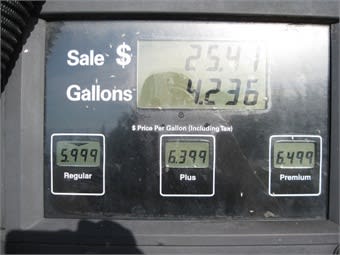
AmeriCo Gas Station in Gorda, Calif. Photo: Charles Hathaway/Flickr
The full research report, to be issued Thursday, June 25, will provide in-depth analysis of the survey results, reviewing trends in support across the six annual surveys, and investigating how the revealed opinions may vary according to respondents’ socio-demographic, political, and travel-behavior characteristics.
More Management

METRO Opens Submissions for 2026 Motorcoach Awards
Nominations are now being accepted for METRO Magazine’s Operator of the Year and Innovative Operator of the Year awards.
Read More →
New York MTA Advances Final Contract for Second Avenue Subway Expansion
Contract Four is the largest in the Second Avenue Subway Phase 2 project and includes construction of station infrastructure, tracks, and signals for the subway expansion, MTA officials said. Work on Contract Four will begin in 2027.
Read More →
Transit Agencies Highlight Safety Gains at National Summit
Leaders from 15 major transit systems shared crime-reduction results and safety initiatives while discussing the role of continued federal support.
Read More →

NITA Names New Leadership, Expands Reduced-Fare Program at First Board Meeting
The new regional transit authority appointed its first board chair and interim executive director while extending reduced fares across CTA, Metra, and Pace for eligible riders.
Read More →
Beyond the Checklist: A Structured Approach to Transit Maintenance
Reliability-Centered Maintenance helps transit agencies move beyond routine checklists to focus limited resources on the assets and failures that have the greatest impact on safety, reliability, and service.
Read More →
APTA 2026 Nominating Committee Selects Leadership Slate, Names Chair and Vice Chair Nominees
Leadership changes will help shape the association’s priorities and its representation of the transportation industry during the 2026–2027 term.
Read More →
DART Launches Major Security, Fare Enforcement Initiative
The 90-day demonstration will deploy coordinated security teams at five light rail stations while testing controlled access and gathering data to guide future investments.
Read More →
Advancing Fare Collection Through Technology and Innovation
Learn about delivering 1300 gates at 91 stations while managing fare evasion. Explore the large scale deployment, solution customization and real-world results that affect the region. Prepare for deployment in your region now.
Read More →
Game Day in Motion: Moving Millions During the 2026 World Cup
Between packed transit stations and team motorcoaches, see how agencies and operators across North America tackled the transportation demands of the 2026 FIFA World Cup.
Read More →
Surface Transportation Extension Averts Shutdown, Leaves Transit Funding Gap
The stopgap keeps federal transportation programs moving, but missing advance funding could complicate the transit and rail projects agencies are planning next.
Read More →