




RELATED: How transit agencies can prepare for a driverless world
Americans would rather drive themselves to work than use AV: Study
Driverless cars aren’t commercially available yet, so people are not familiar with them or may be leery of the technology.
September 17, 2019
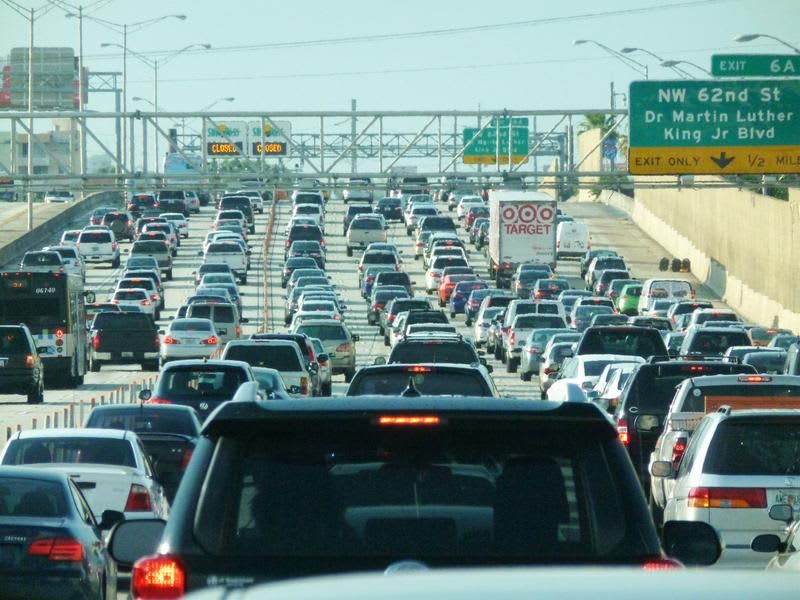
Researchers at the University of Washington studied how Americans’ perceived cost of commute time changes depending on who’s driving.
Public domain
3 min to read
Researchers at the University of Washington studied how Americans’ perceived cost of commute time changes depending on who’s driving.
Public domain
Many Americans use a ride-hailing service — like Uber or Lyft — to get to and from work. It provides the privacy of riding in a personal car and the convenience of catching up on emails or social media during traffic jams. In the future, self-driving vehicles could provide the same service, except without a human driver.
But would consumers be willing to ride in a driverless car?
Researchers at the University of Washington studied how Americans’ perceived cost of commute time changes depending on who’s driving. Through a survey, the team found that people considered a ride-hailing service at least 13% “less expensive,” in terms of time, compared to driving themselves. If the researchers told people the ride-hailing service was driverless, however, then the cost of travel time increased to 15% more than driving a personal car, suggesting that at least for now, people would rather drive themselves than have an autonomous vehicle drive them.
“The idea here is that ‘time is money,’ so the overall cost of driving includes both the direct financial costs and the monetary equivalent of time spent traveling,” said senior author Don MacKenzie, a UW associate professor of civil and environmental engineering who also leads the leads the UW’s Sustainable Transportation Lab. “The average person in our sample would find riding in a driverless car to be more burdensome than driving themselves. This highlights the risks of making forecasts based on how people say they would respond to driverless cars today.”
The team set up a survey that asked people across the continental U.S. to select between a personal car or a ride-hailing service for a 15-mile commute trip. Half the 502 respondents were told that the ride-hailing service was driverless.
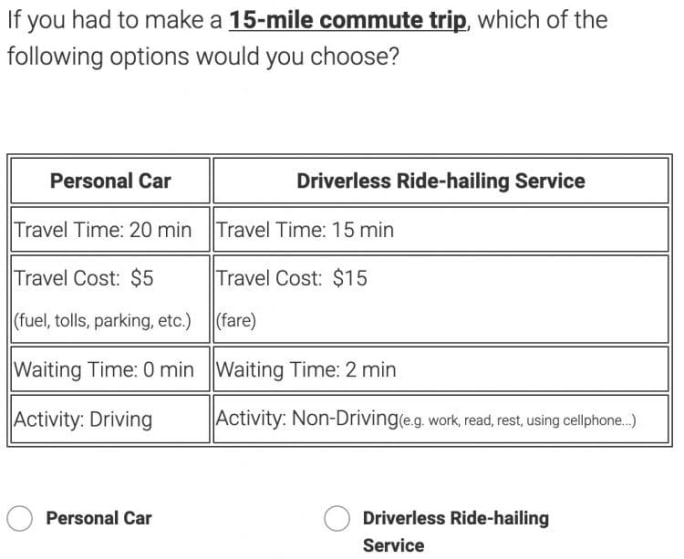
An example survey with details about driving a personal car on the left and details about a ride-hailing service on the right.
The researchers converted the responses to a score of how much respondents deemed that trip would cost per hour.
“If someone values their trip time at $15 per hour, that means they dislike an hour spent traveling as much as they dislike giving up $15,” said co-author Andisheh Ranjbari, a research engineer at the UW’s Supply Chain Transportation & Logistics Center. “So a lower number means that the time spent traveling for that trip is less burdensome.”
On average, respondents preferred a ride-hailing service over driving themselves: Ride-hailing services scored at $21 an hour and driving scored $25 an hour. In addition, if the researchers reminded respondents they could multitask during a ride-hailing service ride, their perceived cost of travel time decreased even more to $13 per hour.
Technically a ride-hailing service should be equally as convenient regardless of whether a human or an autonomous car is driving, but respondents disagreed. Driverless ride-hailing services scored at $28 an hour.
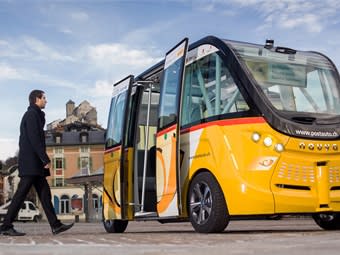
Technically a ride-hailing service should be equally as convenient regardless of whether a human or an autonomous car is driving, but respondents to a recent University of Washington study disagreed.
Navya
These results make sense, according to the team. Driverless cars aren’t commercially available yet, so people are not familiar with them or may be leery of the technology.
“We believe that our respondents are telling us that if they were riding in an automated vehicle today, they would be sufficiently stressed out by the experience that it would be worse than driving themselves,” MacKenzie said. “This is a reminder that automated vehicles will need to offer benefits to consumers before people will adopt them. To a first approximation, a ride-hailing service with driverless cars would need to offer services at a price at least $7 per hour less than human-driven cars, to make the driverless service more attractive.”
More Technology

From Hardware to Digital Partner: Luminator Charts Its Next Chapter
CEO Magnus Friberg discusses Luminator’s shift toward becoming a digital partner, the growing importance of software and interoperability, and how AI can help agencies improve operations and passenger experience.
Read More →
Beyond the Checklist: A Structured Approach to Transit Maintenance
Reliability-Centered Maintenance helps transit agencies move beyond routine checklists to focus limited resources on the assets and failures that have the greatest impact on safety, reliability, and service.
Read More →
NJ TRANSIT Advances Bus Technology Upgrades Across Statewide Fleet
More than 1,500 buses now feature upgraded technology designed to improve arrival predictions and provide free Wi-Fi, with deployment expected to reach nearly 2,000 buses by the end of 2026.
Read More →

Building a Flexible Path to Transit Electrification
John Hroncich discusses BAE Systems’ modular and scalable approach, lessons learned from decades of real-world operations, and how agencies can identify electrification strategies that fit their fleets.
Read More →
Biz Briefs: Alstom Lands Canadian Contract, LYT to Supply California TSP, and More
In METRO's latest installment, we take a look at recent news from Complete Coach Works, Beep, FlixBus, and more partnerships making headlines across the transportation sector.
Read More →
Sponsored•September 8, 2026
From Legacy Silos to Conversational Intelligence
What if transit leaders could ask any operational question and get a trusted answer in seconds? Conversational AI is transforming how agencies use their data.
Read More →
USDOT Announces Rail Vehicle Replacement Grants, Chattanooga AV Shuttle Funding
More than $191 million in federal funding will help three transit agencies replace aging rail vehicles and support a new autonomous shuttle service in Chattanooga.
Read More →
Bus Tech Talk: Keeping Transit Technicians Ahead of the Technology Curve
LA Metro’s Obed Mejia discusses technician training, evolving maintenance technology, fleet replacement, and strategies for getting the most out of today’s transit fleets.
Read More →
Biz Briefs: RIPTA Unveils New Frontrunners, Clevland RTA Adds New Siemens, and More
In METRO's latest installment, we take a look at recent news from Siemens, Prevost, Dodge, and more partnerships making headlines across the transportation sector.
Read More →
Why Simulating Pedestrian Movement Has Become Essential for Modern Rail Stations
Pedestrian microsimulation is helping rail planners identify bottlenecks, test station designs, and prepare complex transit hubs for growing passenger volumes.
Read More →