



Amtrak's next-gen high-speed service plan cuts Northeast Corridor travel time
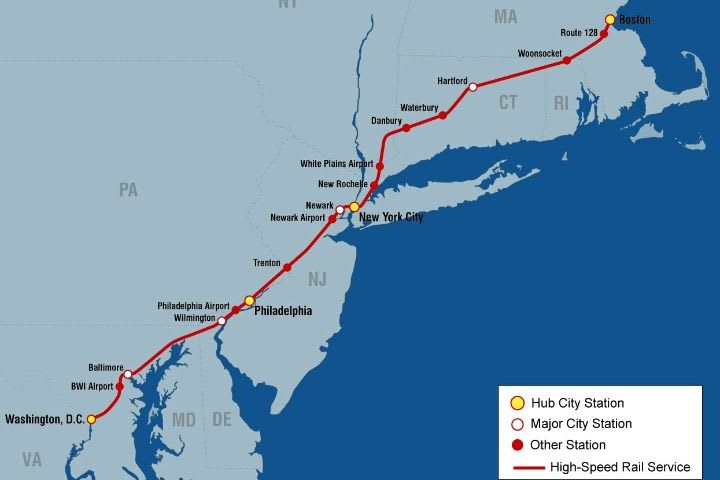
Per an AECOM report, trains would operate at up to 220 miles per hour on a new, dedicated, two-track corridor with a trip time of just under three hours and 30 minutes between Washington and Boston, approximately half the current schedule.

[IMAGE]Amtrak-HSR-Urb-Station-Under-Platform-full-2.jpg[/IMAGE] Amtrak's vision for its next-generation high-speed passenger rail service for the Northeast Corridor would cut the travel time between Washington and Boston to just under three hours and 30 minutes.
To validate its vision, Amtrak engaged AECOM to conduct a comprehensive technical and economic feasibility analysis for high-speed rail service on the Northeast Corridor.
Under the study’s accelerated 12-week schedule, AECOM worked closely with Amtrak staff to deliver a concept plan for a true high-speed rail corridor extending from Washington, D.C., to Boston. Amtrak’s report, A Vision for High-Speed Rail in the Northeast Corridor, confirmed the viability of high-speed rail service in the Northeast. Trains would operate at up to 220 miles per hour on a new, dedicated, two-track corridor with a trip time of just under three hours and 30 minutes between Washington and Boston, approximately half the current schedule.
[IMAGE]Amtrak-HSR-Hub-Station-rev02-full-2.jpg[/IMAGE]
Upon completion in 2040, annual high-speed train ridership in the corridor would approach 18 million passengers and generate an annual operating surplus of approximately $900 million for Amtrak. Under the “Next-Gen HSR Vision,” high-speed rail departures would increase from the current average of one per hour to four per hour in each direction, with additional service in the peak periods.
Total daily high-speed rail departures would increase from 42 today to as many as 148 in 2040. In addition, full system operation in 2040 would utilize only about one third of the system’s capacity, leaving room to expand service sufficiently to accommodate up to 80 million annual high-speed rail passengers compared with 3 million in 2010.
[IMAGE]Amtrak-HSR-Urb-Station-Over-Platform-full-2.jpg[/IMAGE]
“As America’s intercity passenger rail service provider and only high-speed rail operator, Amtrak has established a visionary path forward for high-speed rail passenger service in the United States,” said Thomas Waldron, AECOM vice president, North America director, Transit and Rail. “We were privileged to work at Amtrak’s direction to assess the viability of its vision across the many technical, social, environmental and economic considerations that would need to be addressed as the vision becomes reality.”
“The conceptual study covered the full range of disciplines that would be involved in developing a 426-mile high-speed rail corridor, including planning, infrastructure, alignment, operations, economic, and ridership analysis expertise to prove the engineering feasibility and economic viability of the system,” said Christopher Taylor, AECOM engineering lead for the study. “Working with Amtrak staff, we established the demand for new high-speed rail service in the corridor and identified a potential new route from New York City to Boston that reduced travel time to one hour and 23 minutes, versus the current travel time of three hours and 31 minutes. This almost matched the projected travel time between New York and Washington of one hour and 36 minutes.”
“The study represented a strong test of the broad expertise required to deliver major projects, and specialized expertise in the area of high-speed rail,” said William Crowell, AECOM project manager for the study. “In particular, our colleagues from INOCSA, which has extensive planning, design, and construction management experience with Spain’s high-speed rail program, provided critical input by developing a full conceptual alignment design with typical cross sections, plans and profiles in less than four weeks.”
[IMAGE]Amtrak-nextgen-HSR-map-full-2.jpg[/IMAGE]
This study confirmed that Amtrak’s vision for a true, high-speed Northeast Corridor is feasible from an engineering, operational, and economic perspective. The report serves as a critical first step in Amtrak’s extensive planning and engineering efforts to achieve its long-term vision.
“We applaud Amtrak’s foresight and continuing leadership of U.S. intercity passenger rail service,” said Joseph Pulicare, AECOM executive vice president, North America Transportation. “Through its leadership, Amtrak has provided the framework for the next generation of passenger rail service as well as the resulting economic and social benefits that derive from continuously improved transportation systems.”
A copy of the report is available at www.Amtrak.com.
Click here to learn more about AECOM’s role in the study.
More Rail

New York MTA Advances Final Contract for Second Avenue Subway Expansion
Contract Four is the largest in the Second Avenue Subway Phase 2 project and includes construction of station infrastructure, tracks, and signals for the subway expansion, MTA officials said. Work on Contract Four will begin in 2027.
Read More →
San Diego MTS Breaks Monthly Trolley Ridership Record
Agency officials said July’s ridership indicates MTS’s continued recovery from the pandemic.
Read More →
Report Examines NJ TRANSIT Reliability, Funding Challenges
The Garden State Initiative analysis examines the roles of Amtrak infrastructure, fleet management, and agency operations while recommending a more performance-based approach to improving reliability.
Read More →
Stadler, CapMetro Sign Long-Term Rail Fleet Support Agreement
Beginning in 2027, Stadler will provide on-site technical expertise, spare parts support, training, and obsolescence management to help extend the reliability and longevity of CapMetro’s GTW fleet.
Read More →
Biz Briefs: Alstom Lands Canadian Contract, LYT to Supply California TSP, and More
In METRO's latest installment, we take a look at recent news from Complete Coach Works, Beep, FlixBus, and more partnerships making headlines across the transportation sector.
Read More →
CATS Gold Line Marks 5 Years of Service, 2.8M Passenger Trips
With a six-mile expansion planned, the Charlotte streetcar is positioned to connect more neighborhoods and major transit hubs across the region.
Read More →
Why Simulating Pedestrian Movement Has Become Essential for Modern Rail Stations
Pedestrian microsimulation is helping rail planners identify bottlenecks, test station designs, and prepare complex transit hubs for growing passenger volumes.
Read More →
Amtrak Begins Major Construction at New York’s Sunnyside Yard
The new maintenance facility will support Amtrak’s Airo trainsets while improving maintenance efficiency and turnaround times in New York.
Read More →
Chicago Leaders Unveil Plans for O’Hare Airport Express Train
The privately developed project would offer a 15-minute trip between downtown and O’Hare’s Terminal 2, with trains operating every 15 minutes on a dedicated track. The service would use battery-electric trains and three existing freight rail rights-of-way.
Read More →
OCTA Maps Out 30-Year Strategy to Protect Coastal Rail Corridor
The draft feasibility report identifies strategies to protect the coastal rail line for decades as the agency continues near-term stabilization and sand placement efforts.
Read More →