




Related: SEPTA Fare Collection Gets 'Smart," Retires Tokens
APTA, NFC Forum sign collaboration agreement
Formal Memorandum of Understanding will enable the two organizations to jointly educate the industry on Near Field Communication technologies supporting the needs of public transportation operators.
February 17, 2016
MBTA
2 min to read

MBTA
The American Public Transportation Association (APTA) and the NFC Forum announced a formal Memorandum of Understanding (MOU) that will enable the two organizations to jointly educate the industry on Near Field Communication (NFC) technologies supporting the needs of public transportation operators.
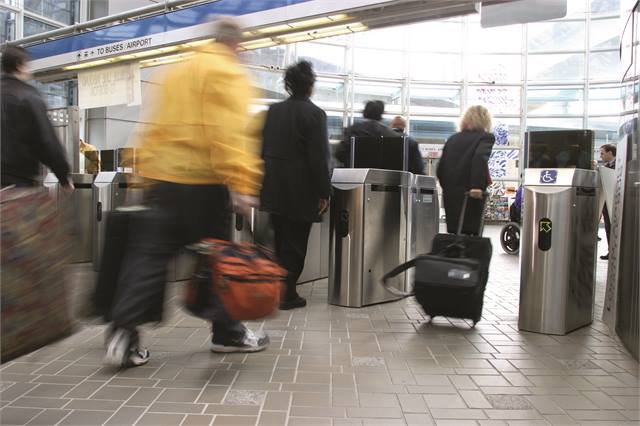
NFC technology has a broad range of use cases. In public transport fare collection, NFC technology provides a wireless connection between mobile devices and wireless readers such as those seen in gated fare collection for public transportation systems. The adoption of NFC will enable a global public transportation environment in which passengers board with unprecedented speed and ease; fare collection and access are handled with accuracy; and the user experience is uniformly positive and consistent from country to country and transit system to transit system.
The use of NFC for public transit ticketing is growing. Recently, New York State announced a plan to support NFC payments for the 11-million-user Metropolitan Transportation Authority, and the UK Cards Assoc. unveiled a framework to implement contactless payments, including NFC, nationwide on all forms of public transit.
Through the MOU, APTA and the NFC Forum will work on joint programs, including training courses, white papers, case study analyses, merchant and transportation customer research, webcasts and hosted events or trade shows. APTA will work with the NFC Forum Transport Special Interest Group (SIG) to define approaches for utilization of NFC technology to address a range of needs, including supporting passenger information systems, ticketing and proof of payment fares.
APTA will also participate in global workshops led by the Transport SIG with leading standards organizations, including the GSM Assoc. (representing mobile operators), CEN/TC278 (the organization promoting Intelligent Transportation Systems), Smart Ticketing Alliance, and public transportation authorities for the purpose of gathering requirements and harmonizing work across the groups.
"NFC will improve the passenger experience by linking passengers with mobile phones and public transit fare payment, and by increasing the opportunities to share digital content to improve the transit passenger convenience," said APTA President and CEO Michael Melaniphy.
Public transportation is a key target market for the NFC Forum. The NFC Forum has been active in promoting the adoption of NFC technology in public transportation, most recently forming an alliance in 2015 with the GSM Assoc., Smart Ticketing Alliance and CEN/TC278 to bring about harmonization of specifications with regard to NFC technology for the public transport industry.
More Management

METRO Opens Submissions for 2026 Motorcoach Awards
Nominations are now being accepted for METRO Magazine’s Operator of the Year and Innovative Operator of the Year awards.
Read More →
New York MTA Advances Final Contract for Second Avenue Subway Expansion
Contract Four is the largest in the Second Avenue Subway Phase 2 project and includes construction of station infrastructure, tracks, and signals for the subway expansion, MTA officials said. Work on Contract Four will begin in 2027.
Read More →
Transit Agencies Highlight Safety Gains at National Summit
Leaders from 15 major transit systems shared crime-reduction results and safety initiatives while discussing the role of continued federal support.
Read More →

NITA Names New Leadership, Expands Reduced-Fare Program at First Board Meeting
The new regional transit authority appointed its first board chair and interim executive director while extending reduced fares across CTA, Metra, and Pace for eligible riders.
Read More →
Beyond the Checklist: A Structured Approach to Transit Maintenance
Reliability-Centered Maintenance helps transit agencies move beyond routine checklists to focus limited resources on the assets and failures that have the greatest impact on safety, reliability, and service.
Read More →
APTA 2026 Nominating Committee Selects Leadership Slate, Names Chair and Vice Chair Nominees
Leadership changes will help shape the association’s priorities and its representation of the transportation industry during the 2026–2027 term.
Read More →
DART Launches Major Security, Fare Enforcement Initiative
The 90-day demonstration will deploy coordinated security teams at five light rail stations while testing controlled access and gathering data to guide future investments.
Read More →
Sponsored•September 9, 2026
Advancing Fare Collection Through Technology and Innovation
Learn about delivering 1300 gates at 91 stations while managing fare evasion. Explore the large scale deployment, solution customization and real-world results that affect the region. Prepare for deployment in your region now.
Read More →
Game Day in Motion: Moving Millions During the 2026 World Cup
Between packed transit stations and team motorcoaches, see how agencies and operators across North America tackled the transportation demands of the 2026 FIFA World Cup.
Read More →
Surface Transportation Extension Averts Shutdown, Leaves Transit Funding Gap
The stopgap keeps federal transportation programs moving, but missing advance funding could complicate the transit and rail projects agencies are planning next.
Read More →