




Related: Transit partners to offer first-, last-mile options
BCycle unveils new smart bike, mobile app and electric bike
The company is the first bike share company to integrate bike share with public transit in the U.S.
October 13, 2016

Photos courtesy BCycle
2 min to read
Photos courtesy BCycle
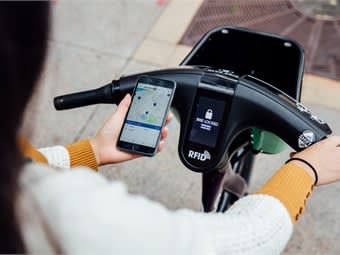
BCycle President Bob Burns introduced a suite of products and software that surround the bike share user and ecosystem during the company's annual BCycle World conference in Madison, Wis.: BCycle Dash, a new smart bike; BCycle Dash +, an electric assist bike share bike; and a new mobile app that unifies bike share, making it easier than ever to incorporate bike share systems into public transit. BCycle is the first bike share company to integrate bike share with public transit in the U.S.
"Bike share should be simple, intuitive, and easy to use," Burns said. "We need to remove barriers for people to be able to access a bike. That is why we introduced these new products and mobile app to help make this possible."
BCycle Dash is an advanced smart bike that puts the rider at the center of the bikeshare experience. Unlike other smart bikes, BCycle Dash incorporates elements that firmly establish bikeshare as a critical component of a city's transit system offerings.
Among its many features, BCycle Dash has the ability to be docked on conventional bike racks, at existing BCycle stations, at its own Dash dock, next to a station, if there are no available docks or anywhere a bike can be docked. The bike also includes a head's up color touchscreen that highlights distance and time traveled, cost spent, and calories burned.
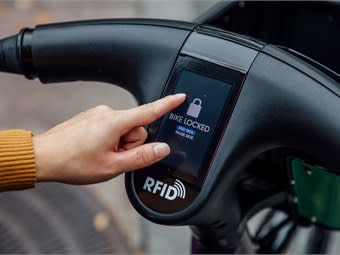
BCycle Dash and BCycle Dash + bikes include a head's up color touchscreen.
In addition, BCycle Dash features turn-by-turn directions that route riders to their destinations via a city's designated bike paths. The directions are clear and easy to read on a moving bicycle — or can be spoken to the rider. The bikes can also be accessed in multiple ways, including phone, fob keys, metro transit cards, and campus identification cards.
BCycle Dash + includes all of the same features as BCycle Dash in a fully-integrated electric assist bike model. The Dash docks can be upgraded to accommodate the electric bike; the bike has a center mounted motor for balance, control, and natural ride; and BCycle Dash + has an integrated lithium-ion battery.
Linking both of these bikes is a world-class mobile app that allows riders to sign up and pay for rides; instantly release the bike by typing the dock number into a mobile device; find out where they are located and where they want to go.
BCycle currently has more than 1,250 stations and 10,200 bikes on the ground in North and South America. All BCycle bikes are designed by Waterloo, Wis.-based Trek.
More New Mobility

From Hardware to Digital Partner: Luminator Charts Its Next Chapter
CEO Magnus Friberg discusses Luminator’s shift toward becoming a digital partner, the growing importance of software and interoperability, and how AI can help agencies improve operations and passenger experience.
Read More →
Biz Briefs: Alstom Lands Canadian Contract, LYT to Supply California TSP, and More
In METRO's latest installment, we take a look at recent news from Complete Coach Works, Beep, FlixBus, and more partnerships making headlines across the transportation sector.
Read More →
CharterUP’s Armir Harris on Technology, AI, and the Future of Group Mobility
In a recent episode of METROspectives, CharterUP Founder/CEO Armir Harris discussed the company’s evolution from an online charter bus marketplace into a technology platform supporting public- and private-sector mobility and much more.
Read More →
Jacksonville’s NAVI Project Charts a New Course for Autonomous Public Transportation
Through its NAVI program, JTA is showing how autonomous vehicles, intelligent infrastructure, and coordinated operations can work together to deliver everyday public transportation.
Read More →
Biz Briefs: Luminator Marks Milestone and More
From manufacturers and suppliers to transit agencies and motorcoach operators, these updates offer a snapshot of the projects, partnerships and business moves driving the industry forward.
Read More →
New Tricks for Old Bureaucracies: Joshua Schank on Making Transit Innovation Stick
Former LA Metro Chief Innovation Officer Joshua Schank discusses why good ideas aren't enough, how transit agencies can overcome resistance to change, and why today's challenges demand more innovation.
Read More →
How DART's GoPass Is Redefining Regional Mobility
Serving 14 transit agencies, GoPass simplifies multimodal travel by allowing riders to plan, pay for, and manage an entire trip through one app.
Read More →
Biz Briefs: OCTA Taps Clean Energy for Hydrogen Station, Stadler to Supply Via Rail Vehicles, and More
From manufacturers and suppliers to transit agencies and motorcoach operators, these updates offer a snapshot of the projects, partnerships and business moves driving the industry forward.
Read More →CharterUP Expands Into New Mobility and Autonomous Transportation
Vice President of New Mobility Stephen Joos discusses how CharterUP is leveraging its nationwide transportation network, technology platform, and autonomous vehicle partnerships to expand into workforce mobility, campus shuttles, and transit solutions.
Read More →
METRO Magazine Announces 2026 Innovative Solutions Awards Winners
Projects Recognized for Advancing Mobility Through Technology, Accessibility, Workforce Innovation, and Operational Excellence
Read More →