



Boston's Commuter Rail Revived Through Rehab
Since Keolis began operation of the commuter rail system, it has worked with the MBTA to revitalize its aging fleet, improve track and infrastructure, and boost revenue and ridership.

The Commuter Rail Maintenance Facility serves as the primary shop for maintaining and repairing the fleet of 410 coach cars and 90 locomotives.
Photos via Janna Starcic
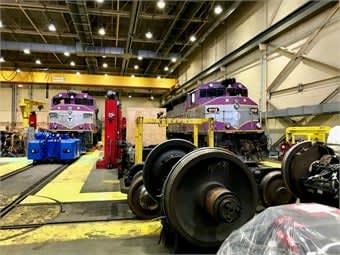
The Commuter Rail Maintenance Facility serves as the primary shop for maintaining and repairing the fleet of 410 coach cars and 90 locomotives.
Photos via Janna Starcic
In July 2104, Keolis Commuter Services (KCS) was awarded an eight-year contract to operate and maintain the Boston-based Massachusetts Bay Transportation Authority's (MBTA) commuter rail system. It is part of a public transport system which also includes bus, metro, trams, and ferries. Since Keolis began operation of the system, it has worked with the MBTA to revitalize its aging fleet, improve track and infrastructure, and boost revenue and ridership.
Challenges to overcome
■ Once Keolis took over the contract, the company began assessing challenges, which included working with a diverse, aging rolling stock fleet that was overdue for overhaul. The unreliable rolling stock combined with poor operational techniques led to decreased system reliability. “The infrastructure suffered from decades of underinvestment and the fleet was also in a very poor state of repair,” says David Scorey, GM/CEO of KCS.
Additionally, union contract rules were outdated and inconsistent with industry norms. According to Scorey, the culture hadn’t evolved in decades, and workforce was not engaged. To that end, Keolis brought in experience and best practices from an international pool to implement their approach. Use of data analysis and action plans have blended really well with action in the field, Scorey explains. “We have made real progress.”
The network was also increasingly paper driven, Scorey adds. Keolis deployed an asset management data system to build historical data on which trends, costs, and labor hours could be planned and based. To improve accountability, shop management was consolidated. The company also introduced Lean Management Techniques in the production shops. In keeping with the implementation of innovative practices and technologies, KCS launched a technologically advanced time clock system that uses biometric scanning to improve the accuracy and ease of timekeeping processes at all Keolis mechanical facilities. The system, in use since 2016, enables employees to clock in and out by swiping their finger and tapping in a personalized PIN number, replacing a badge system.
Maintenance, Operations
■ The Commuter Rail Maintenance Facility serves as the primary shop for maintaining and repairing the commuter rail’s fleet of 410 coach cars and 90 locomotives. Here, coach cars can undergo full overhauls or rebuilds in addition to in-house air brake repair, HVAC repair, and cleaning. The locomotive shop has five tracks for light to medium repairs and partial overhauls. The facility employs 275 employees working three shifts, which results in 22 train-sets serviced and repaired per day.
Keolis’ Cobble Hill railroad operations facility, located in Somerville, Mass., is a multi-functional commuter rail operations center staffed around the clock. It is home to four departments, including training, safety, engineering, and dispatchers. The facility houses the Keolis Emergency Operations Center, a new simulation lab and a number of classrooms and training tools. It employs 140 personnel and is charged with train dispatching for the north side of the network. Additionally, 60 monthly employee training classes are offered at this location.

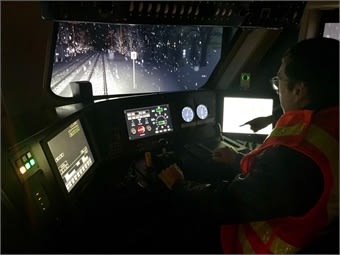
(Top to bottom) Keolis trainees learning how to use track switches. A simulation lab at the Cobble Hill railroad operations facility provides an immersive rail operation experience.
Locomotive overhaul
■ In March of this year, Boston MBTA’s Fiscal and Management Control Board voted to exercise a contract option to initiate the overhaul of 27 additional commuter rail locomotives. Under an existing contract, the MBTA is in the process of overhauling 10 F40 models of the so-called “legacy fleet” of
commuter rail locomotives. The additional overhauls are part of a strategy to improve locomotive reliability in the near term while simultaneously studying ways in which the entire commuter rail network can function in the future.
Originally approved in June 2017, the ongoing contract with Motive Power Inc. returned the first of the overhauled F40s to passenger service in March 2019. The second F40 recently returned to service, while the remaining eight will return on a rolling basis with the all 10 expected to return by the end of August 2019.
The program consists of completely rebuilding and refurbishing the F40 models with additional upgrades, including remote monitoring and diagnostics, forward-facing and cab cameras, and modern brake and control systems.
Other key accomplishments that have been realized since Keolis took over operation of the commuter rail service includes the signing of a revenue-sharing agreement with the MBTA in 2017 that incentivizes ridership growth and modernizes fare collection practices to reduce fare evasion. And, in addition to introducing the MBTA commuter rail app, which is aimed at reducing overcrowding and providing live service alerts, Keolis began using a drone system to help engineers conduct infrastructure inspections.
According to company officials, KCS is performing more repair and capital work on both the network and rolling stock than ever before. On-time performance was 89% in 2017, two points above the previous 10-year average. On average, there are 28 more coaches available daily compared to 2014. In terms of punctuality, KCS is operating 10,000 more scheduled trains annually compared to 2014. In the second quarter of 2018, 96% of trains arrived within 10 minutes of their scheduled time, the highest level in the past four years, according to company data.
More Rail

New York MTA Advances Final Contract for Second Avenue Subway Expansion
Contract Four is the largest in the Second Avenue Subway Phase 2 project and includes construction of station infrastructure, tracks, and signals for the subway expansion, MTA officials said. Work on Contract Four will begin in 2027.
Read More →
San Diego MTS Breaks Monthly Trolley Ridership Record
Agency officials said July’s ridership indicates MTS’s continued recovery from the pandemic.
Read More →
Report Examines NJ TRANSIT Reliability, Funding Challenges
The Garden State Initiative analysis examines the roles of Amtrak infrastructure, fleet management, and agency operations while recommending a more performance-based approach to improving reliability.
Read More →
Stadler, CapMetro Sign Long-Term Rail Fleet Support Agreement
Beginning in 2027, Stadler will provide on-site technical expertise, spare parts support, training, and obsolescence management to help extend the reliability and longevity of CapMetro’s GTW fleet.
Read More →
Biz Briefs: Alstom Lands Canadian Contract, LYT to Supply California TSP, and More
In METRO's latest installment, we take a look at recent news from Complete Coach Works, Beep, FlixBus, and more partnerships making headlines across the transportation sector.
Read More →
CATS Gold Line Marks 5 Years of Service, 2.8M Passenger Trips
With a six-mile expansion planned, the Charlotte streetcar is positioned to connect more neighborhoods and major transit hubs across the region.
Read More →
Why Simulating Pedestrian Movement Has Become Essential for Modern Rail Stations
Pedestrian microsimulation is helping rail planners identify bottlenecks, test station designs, and prepare complex transit hubs for growing passenger volumes.
Read More →
Amtrak Begins Major Construction at New York’s Sunnyside Yard
The new maintenance facility will support Amtrak’s Airo trainsets while improving maintenance efficiency and turnaround times in New York.
Read More →
Chicago Leaders Unveil Plans for O’Hare Airport Express Train
The privately developed project would offer a 15-minute trip between downtown and O’Hare’s Terminal 2, with trains operating every 15 minutes on a dedicated track. The service would use battery-electric trains and three existing freight rail rights-of-way.
Read More →
OCTA Maps Out 30-Year Strategy to Protect Coastal Rail Corridor
The draft feasibility report identifies strategies to protect the coastal rail line for decades as the agency continues near-term stabilization and sand placement efforts.
Read More →