




RELATED: MBTA adopts new fare structure
MBTA releases plan to advance future capital investments
Projects underway include improving real-time arrival information for subway, bus, and commuter rail trains.
March 21, 2019
One important element of the Focus40 Plan identifies three types of areas that need and can support a higher level of transit as "Priority Places."
STV
3 min to read
One important element of the Focus40 Plan identifies three types of areas that need and can support a higher level of transit as "Priority Places."
STV
Boston’s MBTA Fiscal and Management Control Board (FMCB) voted to release Focus40 — a report that establishes an objective process for advancing future capital investments with the goal of positioning the MBTA to meet the region’s needs by 2040.
Focus40 was developed in the context of the MBTA Strategic Plan, which resulted in a forward-looking document. The document was produced following a comprehensive process that factored in scenarios accounting for changes in climate, demographics, and the economy. In addition, the process entailed an extensive data collection and analysis effort, as well as a mechanism for incorporating public feedback.
Focus40 includes several specific capital projects that reflect what the MBTA is doing currently, what is being planned, and what may be done in the future. Projects underway include:
Improving real-time arrival information for subway, bus, and commuter rail trains.
Installing steel doors at the Fenway tunnel portal to protect tracks from flooding.
Replacing the North Station Drawbridge with a modern design that increases the crossing’s capacity.
Replacing the remaining vehicles in the MBTA bus fleet.
Improving the ferry dock at Hewitt’s Cove.
Advancing construction of South Coast Rail, which will lead to passenger service between Boston and the cities of New Bedford and Fall River.
The contents of each of the investment programs in Focus40 reflect a number of strategic priorities, one of which is improving bus service. Bus service improvements will come as a result of efforts to expand the network of dedicated travel space, in addition to the use of new traffic signal technology that favors buses at intersections, and improving the condition of bus shelters.
Other priorities focus on:
Capacity improvements for each rapid transit line.
Investing in “greening" the fleet with vehicles running on different and cleaner fuels.
Making major investments with station improvements, including the initiative underway now at Park Street Station where more than $17 million is being invested in station cleaning, painting, new lighting, updating wayfinding signs to be ADA compliant, and making repairs to benches and the floor areas
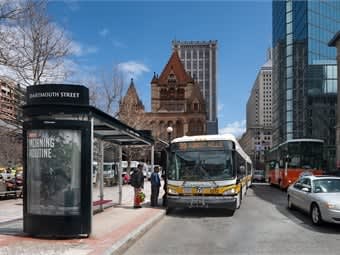
The contents of each of the investment programs in Focus40 reflect a number of strategic priorities, one of which is improving bus service.
MBTA
While some near-term improvements for Commuter Rail are identified in Focus40, the MBTA Rail Vision study is currently underway to evaluate in more detail the capital investment needs for alternative rail service models and system electrification, as well as other possibilities.
One important element of the Focus40 Plan identifies three types of areas that need and can support a higher level of transit as "Priority Places," including major employment districts, inner core communities lacking rapid transit, and urban gateways. Additionally, the plan recognizes today's infrastructure challenges and shifting demographics, changing climate, and evolving technologies that may collectively alter the role the MBTA will play in Greater Boston in the years ahead. Focus40 will be the foundation for decision-making to assist the MBTA in achieving several goals:
Sustainability: Contributing to greenhouse gas reduction goals.
Livability: Improving quality of life with more customer-focused transit options.
Equity and Affordable Housing: Improving mobility options for all — regardless of income or ability, and supporting more affordable housing near high-quality transit.
Economic Competitiveness and Prosperity: Supporting local and regional economic growth and competitiveness.
Focus40’s entire portfolio of recommendations, including the priority investments and the places strategy, are designed to be able to support these goals across a range of potential futures.
To view the full report, click here.
More Management

METRO Opens Submissions for 2026 Motorcoach Awards
Nominations are now being accepted for METRO Magazine’s Operator of the Year and Innovative Operator of the Year awards.
Read More →
New York MTA Advances Final Contract for Second Avenue Subway Expansion
Contract Four is the largest in the Second Avenue Subway Phase 2 project and includes construction of station infrastructure, tracks, and signals for the subway expansion, MTA officials said. Work on Contract Four will begin in 2027.
Read More →
Transit Agencies Highlight Safety Gains at National Summit
Leaders from 15 major transit systems shared crime-reduction results and safety initiatives while discussing the role of continued federal support.
Read More →

NITA Names New Leadership, Expands Reduced-Fare Program at First Board Meeting
The new regional transit authority appointed its first board chair and interim executive director while extending reduced fares across CTA, Metra, and Pace for eligible riders.
Read More →
Beyond the Checklist: A Structured Approach to Transit Maintenance
Reliability-Centered Maintenance helps transit agencies move beyond routine checklists to focus limited resources on the assets and failures that have the greatest impact on safety, reliability, and service.
Read More →
APTA 2026 Nominating Committee Selects Leadership Slate, Names Chair and Vice Chair Nominees
Leadership changes will help shape the association’s priorities and its representation of the transportation industry during the 2026–2027 term.
Read More →
DART Launches Major Security, Fare Enforcement Initiative
The 90-day demonstration will deploy coordinated security teams at five light rail stations while testing controlled access and gathering data to guide future investments.
Read More →
Sponsored•September 9, 2026
Advancing Fare Collection Through Technology and Innovation
Learn about delivering 1300 gates at 91 stations while managing fare evasion. Explore the large scale deployment, solution customization and real-world results that affect the region. Prepare for deployment in your region now.
Read More →
Game Day in Motion: Moving Millions During the 2026 World Cup
Between packed transit stations and team motorcoaches, see how agencies and operators across North America tackled the transportation demands of the 2026 FIFA World Cup.
Read More →
Surface Transportation Extension Averts Shutdown, Leaves Transit Funding Gap
The stopgap keeps federal transportation programs moving, but missing advance funding could complicate the transit and rail projects agencies are planning next.
Read More →