




RELATED: Stantec acquires RNL
Calif.'s Beeline breaks ground on new maintenance facility
RNL, now part of Stantec, provided programming, master planning, architecture, interior design, landscape architecture, and lighting design through Bridging Documents on the 25,000-square foot project, designed to meet and exceed the State of California energy code.
March 8, 2018
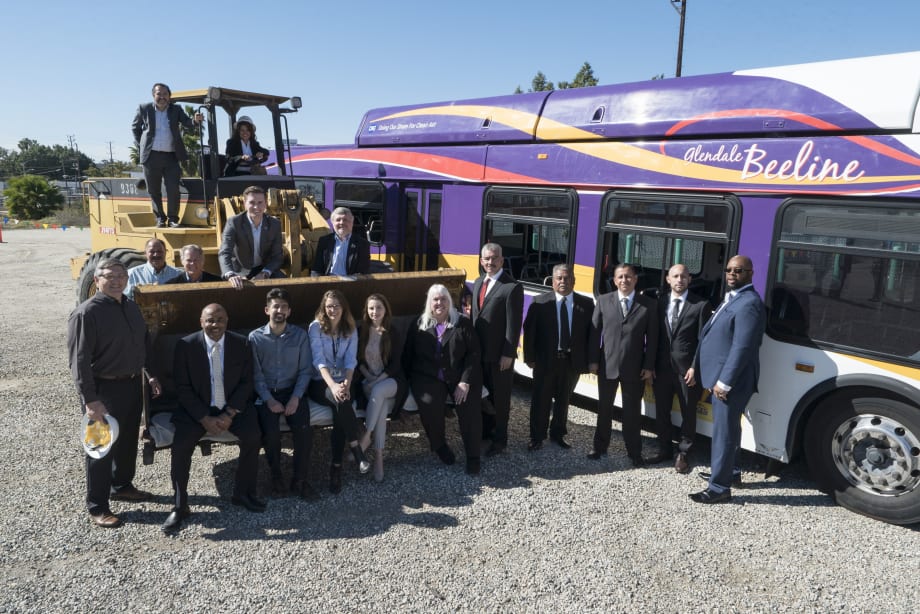
Front Row L-R: Len Sheptock, Arcadis USA; Rudy LeFlore, The LeFlore Group; Shant Mirzaians, Glendale; Alison MacCarley, Glendale, Tatevik Vardanyan, Glendale; Kathryn Engel, Glendale; Jesse Saavedra, MV Transit; Santos Tapia, MV Transit; Nestor Villafuerte, MV Transit; Ramiro Hidalgo, MV Transit; and Fred Hartidge, MV Transit.
Middle Row L-R: David Khalaf , Dorado Design & Construction; Mark Freeman, Dorado Design & Construction; Will Todd, Stantec/RNL; Pat McKelvey, Stantec/RNL.
Back Row L-R: Gabriel Sanchez, Dorado Design & Construction; Violet Nielsen, The LeFlore Group.
City of Glendale
2 min to read
Front Row L-R: Len Sheptock, Arcadis USA; Rudy LeFlore, The LeFlore Group; Shant Mirzaians, Glendale; Alison MacCarley, Glendale, Tatevik Vardanyan, Glendale; Kathryn Engel, Glendale; Jesse Saavedra, MV Transit; Santos Tapia, MV Transit; Nestor Villafuerte, MV Transit; Ramiro Hidalgo, MV Transit; and Fred Hartidge, MV Transit.
Middle Row L-R: David Khalaf , Dorado Design & Construction; Mark Freeman, Dorado Design & Construction; Will Todd, Stantec/RNL; Pat McKelvey, Stantec/RNL.
Back Row L-R: Gabriel Sanchez, Dorado Design & Construction; Violet Nielsen, The LeFlore Group.
City of Glendale
Calif.’s City of Glendale held its official groundbreaking for the Beeline Maintenance Facility, which allows the City to have its first-ever co-located administrative, maintenance, and operations facility to better support its current fleet of 37 buses and nine demand-response vehicles. RNL, now part of Stantec, provided programming, master planning, architecture, interior design, landscape architecture, and lighting design through Bridging Documents on the 25,000-square foot project, designed to meet and exceed the State of California energy code.
“We are thrilled to be breaking ground on this transformational project,” said Kathryn Engel, Transit Manager, City of Glendale. “The City has many constraints on this site and the RNL design team was able to provide all of the functionality we required in a very efficient footprint — there is not an inch of wasted space. The new campus will help us to control operating costs while maintaining outstanding services for our community. RNL, now part of Stantec, utilized an innovative, interactive, and creative approach to make efficient use of the site while allowing for future transit growth.”
The Beeline Maintenance Facility’s contemporary design utilizes high-quality, durable materials, will include exterior sun shading for occupant comfort and energy performance, and is designed to mitigate noise. Sustainable design features include:
The potential for on-site solar energy production.
A convenient location with access to transit and bike facilities.
Rainwater management, heat island reduction, and light pollution reductions.
Water use reduction, water metering, and optimized energy performance.
Indoor air quality, daylighting, and sustainable and healthy building products.
“For us, simply designing the various components of a transit maintenance facility doesn't equal success,” said Patrick M. McKelvey, sr. principal, RNL. “We also need to meet the needs of the people using the facility every day, while designing with community in mind. We are excited for this facility to break ground, which we designed to be a good neighbor to the surrounding community and to push the limits of innovation, operational efficiency, and sustainability.”
The facility is set to open in 2019.
More Management

METRO Opens Submissions for 2026 Motorcoach Awards
Nominations are now being accepted for METRO Magazine’s Operator of the Year and Innovative Operator of the Year awards.
Read More →
New York MTA Advances Final Contract for Second Avenue Subway Expansion
Contract Four is the largest in the Second Avenue Subway Phase 2 project and includes construction of station infrastructure, tracks, and signals for the subway expansion, MTA officials said. Work on Contract Four will begin in 2027.
Read More →
Transit Agencies Highlight Safety Gains at National Summit
Leaders from 15 major transit systems shared crime-reduction results and safety initiatives while discussing the role of continued federal support.
Read More →

NITA Names New Leadership, Expands Reduced-Fare Program at First Board Meeting
The new regional transit authority appointed its first board chair and interim executive director while extending reduced fares across CTA, Metra, and Pace for eligible riders.
Read More →
Beyond the Checklist: A Structured Approach to Transit Maintenance
Reliability-Centered Maintenance helps transit agencies move beyond routine checklists to focus limited resources on the assets and failures that have the greatest impact on safety, reliability, and service.
Read More →
APTA 2026 Nominating Committee Selects Leadership Slate, Names Chair and Vice Chair Nominees
Leadership changes will help shape the association’s priorities and its representation of the transportation industry during the 2026–2027 term.
Read More →
DART Launches Major Security, Fare Enforcement Initiative
The 90-day demonstration will deploy coordinated security teams at five light rail stations while testing controlled access and gathering data to guide future investments.
Read More →
Sponsored•September 9, 2026
Advancing Fare Collection Through Technology and Innovation
Learn about delivering 1300 gates at 91 stations while managing fare evasion. Explore the large scale deployment, solution customization and real-world results that affect the region. Prepare for deployment in your region now.
Read More →
Game Day in Motion: Moving Millions During the 2026 World Cup
Between packed transit stations and team motorcoaches, see how agencies and operators across North America tackled the transportation demands of the 2026 FIFA World Cup.
Read More →
Surface Transportation Extension Averts Shutdown, Leaves Transit Funding Gap
The stopgap keeps federal transportation programs moving, but missing advance funding could complicate the transit and rail projects agencies are planning next.
Read More →