




RELATED: Fare Payment Upgrades Leverage Latest Tech Advancements
Calif.'s Omnitrans introduces Token Transit mobile fare payment app
The transit agency expects that as customers switch from traditional paper passes to mobile fares, it will be able to save on printing and outlet distribution costs.
August 21, 2017
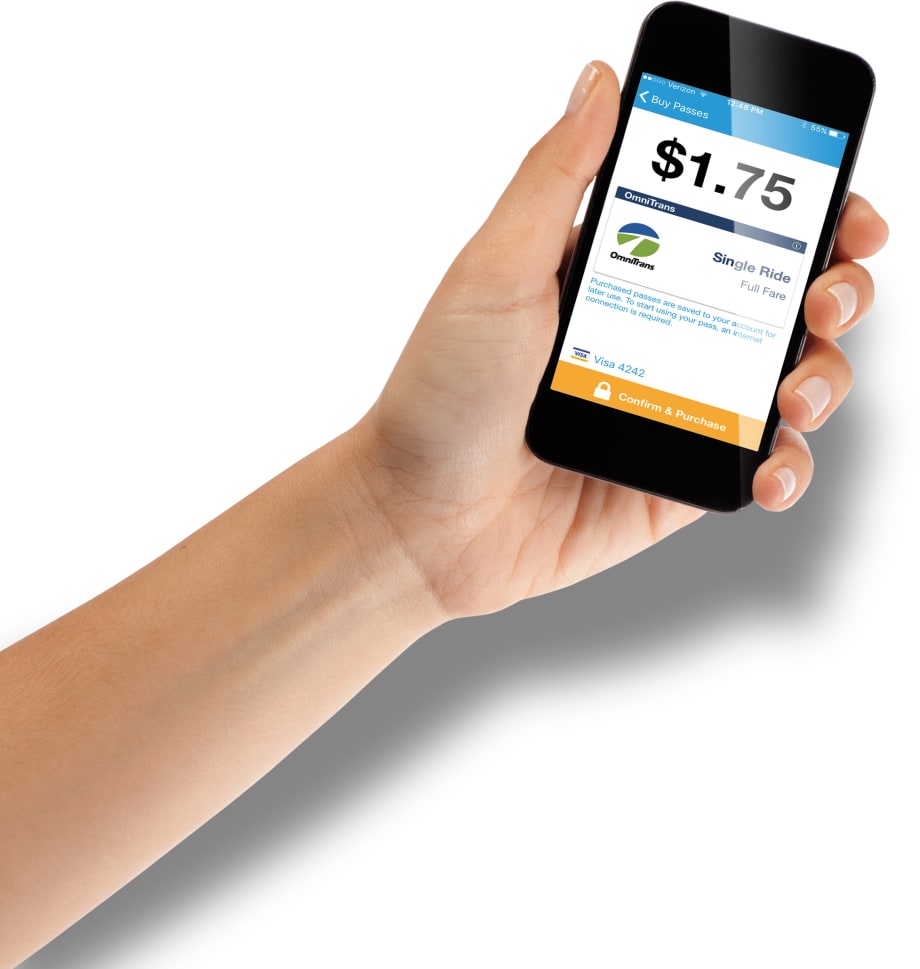
Over 20% of non-riders surveyed in spring 2017 indicated that the ability to pay by phone was an amenity that would entice them to use Omnitrans. Photo: Omnitrans
2 min to read
Over 20% of non-riders surveyed in spring 2017 indicated that the ability to pay by phone was an amenity that would entice them to use Omnitrans. Photo: Omnitrans
San Bernardino Valley, Calif.-based Omnitrans, launched a new mobile fare payment partnership with Token Transit, offering riders the ability to go cashless when purchasing ride passes.
Riders first need to download the free Token Transit app, and then set up an account tied to a credit or debit card. Purchasing and activating a pass takes seconds and riders only need show the driver their phone displaying an active pass to board.
Over 20% of non-riders surveyed in spring 2017 indicated that the ability to pay by phone was an amenity that would entice them to use Omnitrans. The transit agency already offers real-time arrival information and online trip planning via smartphone through the free Omnitrans mobile app and the agency’s mobile-friendly website, www.omnitrans.org.
The Token Transit app is available through Google Play and the App Store. Also, texting “TOKEN” to 41411 will generate a download link.
All fare categories are available for mobile purchase including single-ride, one-day, 7-day, and 31-day passes for full-fare and reduced-fare customers.
“To encourage customers to give it a try, we are offering half off their first 7-day or 31-day pass purchase through December 31 of this year,” said Wendy Williams, Omnitrans director of marketing and planning.
Regular bus fares are $1.75 for a single ride, $5 for a 1-day pass, $18 for a 7-day pass and $55 for a 31-day pass. Discounted fares are offered for seniors age 62 and up, people with disabilities, military veterans, and youth age 18 and under.
Aside from the convenience for customers, on board mobile fare transactions are four to five times quicker than inserting bills and coins into the fare box. This helps keep buses running on time.
Currently, about one-third of Omnitrans boardings involve a cash transaction. The transit agency expects that as customers switch from traditional paper passes to mobile fares, it will be able to save on printing and outlet distribution costs.
More Bus

New York MTA Plans Largest Bus Fleet Upgrade in More Than a Decade
The agency is seeking manufacturers for 650 new CNG buses to replace aging vehicles, improve reliability, and advance its broader fleet modernization strategy.
Read More →
Building a Flexible Path to Transit Electrification
John Hroncich discusses BAE Systems’ modular and scalable approach, lessons learned from decades of real-world operations, and how agencies can identify electrification strategies that fit their fleets.
Read More →
Bus Tech Talk: Keeping Transit Technicians Ahead of the Technology Curve
LA Metro’s Obed Mejia discusses technician training, evolving maintenance technology, fleet replacement, and strategies for getting the most out of today’s transit fleets.
Read More →
Biz Briefs: RIPTA Unveils New Frontrunners, Clevland RTA Adds New Siemens, and More
In METRO's latest installment, we take a look at recent news from Siemens, Prevost, Dodge, and more partnerships making headlines across the transportation sector.
Read More →
People Movement: Holly Arnold Joins Transdev and More
In this edition, we also cover recent appointments and announcements at Pace, CamTran, MCI, and more, showcasing the individuals helping to shape the future of transportation.
Read More →
The High Cost of Transit Buses: Industry Leaders Look to Procurement Reform
Transit leaders and policymakers examine how standardized bus designs, streamlined procurement, and predictable funding could help agencies stretch budgets and deliver better service.
Read More →
The Business Voice Behind Public Transportation
As chair of APTA’s Business Members Board of Governors, Ray Melleady explains how more than 850 business members are partnering with transit agencies to advance funding, innovation, and industry-wide collaboration.
Read More →
From Surviving to Thriving: Building Stronger Transportation Organizations
Bus Business Consultants founder Brian Dickson shares lessons on leadership, organizational health, and creating options for long-term success in a changing transportation industry.
Read More →
Finding the ‘Happy Medium’: Optimizing Maintenance Without Sacrificing Reliability
The key to maintenance optimization isn’t doing less work—it’s doing the right work at the right time on the right assets.
Read More →
LA Metro, City of West Hollywood, and Partners Advance Smarter Bus Lane Enforcement
The award-winning partnership combines AI-powered detection with human oversight to improve bus reliability, accessibility, and enforcement efficiency.
Read More →