



California could lose up to $20B over next 10 years because of COVID-19
The Mineta Transportation Institute study looked just at transportation revenue collected by the state, a package of taxes and fees established by Senate Bill 1 in 2017.

Under a worst-case scenario, a slow economic recovery could cause California to receive 17% less revenue through 2030 than the state would have received without COVID-19.
Steven Pavlov
Under a worst-case scenario, a slow economic recovery could cause California to receive 17% less revenue through 2030 than the state would have received without COVID-19.
Steven Pavlov
California could lose up to $20 billion in transportation revenue over the next 10 years following the COVID-19 pandemic, according to new research released by the Mineta Transportation Institute (MTI).
In the new report, “The Impact of COVID-19 on California Transportation Revenue,” MTI researcher Asha Weinstein Agrawal and UCLA researchers Hannah King and Martin Wachs projected how much revenue will be generated over the next decade by the state taxes on fuel purchases and fees on vehicle ownership. COVID-19 has already reduced those revenues substantially because Californians are driving less and therefore buying less fuel.
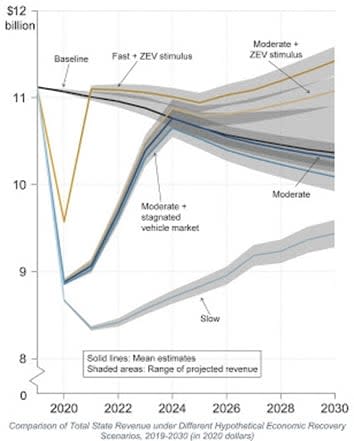
Projected total revenue varied across different economic recovery scenarios tested. “Under a worst-case scenario, a slow economic recovery could cause California to receive 17% less revenue through 2030 than the state would have received without COVID-19,” explained Agrawal, the director of MTI’s National Transportation Finance Center. “The projected revenue for the slow-recovery scenario is $98 billion, compared to a projected $118 had COVID-19 not occurred.”
The study finds that state policy choices could counteract projected revenues shortfalls. King explains that “one hypothetical recovery scenario we tested could generate $121 billion, a 3% revenue gain compared to revenue had COVID-19 not struck.” This scenario assumed a swift and complete economic recovery coupled with policies to encourage Californians to purchase electric vehicles.
“California policymakers are hastily planning for a future with less-than-anticipated revenue,” said Wachs, a Professor Emeritus of Urban Planning at UCLA and researcher at its Institute of Transportation Studies. “The scenarios in this study are not predictions of what will happen, but with so much uncertainty about the future they help policymakers ask important ‘what if’ questions.”
The study looked just at transportation revenue collected by the state, a package of taxes and fees established by Senate Bill 1 in 2017. These are gasoline and diesel fuel taxes, an annual fee on vehicles with the rate based on vehicle value, and an annual fee for zero-emission vehicles (ZEVs).
In addition to these state-generated revenues, transportation funds in California are also raised locally through transit fares, tolls, sales taxes, and property taxes. California also receives federal funding that will be important to a transportation program recovery.
Agrawal explained how shortfalls in state transportation revenue would influence drivers. “Revenue shortfalls will likely result in both reduced maintenance and delayed capital investments. Drivers will have to wait longer for planned improvements like replacing outdated bridges and rehabilitating freeways.”
The researchers constructed five recovery scenarios based on transportation-specific variables that are most likely to be affected by COVID-19, including fuel consumption, the number of registered petroleum-powered and electric vehicles, and the price of cars. They projected potential revenue exploring possible government policies to stimulate the market, like tax credits to incentivize new vehicle purchases. The five recovery scenarios that were compared with a baseline of what was expected before the COVID-19 emergency, are 1) slow, 2) moderate, 3) moderate with a stagnated vehicle market, 4) moderate with an electric-vehicle stimulus, and 5) fast with an electric-vehicle stimulus.
More Management

METRO Opens Submissions for 2026 Motorcoach Awards
Nominations are now being accepted for METRO Magazine’s Operator of the Year and Innovative Operator of the Year awards.
Read More →
New York MTA Advances Final Contract for Second Avenue Subway Expansion
Contract Four is the largest in the Second Avenue Subway Phase 2 project and includes construction of station infrastructure, tracks, and signals for the subway expansion, MTA officials said. Work on Contract Four will begin in 2027.
Read More →
Transit Agencies Highlight Safety Gains at National Summit
Leaders from 15 major transit systems shared crime-reduction results and safety initiatives while discussing the role of continued federal support.
Read More →

NITA Names New Leadership, Expands Reduced-Fare Program at First Board Meeting
The new regional transit authority appointed its first board chair and interim executive director while extending reduced fares across CTA, Metra, and Pace for eligible riders.
Read More →
Beyond the Checklist: A Structured Approach to Transit Maintenance
Reliability-Centered Maintenance helps transit agencies move beyond routine checklists to focus limited resources on the assets and failures that have the greatest impact on safety, reliability, and service.
Read More →
APTA 2026 Nominating Committee Selects Leadership Slate, Names Chair and Vice Chair Nominees
Leadership changes will help shape the association’s priorities and its representation of the transportation industry during the 2026–2027 term.
Read More →
DART Launches Major Security, Fare Enforcement Initiative
The 90-day demonstration will deploy coordinated security teams at five light rail stations while testing controlled access and gathering data to guide future investments.
Read More →
Advancing Fare Collection Through Technology and Innovation
Learn about delivering 1300 gates at 91 stations while managing fare evasion. Explore the large scale deployment, solution customization and real-world results that affect the region. Prepare for deployment in your region now.
Read More →
Game Day in Motion: Moving Millions During the 2026 World Cup
Between packed transit stations and team motorcoaches, see how agencies and operators across North America tackled the transportation demands of the 2026 FIFA World Cup.
Read More →
Surface Transportation Extension Averts Shutdown, Leaves Transit Funding Gap
The stopgap keeps federal transportation programs moving, but missing advance funding could complicate the transit and rail projects agencies are planning next.
Read More →