




RELATED: 'Connected Vehicle Testing Aims to Bolster Bus Safety
Campus' on-demand transit system 'mashes up' Uber, fixed-route, light rail
Passengers could be trying out the new "hub-and-shuttle" system on the University of Michigan's North Campus as soon as summer 2017.
November 7, 2016

Joseph Xu, Michigan Engineering
4 min to read

Joseph Xu, Michigan Engineering
Passengers could be trying out a new urban mobility system on the University of Michigan's North Campus as soon as summer 2017.
Its creators say it could deliver riders to their destinations in as little as half the time of the existing bus system at a lower cost, eventually using a fleet of autonomous shared vehicles. The limited test deployment would likely mark the world's first on-the-ground implementation of such a system.
Called Reinventing Public Urban Transportation and Mobility (RITMO), the proposed system mashes up aspects of Uber-style ridesharing, fixed-route buses, and light rail into a single system called "hub-and-shuttle." It would combine high-frequency buses serving the busiest transportation hubs with a fleet of about 50 on-demand shared shuttles to get riders to and from those hubs.
Passengers would hail rides using a smartphone app that would calculate the most efficient journey for a given destination — it could be a direct shuttle ride from A to B, a shuttle followed by a bus trip or any similar combination. The app would track the progress of each passenger and each vehicle, feeding data to a back-end system that would be optimized in real time to minimize congestion and maximize efficiency.
The on-demand vehicles would have human drivers at first, but the designers hope they would eventually be replaced with autonomous vehicles, lowering costs further, says RITMO lead research Pascal Van Hentenryck, the Seth Bonder Collegiate Professor of Industrial and Operations Engineering at U-M.
Development of the system is funded with a $1.4 million grant from the Michigan Institute for Data Science. If the test deployment is successful, the team plans to expand the system across U-M's campus within a year, to all of Ann Arbor within three years and eventually to the Detroit area as well.
"It's similar in some ways to the ride sharing that's available now, but much more sophisticated," Van Hentenryck said. "Obviously you can't have everyone using something like Uber because that would cause massive congestion. But on-demand hub-and-shuttle can provide some of the convenience of point-to-point travel along with the efficiency of a high-frequency transit system."
The proposed system was inspired by a 2015 study that examined the viability of a similar approach in Canberra, Australia. Led by Van Hentenryck, that project showed that a hub-and-shuttle system would likely cost the same or less than a traditional bus system because fewer fixed-route buses would be required.
"A bus costs many times more than a car, so high-capacity buses often aren't the most efficient way to serve areas where demand is low," he said. "Serving those areas with small, on-demand vehicles would be much more efficient and more convenient for riders."
Van Hentenryck says that if the new system is successful, it could gradually replace U-M's existing fixed-route bus system. The core U-M system would remain free to users, although he believes that riders eventually will be able to choose from several different transportation options for a given journey—some free, some not.
"The app could display several different choices with a range of costs, depending, for instance, on the type of vehicle and the speed of the journey," he said. "It's a way to offer riders more options, and also to avoid overloading the on-demand component."
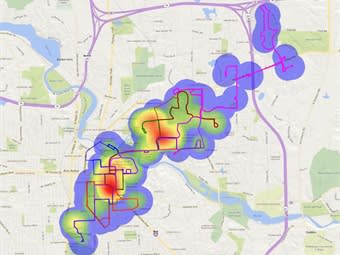
This heatmap shows usage of the current U-M bus system throughout the day. It shows that most usage is concentrated in a few high-traffic areas, while other areas show far less usage. Image
Courtesy of Pascal Van Hentenryck
The key to making it all work, Van Hentenryck says, is data. The team has already begun collecting that data, asking students and staff to volunteer anonymous GPS tracking information through the existing U-M smartphone app. The detailed data will enable them to apply data mining, machine learning, and mathematical optimization techniques to tease out patterns and make predictions about how people move around U-M's campus. They're also using existing data from the U-M and Ann Arbor public transportation systems, as well as demographic and mobility data.
"From a data science standpoint, it's a fascinating optimization problem," Van Hentenryck said. "What are the mobility patterns in Ann Arbor? How do you define the size of the fleets, where do you put the high-frequency buses and how many? Those are the kinds of questions we're answering with the data we collect in this initial part of the study."
The team, which also includes the U-M School of Information and Information Technology Services, hopes to have an initial version up and running by early 2017.
"We're working to build a deep understanding of how people use transportation solutions," said Ceren Budak, assistant professor in the U-M School of Information. "That will help us build transportation planning tools that will be a permanent part of users' mobile lives."
Other U-M departments involved in the project include the U-M Transportation Research Institute, Department of Emergency Medicine, Taubman College of Architecture and Urban Planning, Department of Electrical Engineering and Computer Science, U-M Parking and Transportation Services, and Advanced Research Computing Technology Services. The 2015 study upon which the project is based is titled "Benders decomposition for the design of a hub and shuttle public transit system."
This story was written by Gabriel Cherry from the University of Michigan.
More New Mobility

From Hardware to Digital Partner: Luminator Charts Its Next Chapter
CEO Magnus Friberg discusses Luminator’s shift toward becoming a digital partner, the growing importance of software and interoperability, and how AI can help agencies improve operations and passenger experience.
Read More →
Biz Briefs: Alstom Lands Canadian Contract, LYT to Supply California TSP, and More
In METRO's latest installment, we take a look at recent news from Complete Coach Works, Beep, FlixBus, and more partnerships making headlines across the transportation sector.
Read More →
CharterUP’s Armir Harris on Technology, AI, and the Future of Group Mobility
In a recent episode of METROspectives, CharterUP Founder/CEO Armir Harris discussed the company’s evolution from an online charter bus marketplace into a technology platform supporting public- and private-sector mobility and much more.
Read More →
Jacksonville’s NAVI Project Charts a New Course for Autonomous Public Transportation
Through its NAVI program, JTA is showing how autonomous vehicles, intelligent infrastructure, and coordinated operations can work together to deliver everyday public transportation.
Read More →
Biz Briefs: Luminator Marks Milestone and More
From manufacturers and suppliers to transit agencies and motorcoach operators, these updates offer a snapshot of the projects, partnerships and business moves driving the industry forward.
Read More →
New Tricks for Old Bureaucracies: Joshua Schank on Making Transit Innovation Stick
Former LA Metro Chief Innovation Officer Joshua Schank discusses why good ideas aren't enough, how transit agencies can overcome resistance to change, and why today's challenges demand more innovation.
Read More →
How DART's GoPass Is Redefining Regional Mobility
Serving 14 transit agencies, GoPass simplifies multimodal travel by allowing riders to plan, pay for, and manage an entire trip through one app.
Read More →
Biz Briefs: OCTA Taps Clean Energy for Hydrogen Station, Stadler to Supply Via Rail Vehicles, and More
From manufacturers and suppliers to transit agencies and motorcoach operators, these updates offer a snapshot of the projects, partnerships and business moves driving the industry forward.
Read More →CharterUP Expands Into New Mobility and Autonomous Transportation
Vice President of New Mobility Stephen Joos discusses how CharterUP is leveraging its nationwide transportation network, technology platform, and autonomous vehicle partnerships to expand into workforce mobility, campus shuttles, and transit solutions.
Read More →
METRO Magazine Announces 2026 Innovative Solutions Awards Winners
Projects Recognized for Advancing Mobility Through Technology, Accessibility, Workforce Innovation, and Operational Excellence
Read More →