




RELATED: Smart Cities are critical opportunities for Public Transit
CEOs Discuss Focusing on Behaviors for Better Results
Culture isn’t about results, it’s about behaviors — leadership behaviors, employee behaviors, and customer behaviors. That was the takeaway at the Monday session “Executive Roundtable: Creating World Class Organizations – Leadership, Culture, Trust, Empowerment.”
October 10, 2017
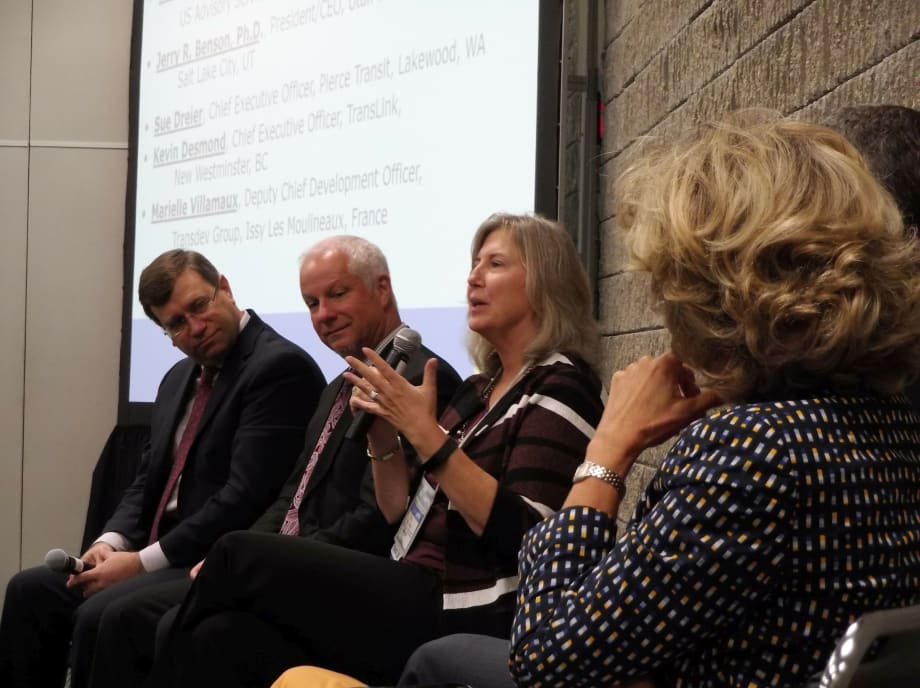
Pierce Transit's Sue Drier (center) and other CEOS from both the public and private sector discussed keys to creating and maintaining a world class organization during the Executive Roundtable at APTA EXPO.
4 min to read
Pierce Transit's Sue Drier (center) and other CEOS from both the public and private sector discussed keys to creating and maintaining a world class organization during the Executive Roundtable at APTA EXPO.
Culture isn’t about results, it’s about behaviors — leadership behaviors, employee behaviors, and customer behaviors. That was the takeaway at the Monday session “Executive Roundtable: Creating World Class Organizations – Leadership, Culture, Trust, Empowerment.”
Five speakers from transit agencies and authorities, and the private sector from multiple countries explained their outlooks on what “culture” means in the transit industry and how to affect change. From ways to boost employee engagement and morale to better leveraging and digging into customer feedback, the speakers emphasized that too many agencies focus on results instead of culture.
“Culture is about behaviors, collective behaviors,” said Eric Roecks, senior VP and CEO, U.S. Advisory Services, WSP USA. Roecks outlined five “needle movers” on how to actually implement a new culture at an organization. First, he said, it’s important to focus on culture ahead of strategy and mechanics, meaning that organizations need to focus on people first. The people make the mechanics happen.
Second, build possible failures into the planning process. Roecks used airport check-in kiosks as an example, citing how there were several failures on the technology and process before United was able to scale. Now, kiosks have drastically changed the check-in process across the industry. In his third and fourth needle-movers, Roecks encouraged leaders to “stay behind the curtain and empower others,” and to be transparent with employees about problems. You never know who might have a unique solution.
Lastly, whether positive or negative events occur, Roecks said to remember that “every detail is a message waiting to be shared.” This means that agencies must be prepared to respond to the negative — and be transparent — but also use the positive as public wins.
From Utah Transit Authority, President/CEO Jerry Benson shared stories of UTA employees stepping up to help do more, such as more detailed “dirty bus” checks. “A high-performing culture is when people are at their best,” he said. But how do you get to a high-performing culture? “One way is to lead with humility and another is to respect every individual — if employees don’t feel like they are respected by top management, they will not share their best ideas,” Benson said, encouraging agencies to objectively look at all their programs, such as rewards programs, and consider what doesn’t align with the preferred company culture.
Benson called behavior the “tip of the iceberg” and that by addressing behavior first, the rest will follow. “Behavior drives culture and culture drives results,” he said, adding that building a high-performance culture is really about “changing who we are as leaders and employees.” He emphasized that the leadership must be sincere in the respect they give employees.
Sue Dreier, CEO of Pierce Transit in Lakewood, WA, gave examples of how the agency has applied much of what Benson described. Pierce has a long list of LEAN strategies that have drastically changed operations, but that it started with the employees. From food truck Fridays and weekly notes of encouragement from leadership to providing college education reimbursement and alternative work schedules, the agency is largely focused on worker happiness. “We are committed to professional growth,” she said.
With a long history in transit, Kevin Desmond, CEO of TransLink in New Westminster, BC, told the audience of TransLink’s mission to change its company culture. He explained how the agency had a poor reputation in the community and how they’ve been working to improve this view. Similar to other speakers, he also emphasized the importance of employee morale and feedback to make change happen.
What was Desmond’s 100-day plan to kickstart change? Be visible, listen, reconnect with stakeholders including employees and customers, and assess organizational strengths and weaknesses. In focusing on “reconnect” and better engaging employees, TransLink has found significant improvement in employee surveys. While there’s still a long way to go, Desmond said, the increase is having a direct impact on customer service.
The last speaker, Marielle Villamaux, deputy chief development officer of TransDev Group out of France, put it well with her “mind the gap” analogy. While the phrase is typically used as a reminder to passengers take caution of the physical gap between the train door and platform, she used it to describe how to take ahold of organizational culture. “Find the gaps in your organization,” she said, adding that this “gap” could be an inconsistency with customer expectations versus customer experience, or a discrepancy between the designed service with actual delivered experience.
Villamaux also encouraged operators to ask, “How much do you measure the customer journey?” To do this she said agencies should create “personas” of every type of rider and have employees go and use the system as though they are that persona. Using herself as an example, her persona would be a French tourist who’s never been to Atlanta. “What are the touchpoints of each customer journey?” she asked, adding, “what are the problems?” Taking the time to map your customer’s journeys allows agencies to address and possibly prevent complaints and inconsistencies.
Overall, the speakers all hit on the same message which is that it starts with happy employees. Because a happy employee is more likely to provide happy customer service.
More Management

METRO Opens Submissions for 2026 Motorcoach Awards
Nominations are now being accepted for METRO Magazine’s Operator of the Year and Innovative Operator of the Year awards.
Read More →
New York MTA Advances Final Contract for Second Avenue Subway Expansion
Contract Four is the largest in the Second Avenue Subway Phase 2 project and includes construction of station infrastructure, tracks, and signals for the subway expansion, MTA officials said. Work on Contract Four will begin in 2027.
Read More →
Transit Agencies Highlight Safety Gains at National Summit
Leaders from 15 major transit systems shared crime-reduction results and safety initiatives while discussing the role of continued federal support.
Read More →

NITA Names New Leadership, Expands Reduced-Fare Program at First Board Meeting
The new regional transit authority appointed its first board chair and interim executive director while extending reduced fares across CTA, Metra, and Pace for eligible riders.
Read More →
Beyond the Checklist: A Structured Approach to Transit Maintenance
Reliability-Centered Maintenance helps transit agencies move beyond routine checklists to focus limited resources on the assets and failures that have the greatest impact on safety, reliability, and service.
Read More →
APTA 2026 Nominating Committee Selects Leadership Slate, Names Chair and Vice Chair Nominees
Leadership changes will help shape the association’s priorities and its representation of the transportation industry during the 2026–2027 term.
Read More →
DART Launches Major Security, Fare Enforcement Initiative
The 90-day demonstration will deploy coordinated security teams at five light rail stations while testing controlled access and gathering data to guide future investments.
Read More →
Sponsored•September 9, 2026
Advancing Fare Collection Through Technology and Innovation
Learn about delivering 1300 gates at 91 stations while managing fare evasion. Explore the large scale deployment, solution customization and real-world results that affect the region. Prepare for deployment in your region now.
Read More →
Game Day in Motion: Moving Millions During the 2026 World Cup
Between packed transit stations and team motorcoaches, see how agencies and operators across North America tackled the transportation demands of the 2026 FIFA World Cup.
Read More →
Surface Transportation Extension Averts Shutdown, Leaves Transit Funding Gap
The stopgap keeps federal transportation programs moving, but missing advance funding could complicate the transit and rail projects agencies are planning next.
Read More →