




Keep Reading: Proposed Chicago Pace Budget Maintains Service, Raises Fares 10%
Chicago’s Pace Caps 2025 With More Service and Launch of VanGo Joliet
The agency boosts mobility with new flexible service, expanded routes, rising ridership, and major federal investment to support sustainable transit in 2026.
December 11, 2025
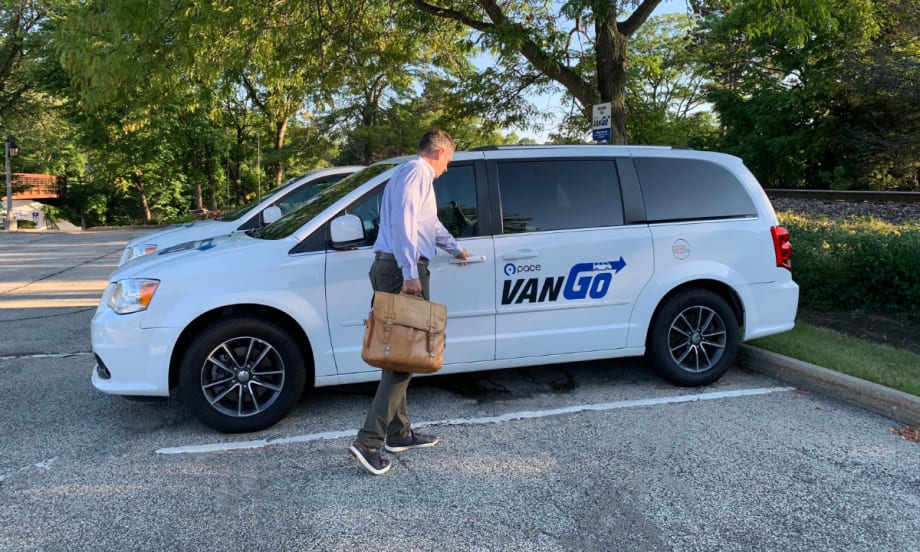
Earlier this month, Pace launched VanGo Joliet, a flexible, reservation-based service designed to close the first- and last-mile gaps for commuters.
Photo: Pace Suburban Bus
2 min to read
Pace Suburban Bus is closing out the year with expanded service and the launch of a new flexible transit option in Joliet.
At a recent meeting of the Pace Board of Directors, Executive Director Melinda Metzger provided several agency updates, including the final round of service improvements for 2025, the launch of VanGo Joliet, and the Federal Transit Administration (FTA) award of a $39,780,000 “Low or No Emission” grant to Pace.
On Dec. 7–8, Pace expanded service on six routes and adjusted schedules on two. Earlier this month, Pace launched VanGo Joliet, a flexible, reservation-based service designed to close the first- and last-mile gaps for commuters. For $5 per day, riders can easily connect with employment centers.
Year-to-date system ridership reached 22.1 million rides, a 4.2% increase systemwide compared to 2024. Pilot service improvements have driven strong growth, with ridership on enhanced routes increasing 13.5% year-over-year.
"This year’s service improvements and the launch of VanGo Joliet show how Pace is adapting to meet the needs of riders today while preparing for the future,” said Chairman Rick Kwasneski. “We’re proud to expand access, improve reliability, and deliver innovative solutions that strengthen communities across our region.”
Pace Sees Grants, Hybrid Buses, and New Express Service
Metzger also discussed the impact of a recent Federal Transit Administration (FTA) Low or No Emission Grant Program. One of the largest federal grants in the agency’s history, the funding will allow Pace to purchase 36 hybrid-electric buses for its West Division in Melrose Park.
"This marks the second consecutive year Pace has received a Low or No Emission grant. In 2024, Pace was awarded $30.9 million to purchase 33 hybrid-electric buses, which began arriving in October 2025," Metzger said. "Together, these investments will reduce greenhouse gas emissions, improve service reliability, and enhance rider comfort."
Metzger also briefed the Board of Directors on a recent open house to gather input on the agency’s I-290/I-88 Express Service Study, which is evaluating potential bus-on-shoulder service connecting the CTA Forest Park Blue Line to Oak Brook and the Schaumburg/Woodfield area.
This study is being conducted in partnership with IDOT and its shoulder improvement project. Community engagement remains critical to shaping corridor investments, and Pace is pleased to see strong interest in this project. Key findings and next steps will be shared early in 2026.
With new services, expanded routes, and historic federal and state investment, Pace ends 2025 on a strong note. The agency remains focused on delivering safe, sustainable, and innovative transit solutions that meet the needs of riders across the region and position Pace for continued growth in 2026.
More Management

Castro to Lead RTC of Southern Nevada and More in People Movement
In this edition, we also cover recent appointments and announcements at the STV, MCI, and more, showcasing the individuals helping to shape the future of transportation.
Read More →
STraffic Expands North American Presence with Fare Collection Technology
John Moon, Associate Director, Product Strategy at STraffic, discusses the company's growth in North America, its efforts to reduce fare evasion, and more.
Read More →
Study: Denver RTD Generates $2.1 Billion in Annual Economic Activity
An economic impact study finds the agency supports approximately 17,500 jobs, delivers $1.6 billion in annual community and mobility benefits, and generates $2.42 in economic value for every dollar invested.
Read More →
Mark Aesch Nominated to Lead Federal Transit Administration
The former Rochester transit chief and TransPro founder, who has also contributed to METRO Magazine, brings decades of industry experience and a focus on performance, accountability, and financial sustainability to the nomination.
Read More →
Best and Worst U.S. Cities for Public Transportation in 2026
A new analysis of 50 major U.S. urban areas ranks public transit systems based on accessibility, affordability, usefulness, and safety, highlighting where transit performs best and where challenges remain.
Read More →
Laketran Cuts Fuel Costs, Boosts Efficiency with Propane-Powered Fleet
The Ohio transit agency is using propane-powered vehicles and on-site fueling infrastructure to cut fuel and maintenance costs while meeting growing demand for paratransit services.
Read More →
Canada’s Public Transit Supports $65.6 Billion in Annual GDP
New research from the Canadian Chamber of Commerce examines transit's economic contributions, including job creation and the financial implications of transportation investment.
Read More →
Pierce Transit Moves to Expand Fleet Following Proposition 1 Approval
The agency authorized the purchase or refurbishment of up to 60 buses to support a 47% service expansion, as voters nationwide approved billions in new transit funding.
Read More →
Right-Sizing Rural Transit: Lessons from North Grenville’s On-Demand Model
A small municipality shows how flexible service, rider needs, and public accountability can expand mobility with limited resources.
Read More →
Transit Ballot Victories Signal Strong Voter Support: What Comes Next?
Voters approved billions in public transportation investments in 2026, giving agencies opportunities to preserve service, expand operations, and strengthen regional connections amid a changing political landscape.
Read More →