




RELATED: Autonomous Vehicles Have Potential to Deliver Array of Benefits
Colorado celebrates 'Connected and Autonomous Vehicle Day'
Declaration reinforces initiatives like Panasonic’s connected vehicle partnership with the Colorado DOT, as well as acknowledge EasyMile for their North American headquarters grand opening.
December 5, 2017
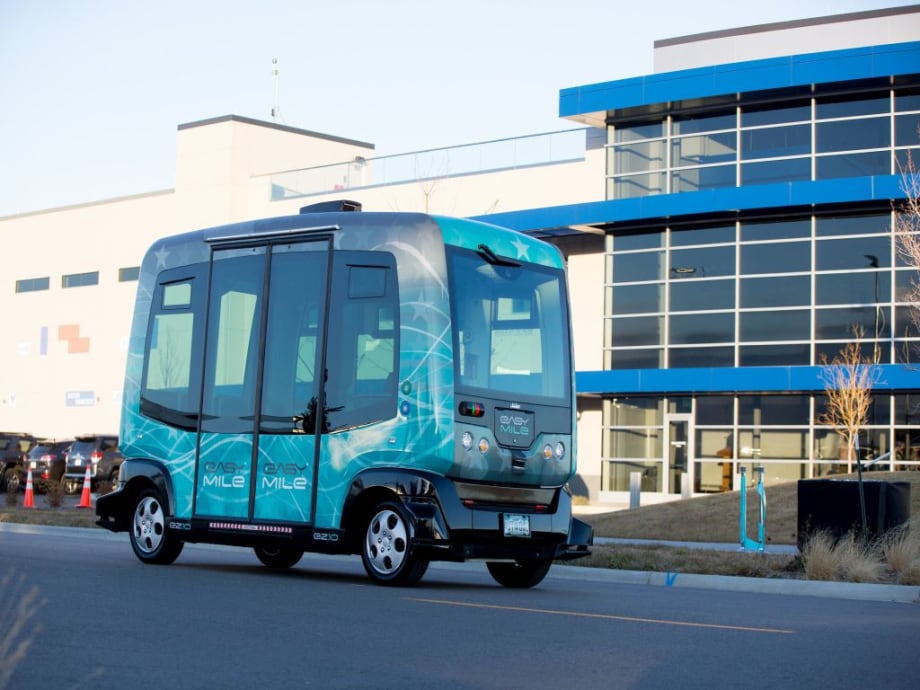
In addition to Panasonic’s connected vehicle technology demonstration, EasyMile highlighted its autonomous shuttle at the Peña Station NEXT development.
2 min to read
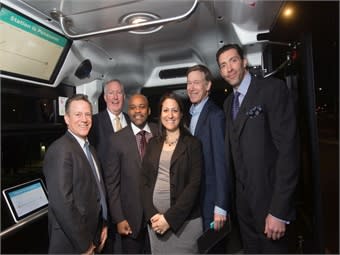
Right to left: RTD’s Dave Genova (Regional Transportation District), PNA’s Jim Doyle, Denver Mayor Michael B. Hancock, EasyMile’s Lauren Isaac, Colorado Governor John Hickenlooper, and PNA’s Jarrett Wendt.
Panasonic welcomed Colorado Gov. John Hickenlooper to its Denver offices, where he proclaimed December 4 as “Connected and Autonomous Vehicle Day” to reinforce initiatives like Panasonic’s connected vehicle partnership with the Colorado Department of Transportation’s (CDOT) RoadX Program, as well as acknowledge EasyMile for their North American headquarters grand opening co-located within the Panasonic building.
“By launching this first-of-its-kind connected vehicle program, we are rapidly leveraging transportation technology to improve safety and mobility on our roadways,” said Gov. Hickenlooper.
Enabled by the autonomous vehicle legislation that State Representatives, Gov. Hickenlooper, and other critical stakeholders recently spearheaded, Panasonic and EasyMile, in coordination with CDOT, the City and County of Denver, and the Regional Transit District, are planning the implementation of an autonomous vehicle technology deployment next to the Panasonic building in spring 2018. The driverless shuttle program will connect RTD’s 61st and Pena Station light rail station to bus routes on Tower Road, to provide a seamless first- and last-mile solution. This implementation will be the first project of its kind in North America.
In addition to Panasonic’s connected vehicle technology demonstration, EasyMile highlighted its autonomous shuttle at the Peña Station NEXT development.
Panasonic marked the milestone yesterday in its alliance with the CDOT, by highlighting its connected vehicle operations center. Gov. Hickenlooper, civic leaders, and select corporate executives were invited to experience an exclusive demonstration of Colorado’s first connected transportation program that shares real-time data across vehicles, infrastructure, and people to improve safety and mobility on the road. Panasonic and CDOT have committed to preparing the statewide deployment of an eco-system of connected cars and autonomous vehicles. This effort, which is already underway, is expected to significantly reduce crashes and injuries, improve traffic flow, and increase capacity of the highway.
In addition to Panasonic’s connected vehicle technology demonstration, EasyMile highlighted its autonomous shuttle at the Peña Station NEXT development. Announced as part of the Dec. 4 proclamation ceremony, the EasyMile shuttle made its inaugural ride to Peña Station, offering a practical application of first- and last-mile connections with existing public transit systems. This unique coordination between EasyMile, RTD, CDOT, City and County of Denver, and Panasonic is one of the first of its kind in the U.S. The route is set to be in service in late Spring/early Summer 2018.
“We selected Denver as our North America headquarters for many reasons: the regulations are very supportive of our technology, we’ve already established partnerships with many Denver-based organizations, including Colorado DOT, RTD, the City and County of Denver, Panasonic and NREL, and there is a wealth of talent to leverage,” said Gilbert Gagnaire, CEO and founder of EasyMile.
More New Mobility

From Hardware to Digital Partner: Luminator Charts Its Next Chapter
CEO Magnus Friberg discusses Luminator’s shift toward becoming a digital partner, the growing importance of software and interoperability, and how AI can help agencies improve operations and passenger experience.
Read More →
Biz Briefs: Alstom Lands Canadian Contract, LYT to Supply California TSP, and More
In METRO's latest installment, we take a look at recent news from Complete Coach Works, Beep, FlixBus, and more partnerships making headlines across the transportation sector.
Read More →
CharterUP’s Armir Harris on Technology, AI, and the Future of Group Mobility
In a recent episode of METROspectives, CharterUP Founder/CEO Armir Harris discussed the company’s evolution from an online charter bus marketplace into a technology platform supporting public- and private-sector mobility and much more.
Read More →
Jacksonville’s NAVI Project Charts a New Course for Autonomous Public Transportation
Through its NAVI program, JTA is showing how autonomous vehicles, intelligent infrastructure, and coordinated operations can work together to deliver everyday public transportation.
Read More →
Biz Briefs: Luminator Marks Milestone and More
From manufacturers and suppliers to transit agencies and motorcoach operators, these updates offer a snapshot of the projects, partnerships and business moves driving the industry forward.
Read More →
New Tricks for Old Bureaucracies: Joshua Schank on Making Transit Innovation Stick
Former LA Metro Chief Innovation Officer Joshua Schank discusses why good ideas aren't enough, how transit agencies can overcome resistance to change, and why today's challenges demand more innovation.
Read More →
How DART's GoPass Is Redefining Regional Mobility
Serving 14 transit agencies, GoPass simplifies multimodal travel by allowing riders to plan, pay for, and manage an entire trip through one app.
Read More →
Biz Briefs: OCTA Taps Clean Energy for Hydrogen Station, Stadler to Supply Via Rail Vehicles, and More
From manufacturers and suppliers to transit agencies and motorcoach operators, these updates offer a snapshot of the projects, partnerships and business moves driving the industry forward.
Read More →CharterUP Expands Into New Mobility and Autonomous Transportation
Vice President of New Mobility Stephen Joos discusses how CharterUP is leveraging its nationwide transportation network, technology platform, and autonomous vehicle partnerships to expand into workforce mobility, campus shuttles, and transit solutions.
Read More →
METRO Magazine Announces 2026 Innovative Solutions Awards Winners
Projects Recognized for Advancing Mobility Through Technology, Accessibility, Workforce Innovation, and Operational Excellence
Read More →