



Cost of building Chinese high-speed rail one-third lower than in other countries
The major factors include the line design speed, topography along the alignment, weather conditions, land acquisition costs, use of viaducts instead of embankments, the construction of major bridges across wide rivers, and the construction of mega stations, according to a World Bank report.

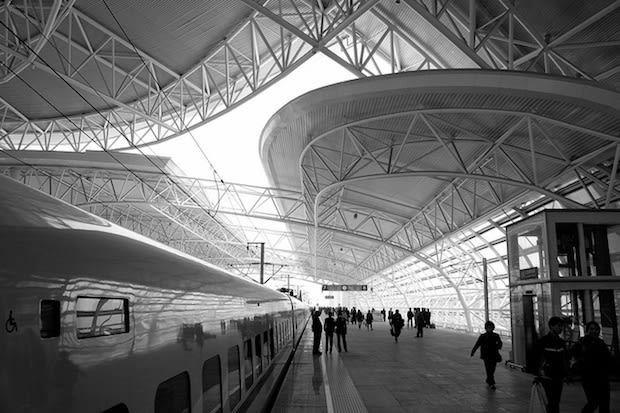
Kunshan South Station by ROSS HONG KONG via Flickr
Kunshan South Station by ROSS HONG KONG via Flickr
BEIJING — By the end of 2013, China had built a high-speed rail network of over 10,000 route-km (6,000 miles), far exceeding that in any other country and larger than the network in the entire European Union. It has been accomplished at a cost which is at most two-thirds of that in other countries, according to a new report.
A new World Bank paper takes a look at this expansion, its construction unit costs and some of its key cost components. It also outlines reasons that may explain the comparatively low cost of high-speed railway construction in China.
According to the paper, "High-Speed Railways in China: A Look at Construction Costs," several factors influence the cost of a high-speed rail project construction. The major factors include the line design speed, topography along the alignment, weather conditions, land acquisition costs, use of viaducts instead of embankments, the construction of major bridges across wide rivers, and the construction of mega stations.
Laying track on viaducts is often preferred in China to minimize resettlement and the use of fertile land as well as to reduce environmental impacts. The estimated cost of viaducts in China ranges from RMB 57 to 73 m/km ($9 to $12 million U.S.) for a double-track line. Such costs are kept low through standardization of the design and manufacturing process for casting and laying bridge beams on viaducts.
Special bridges that cross large navigable rivers or that need to accommodate special topographic features like mountains have much higher cost per kilometer than that of a regular viaduct. Usually such bridges represent a small percentage of the total number of bridges. Projects having larger proportion of special bridges tend to have a high unit cost.
Railway stations play a dual role as transport hubs and urban centers. Small stations (3,000 sq m station building) cost about RMB 40 million ($6.5 million) and account for 1.0 to 1.5% of the total project cost, while mega stations may cost up to RMB 13 billion ($2 billion) and are frequently built as independent projects.
The paper notes that construction cost of high-speed rail in China tends to be lower than in other countries. China’s high-speed rail with a maximum speed of 350 km/h has a typical infrastructure unit cost of about US$ 17 to 21 million per km, with a high ratio of viaducts and tunnels, as compared with US$25-39 million per km in Europe and as high as US$ 56 million per km currently estimated in California.
“China has accomplished a remarkable feat in building over 10,000 km of high-speed railway network in a period of six to seven years at a unit cost that is lower than the cost of similar projects in other countries,” said Gerald Ollivier, a World Bank Senior Transport Specialist and co-author of the paper. “Besides the lower cost of labor in China, one possible reason for this is the large scale of the high speed railway network planned in China. This has allowed the standardization of the design of various construction elements, the development of innovative and competitive capacity for manufacture of equipment and construction and the amortization of the capital cost of construction equipment over a number of projects.”
This paper is the ninth of a series of papers on transport topics produced by the World Bank in Beijing. The World Bank has supported six railway projects with speeds ranging from 200 km/h to 350 km/h in China.
More Management

METRO Opens Submissions for 2026 Motorcoach Awards
Nominations are now being accepted for METRO Magazine’s Operator of the Year and Innovative Operator of the Year awards.
Read More →
New York MTA Advances Final Contract for Second Avenue Subway Expansion
Contract Four is the largest in the Second Avenue Subway Phase 2 project and includes construction of station infrastructure, tracks, and signals for the subway expansion, MTA officials said. Work on Contract Four will begin in 2027.
Read More →
Transit Agencies Highlight Safety Gains at National Summit
Leaders from 15 major transit systems shared crime-reduction results and safety initiatives while discussing the role of continued federal support.
Read More →

NITA Names New Leadership, Expands Reduced-Fare Program at First Board Meeting
The new regional transit authority appointed its first board chair and interim executive director while extending reduced fares across CTA, Metra, and Pace for eligible riders.
Read More →
Beyond the Checklist: A Structured Approach to Transit Maintenance
Reliability-Centered Maintenance helps transit agencies move beyond routine checklists to focus limited resources on the assets and failures that have the greatest impact on safety, reliability, and service.
Read More →
APTA 2026 Nominating Committee Selects Leadership Slate, Names Chair and Vice Chair Nominees
Leadership changes will help shape the association’s priorities and its representation of the transportation industry during the 2026–2027 term.
Read More →
DART Launches Major Security, Fare Enforcement Initiative
The 90-day demonstration will deploy coordinated security teams at five light rail stations while testing controlled access and gathering data to guide future investments.
Read More →
Advancing Fare Collection Through Technology and Innovation
Learn about delivering 1300 gates at 91 stations while managing fare evasion. Explore the large scale deployment, solution customization and real-world results that affect the region. Prepare for deployment in your region now.
Read More →
Game Day in Motion: Moving Millions During the 2026 World Cup
Between packed transit stations and team motorcoaches, see how agencies and operators across North America tackled the transportation demands of the 2026 FIFA World Cup.
Read More →
Surface Transportation Extension Averts Shutdown, Leaves Transit Funding Gap
The stopgap keeps federal transportation programs moving, but missing advance funding could complicate the transit and rail projects agencies are planning next.
Read More →