



DeMartino steps down as CEO of San Joaquin RTD
Has accepted the position of managing director of rail agency that manages Amtrak's Pacific Surfliner intercity passenger rail service.

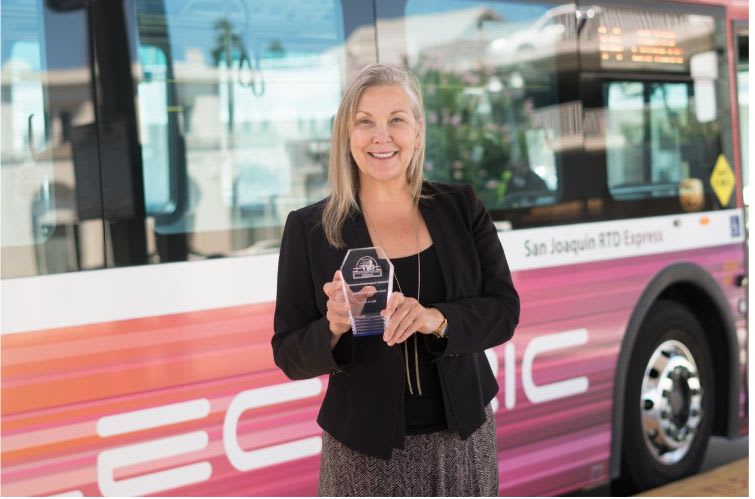
“Professionally, I have accomplished everything I had envisioned for RTD and more,” said Donna DeMartino of her role as CEO of San Joaquin RTD.
SJRTD
“Professionally, I have accomplished everything I had envisioned for RTD and more,” said Donna DeMartino of her role as CEO of San Joaquin RTD.
SJRTD
Donna DeMartino is stepping down from her position of CEO at San Joaquin Regional Transit District in late January after 19 years of service at the California-based agency.
DeMartino has accepted the position of Managing Director of Los Angeles-San Diego-San Luis Obispo (LOSSAN) Rail Corridor Agency, a joint powers authority that has management responsibility for the state-supported Pacific Surfliner intercity passenger rail service. The 351-mile LOSSAN Corridor travels through a six-county coastal region in Southern California and is the second-busiest intercity passenger rail corridor in the U.S. and the busiest state-supported Amtrak route.
The RTD Board announced that it will begin contract discussions with Gloria Salazar, Deputy CEO at RTD, to assume the role of CEO after DeMartino’s departure in January. The Board also announced its support of Kimberly Gayle as Deputy CEO/Chief of Staff.
Notable successes and achievements under DeMartino’s leadership:
Led environmentally important fleet changes, testing some of the first diesel-electric hybrid and all-electric buses in the state, ultimately converting the entire Stockton Metropolitan Area (SMA) fleet to all hybrid and electric buses.
Designed and funded important facilities upgrades, including the construction of a new Downtown Transit Center, a new Regional Transportation Center, and several major passenger transferlocations. RTD was able to make these long-term infrastructure investments in the community by successfully competing for and obtaining over $175 million in federal and state grants and without incurring any debt for RTD.
Implemented important service changes, in particular by introducing five high-capacity bus rapid transit (BRT) corridors; city and countywide deviated fixed-route Hoppers; partnerships with United Cerebral Palsy, taxi providers, and most recently UBER to deliver ADA and general public transit services in a more cost-effective manner. Introduced Van Go!—an innovative ride sharing service.
Initiated a partnership with SUSD to provide free transportation for all 7th–12thgrade students.
Led the agency to win multiple awards and recognitions, including the 2018 Outstanding Public Transportation System Achievement –American Public Transportation Association (APTA); Women's Transportation Seminar (WTS) Innovative Transportation Solution Award; California Transportation Foundation (CTF) Sustainable Transportation/Environmental Award.
“Professionally, I have accomplished everything I had envisioned for RTD and more,” said DeMartino. “Together we have made important infrastructure investments that will serve this community for decades. It has been a great ride, and I am proud to be leaving RTD in a very strong state of repair and with extraordinary alliances and support from our local, state, and federal representatives and regulatory partners. I am thankful for this amazing opportunity.”
More Management

METRO Opens Submissions for 2026 Motorcoach Awards
Nominations are now being accepted for METRO Magazine’s Operator of the Year and Innovative Operator of the Year awards.
Read More →
New York MTA Advances Final Contract for Second Avenue Subway Expansion
Contract Four is the largest in the Second Avenue Subway Phase 2 project and includes construction of station infrastructure, tracks, and signals for the subway expansion, MTA officials said. Work on Contract Four will begin in 2027.
Read More →
Transit Agencies Highlight Safety Gains at National Summit
Leaders from 15 major transit systems shared crime-reduction results and safety initiatives while discussing the role of continued federal support.
Read More →

NITA Names New Leadership, Expands Reduced-Fare Program at First Board Meeting
The new regional transit authority appointed its first board chair and interim executive director while extending reduced fares across CTA, Metra, and Pace for eligible riders.
Read More →
Beyond the Checklist: A Structured Approach to Transit Maintenance
Reliability-Centered Maintenance helps transit agencies move beyond routine checklists to focus limited resources on the assets and failures that have the greatest impact on safety, reliability, and service.
Read More →
APTA 2026 Nominating Committee Selects Leadership Slate, Names Chair and Vice Chair Nominees
Leadership changes will help shape the association’s priorities and its representation of the transportation industry during the 2026–2027 term.
Read More →
DART Launches Major Security, Fare Enforcement Initiative
The 90-day demonstration will deploy coordinated security teams at five light rail stations while testing controlled access and gathering data to guide future investments.
Read More →
Advancing Fare Collection Through Technology and Innovation
Learn about delivering 1300 gates at 91 stations while managing fare evasion. Explore the large scale deployment, solution customization and real-world results that affect the region. Prepare for deployment in your region now.
Read More →
Game Day in Motion: Moving Millions During the 2026 World Cup
Between packed transit stations and team motorcoaches, see how agencies and operators across North America tackled the transportation demands of the 2026 FIFA World Cup.
Read More →
Surface Transportation Extension Averts Shutdown, Leaves Transit Funding Gap
The stopgap keeps federal transportation programs moving, but missing advance funding could complicate the transit and rail projects agencies are planning next.
Read More →