



Denver RTD Unveils ‘Zero Fare for Better Air’ Final Report
RTD was able to support the ridership increase without incurring significant costs related to increased service demand.

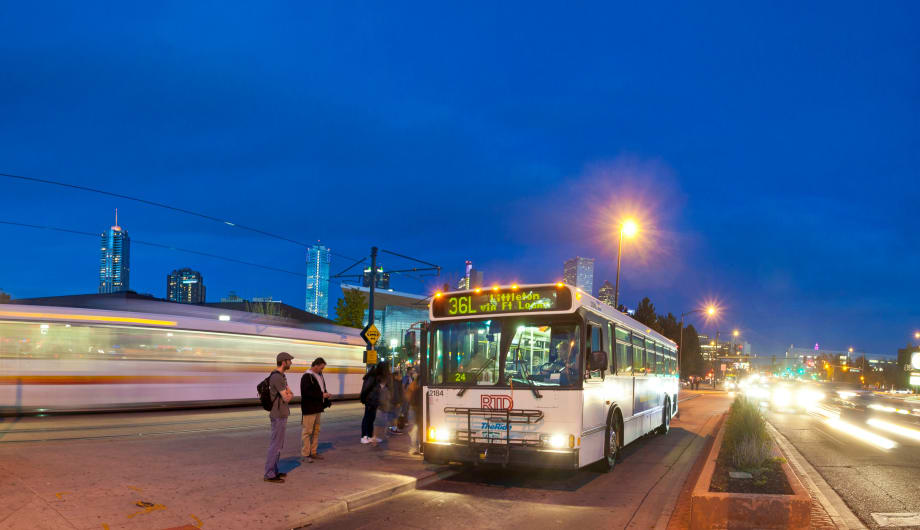
RTD’s buses saw the largest increase, with a 23.4% increase over July and a 33.3% increase over August 2021.
Denver RTD
During the Denver Regional Transportation District (RTD) ’s inaugural Zero Fare for Better Air (ZFBA) period in August, transit ridership increased systemwide, but catalysts for these results are unclear, according to the agency.
RTD was able to support the ridership increase without incurring significant costs related to increased service demand. The program did not yield significant operating impacts, nor did it lead to a major increase in quality of life or crime incidents on RTD services. And, the impacts of the initiative on air quality are difficult to quantify, as there was no baseline provided.
These are a few of the outcomes resulting from the monthlong ZFBA period, detailed in a final report submitted to the Colorado Energy Office as a requirement of the Ozone Season Free Transit Grant Program created in Colorado Senate Bill 22-180. The initiative is designed to reduce ground-level ozone by increasing the use of public transit across the state.
The grant program provides funding to recover up to 80% of the lost fare revenue and other costs incurred by RTD if fares are offered at no cost to customers for at least 30 days during ozone season in 2022 and 2023. RTD provided zero-fare service on all transit modes — bus, rail, paratransit, and microtransit — during Colorado’s highest ozone month, August. The total cost to RTD associated with the initiative during that month was approximately $10.3 million.
The analysis assesses the impact of the program on ridership, revenue and costs, operations, and customers. It evaluates operational impacts that include overcrowding, on-time performance, and impact on RTD’s frontline employees. It also includes recommendations for RTD staff should the ZFBA initiative be continued next year.
RTD GM and CEO Debra A. Johnson affirmed the agency’s commitment to environmental stewardship when she announced the initiative in June. This week, she noted that the agency’s overall experience was positive, with customers saying they appreciated the zero-fare period and there being minimal disruptions to day-to-day operations. She called the initiative an example of working with the General Assembly and administration to implement a successful partnership. She cautioned that drawing conclusions on the success of a one-month pilot is challenging, as transit trends and data are influenced by seasonal factors, such as vacations and the resumption of the school year, in addition to persisting pandemic impacts and large scheduled events.
“The data that were gathered provide a snapshot into various potential and experienced impacts across the agency’s services, all of which will help RTD garner a better understanding of customer behavior and how to approach future zero fare periods that extend beyond a day or two,” Johnson said, referencing the agency’s most recent election-related zero fare days this fall. “The purpose of public transit lies in the value it provides, and RTD’s participation in this initiative enabled customers to experience the value of our services, whether their travel habits changed for a day, a month or the whole of the pandemic.”
Highlights from the report are noted within the following categories:
Ridership impacts
Overall ridership increased by 22% from July 2022 to August 2022, and 36% from August 2021.
Average weekday daily ridership increased 19.9% in August compared with July and increased 32.4% as compared with August 2021.
RTD’s buses saw the largest increase, with a 23.4% increase over July and a 33.3% increase over August 2021.
Light rail and commuter rail ridership increases were more modest from July 2022 to August 2022, at 15.1% and 12.1%, respectively.
Much of RTD’s ridership growth observed in August 2022 was sustained into September 2022, even with the resumption of fare collection.
Ridership increased during the ZFBA period across all RTD’s complementary paratransit services, including Access-a-Ride, Access-a-Cab, and the Uber-based Access-on-Demand service.
Revenue and cost impacts
The single largest financial impact associated with ZFBA was forgone fare revenue, in the amount of $9,267,964 (based upon revenue forecasts and historical ridership data).
While staff anticipated the need for additional security and cleaning services in response to increased demand as a result of ZFBA, no such costs were incurred, largely due to workforce constraints.
Operational impacts
While ZFBA increased bus ridership and resulted in higher onboard passenger loads, it did not result in widespread overcrowding.
At no point in the review period of the impact analysis (August 2019 through September 2022) did rail trips experience maximum loads at or above 100% of planned capacity.
To read the full report, click here.
More Management

METRO Opens Submissions for 2026 Motorcoach Awards
Nominations are now being accepted for METRO Magazine’s Operator of the Year and Innovative Operator of the Year awards.
Read More →
New York MTA Advances Final Contract for Second Avenue Subway Expansion
Contract Four is the largest in the Second Avenue Subway Phase 2 project and includes construction of station infrastructure, tracks, and signals for the subway expansion, MTA officials said. Work on Contract Four will begin in 2027.
Read More →
Transit Agencies Highlight Safety Gains at National Summit
Leaders from 15 major transit systems shared crime-reduction results and safety initiatives while discussing the role of continued federal support.
Read More →

NITA Names New Leadership, Expands Reduced-Fare Program at First Board Meeting
The new regional transit authority appointed its first board chair and interim executive director while extending reduced fares across CTA, Metra, and Pace for eligible riders.
Read More →
Beyond the Checklist: A Structured Approach to Transit Maintenance
Reliability-Centered Maintenance helps transit agencies move beyond routine checklists to focus limited resources on the assets and failures that have the greatest impact on safety, reliability, and service.
Read More →
APTA 2026 Nominating Committee Selects Leadership Slate, Names Chair and Vice Chair Nominees
Leadership changes will help shape the association’s priorities and its representation of the transportation industry during the 2026–2027 term.
Read More →
DART Launches Major Security, Fare Enforcement Initiative
The 90-day demonstration will deploy coordinated security teams at five light rail stations while testing controlled access and gathering data to guide future investments.
Read More →
Advancing Fare Collection Through Technology and Innovation
Learn about delivering 1300 gates at 91 stations while managing fare evasion. Explore the large scale deployment, solution customization and real-world results that affect the region. Prepare for deployment in your region now.
Read More →
Game Day in Motion: Moving Millions During the 2026 World Cup
Between packed transit stations and team motorcoaches, see how agencies and operators across North America tackled the transportation demands of the 2026 FIFA World Cup.
Read More →
Surface Transportation Extension Averts Shutdown, Leaves Transit Funding Gap
The stopgap keeps federal transportation programs moving, but missing advance funding could complicate the transit and rail projects agencies are planning next.
Read More →