



Environmental Assessment Details Effects of Proposed Congestion Pricing Program in New York
The document finds that central business district tolling would accomplish the goal of New York State’s MTA Reform and Traffic Mobility Act of reducing traffic congestion in the Manhattan Central Business District and raising revenue for investment in transit.

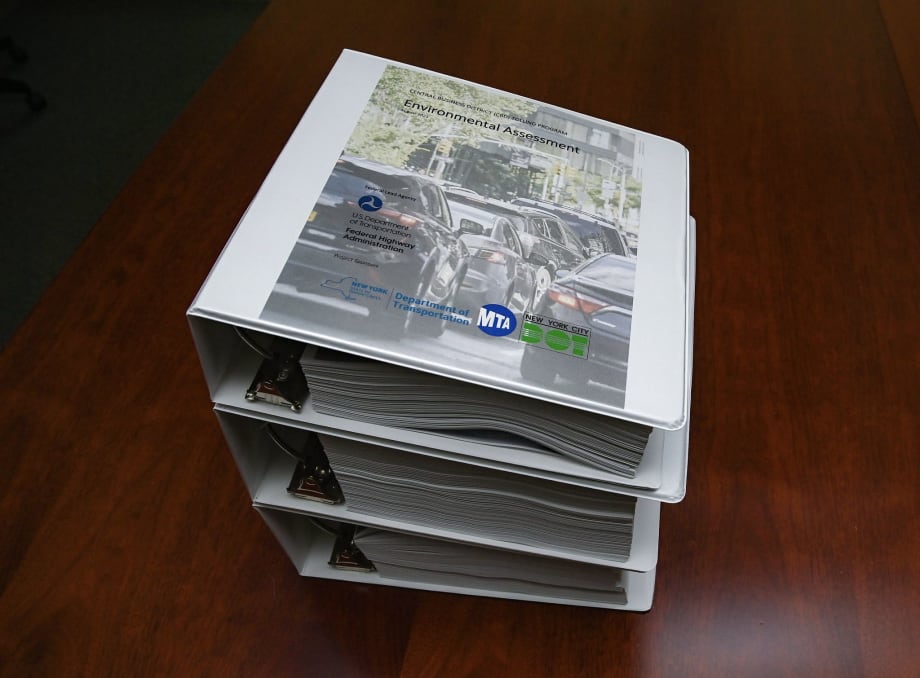
The document evaluates the effects of the program compared with taking no action.
Marc A. Hermann
The Federal Highway Administration, New York State Department of Transportation, MTA Triborough Bridge and Tunnel Authority, and New York City Department of Transportation released an Environmental Assessment of the proposed Central Business District Tolling Program (CBDTP) in Manhattan, known commonly as congestion pricing. The Environmental Assessment document is available for review online and in more than 60 locations throughout the New York City metropolitan region.
The document evaluates the effects of the program compared with taking no action. The document finds that central business district tolling would accomplish the goal of New York State’s MTA Reform and Traffic Mobility Act of reducing traffic congestion in the Manhattan Central Business District (CBD) and raising revenue for investment in transit.
"The tremendous detail included in this assessment makes clear the widespread benefits that would result from central business district tolling,” said MTA Chair and CEO Janno Lieber. “Bottom line: congestion pricing is good for the environment, good for public transit and good for New York and the region. We look forward to receiving public feedback in the weeks ahead.”
The Environmental Assessment (EA) is based on modeling of seven tolling scenarios within the CBD Tolling Alternative, with different combinations of potential exemptions, discounts and/or crossing credits, and the resultant toll rates. The EA finds the program would result in either beneficial effects or no adverse effects for the majority of topics studied, including regional air quality, regional transportation, and parking. Where potential adverse effects were identified, mitigation is provided.
The assessment found that 85% of existing work trips to the CBD are made by transit, 5% by car from New York City, 3% by car from New York suburban counties, 3% by car from New Jersey, 0.2% by car from Connecticut, and 4% by other modes, including taxis, for-hire vehicles, bicycling and walking.
Among the key findings of the assessment are:
Implementation of tolls would achieve the purpose and need of the project — to reduce traffic congestion in the Manhattan CBD in a manner that will generate revenue for future transportation improvements.
With initiation of the program, the number of vehicles entering the CBD would decline by 15.4% to 19.9%, depending on the tolling scenario. Traffic elsewhere in the region would change between -1.5% to 0.2%, depending on the location and the tolling scenario.
Air quality would improve overall, with greater beneficial effects within and closer to the CBD.
Reduction in traffic would result in increased reliability of bus service.
Increase in transit ridership of 1% to 2%.
The project partners received more than 7,300 comments in early enhanced outreach as the Environmental Assessment was being prepared. Seeking feedback on the document now that the Environmental Assessment has been released, the project partners have outlined a series of virtual public hearings that will take place from Aug. 25 through Aug. 31, as well as a meeting of the Environmental Justice Stakeholder Working Group, on Aug. 19, and a meeting of the Environmental Justice Technical Advisory Group, for Aug. 22. The project partners are accepting comments online, via email, mail, voicemail and fax.
Following the public review period, the Federal Highway Administration (FHWA) will determine whether establishment of the program would result in significant effects in addition to the widespread benefits detailed in the assessment. The FHWA will issue one of two documents responding to the environmental assessment: either a Finding of No Significant Impact (FONSI), establishing that any adverse effects are not significant or can be mitigated below significant level, or, if determined that there are significant effects that cannot be mitigated, a request for an Environmental Impact Statement (EIS) requiring further study of the proposed program.
If the FHWA approves the project, contractors would have 310 days to design, develop, and implement the tolling infrastructure and tolling system technology that would process the tolls.
More Management

METRO Opens Submissions for 2026 Motorcoach Awards
Nominations are now being accepted for METRO Magazine’s Operator of the Year and Innovative Operator of the Year awards.
Read More →
New York MTA Advances Final Contract for Second Avenue Subway Expansion
Contract Four is the largest in the Second Avenue Subway Phase 2 project and includes construction of station infrastructure, tracks, and signals for the subway expansion, MTA officials said. Work on Contract Four will begin in 2027.
Read More →
Transit Agencies Highlight Safety Gains at National Summit
Leaders from 15 major transit systems shared crime-reduction results and safety initiatives while discussing the role of continued federal support.
Read More →

NITA Names New Leadership, Expands Reduced-Fare Program at First Board Meeting
The new regional transit authority appointed its first board chair and interim executive director while extending reduced fares across CTA, Metra, and Pace for eligible riders.
Read More →
Beyond the Checklist: A Structured Approach to Transit Maintenance
Reliability-Centered Maintenance helps transit agencies move beyond routine checklists to focus limited resources on the assets and failures that have the greatest impact on safety, reliability, and service.
Read More →
APTA 2026 Nominating Committee Selects Leadership Slate, Names Chair and Vice Chair Nominees
Leadership changes will help shape the association’s priorities and its representation of the transportation industry during the 2026–2027 term.
Read More →
DART Launches Major Security, Fare Enforcement Initiative
The 90-day demonstration will deploy coordinated security teams at five light rail stations while testing controlled access and gathering data to guide future investments.
Read More →
Advancing Fare Collection Through Technology and Innovation
Learn about delivering 1300 gates at 91 stations while managing fare evasion. Explore the large scale deployment, solution customization and real-world results that affect the region. Prepare for deployment in your region now.
Read More →
Game Day in Motion: Moving Millions During the 2026 World Cup
Between packed transit stations and team motorcoaches, see how agencies and operators across North America tackled the transportation demands of the 2026 FIFA World Cup.
Read More →
Surface Transportation Extension Averts Shutdown, Leaves Transit Funding Gap
The stopgap keeps federal transportation programs moving, but missing advance funding could complicate the transit and rail projects agencies are planning next.
Read More →