



Feds advance rail plans for Northeast Corridor
NEC FUTURE is FRA’s comprehensive planning effort to identify ways to improve the reliability, capacity, connectivity, performance, and resiliency of passenger rail service throughout the Northeast Corridor through 2040 and beyond.

NEC Future logo
NEC Future logo
The Federal Railroad Administration (FRA) released the Northeast Corridor (NEC) FUTURE Record of Decision (ROD). NEC FUTURE is FRA’s comprehensive planning effort to identify ways to improve the reliability, capacity, connectivity, performance, and resiliency of passenger rail service throughout the Northeast Corridor through 2040 and beyond.
The ROD marks the completion of the Tier 1 environmental review process under the National Environmental Policy Act (NEPA), and establishes a long-term strategy for the NEC. The NEC FUTURE ROD expedites the environmental review process by focusing Tier 2 (project-level) environmental planning work and future analysis on priority issues; establishing agency relationships and agreements that will expedite and coordinate reviews; and narrowing the range of possible alternatives that would need to be examined at the project level.
The ROD also allows priority projects to move forward more expeditiously, because the Tier 1 environmental review process will already have been completed.
“Safe, reliable and efficient rail transportation is a vital part of our nation’s infrastructure,” said U.S. Department of Transportation Secretary Elaine L. Chao. “And expediting the project delivery process is key to delivering needed infrastructure more quickly.”
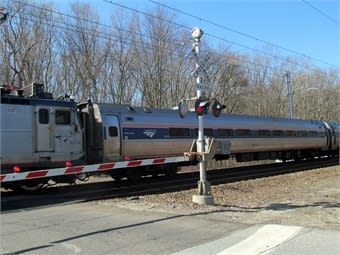
Amtrak train on NEC. Courtesy Amtrak
Developed in concert with NEC states, local communities and railroads and with significant input from the public, the NEC FUTURE ROD lays out a menu of potential ways to improve passenger rail service by:
Increasing, and in some areas doubling, the number of regional commuter trains and providing three to five times more intercity trains.
Improving travel times between key city centers: Boston to New York City would be 45 minutes faster; New York City to Washington, D.C., would be 35 minutes faster.
Expanding the NEC to a four-to-six-track modernized, integrated rail network with sufficient capacity to accommodate the projected increase in demand for intercity and commuter rail service.
Adding more than 200 miles of expanded track capacity between Washington, D.C., and New Haven, Conn., and between Providence, R.I., and Boston, Mass.
Creating a seamless customer experience through integrated ticketing and convenient connections.
Preparing for the future by stipulating that “new segments should be designated for 220 mph operations, unless there are unique or exceptional constraints that justify limiting the highest practical speed.”
Calling for a New Haven-to-Providence Capacity Planning Study to identify on- and off-corridor infrastructure to address the capacity constraints, speed restrictions and flooding vulnerability along the Connecticut and Rhode Island shoreline.
“Given the high cost projections of the recommendations in the NEC ROD and the reality of state budgets, the completion of the Tier 1 study will enable states to better prioritize which projects to pursue,” said FRA Deputy Administrator Heath Hall. “Through this effort, localities will have a clearer picture of how their projects will fit in with the rest of the Northeast corridor.”
The NEC mainline is 457 miles long, stretching from Washington, D.C., to Boston. Adding the “connecting corridors” (including Richmond, Virginia, and Albany, New York, etc.) ensures that the corridor rail lines total 899 miles. Every weekday, about 820,000 passenger trips occur along the NEC corridor — 95% of them on eight commuter railroads and about 5% via Amtrak. The ROD assumes that by 2040, ridership will grow about 70% at New York’s Penn Station, greater than 80% at Washington, D.C.’s Union Station, and 50% at Boston’s South Station.
The NEC FUTURE ROD does not include funding recommendations to implement suggested improvements, in recognition that those decisions must be made by local and regional stakeholders. The approximate total cost estimate for all projects known to be within the parameters of the ROD totals $121 billion to $153 billion.
More Rail

New York MTA Advances Final Contract for Second Avenue Subway Expansion
Contract Four is the largest in the Second Avenue Subway Phase 2 project and includes construction of station infrastructure, tracks, and signals for the subway expansion, MTA officials said. Work on Contract Four will begin in 2027.
Read More →
San Diego MTS Breaks Monthly Trolley Ridership Record
Agency officials said July’s ridership indicates MTS’s continued recovery from the pandemic.
Read More →
Report Examines NJ TRANSIT Reliability, Funding Challenges
The Garden State Initiative analysis examines the roles of Amtrak infrastructure, fleet management, and agency operations while recommending a more performance-based approach to improving reliability.
Read More →
Stadler, CapMetro Sign Long-Term Rail Fleet Support Agreement
Beginning in 2027, Stadler will provide on-site technical expertise, spare parts support, training, and obsolescence management to help extend the reliability and longevity of CapMetro’s GTW fleet.
Read More →
Biz Briefs: Alstom Lands Canadian Contract, LYT to Supply California TSP, and More
In METRO's latest installment, we take a look at recent news from Complete Coach Works, Beep, FlixBus, and more partnerships making headlines across the transportation sector.
Read More →
CATS Gold Line Marks 5 Years of Service, 2.8M Passenger Trips
With a six-mile expansion planned, the Charlotte streetcar is positioned to connect more neighborhoods and major transit hubs across the region.
Read More →
Why Simulating Pedestrian Movement Has Become Essential for Modern Rail Stations
Pedestrian microsimulation is helping rail planners identify bottlenecks, test station designs, and prepare complex transit hubs for growing passenger volumes.
Read More →
Amtrak Begins Major Construction at New York’s Sunnyside Yard
The new maintenance facility will support Amtrak’s Airo trainsets while improving maintenance efficiency and turnaround times in New York.
Read More →
Chicago Leaders Unveil Plans for O’Hare Airport Express Train
The privately developed project would offer a 15-minute trip between downtown and O’Hare’s Terminal 2, with trains operating every 15 minutes on a dedicated track. The service would use battery-electric trains and three existing freight rail rights-of-way.
Read More →
OCTA Maps Out 30-Year Strategy to Protect Coastal Rail Corridor
The draft feasibility report identifies strategies to protect the coastal rail line for decades as the agency continues near-term stabilization and sand placement efforts.
Read More →