




Related: Kinetic storage system increases efficient use of rail power
Flywheel tech on light rail, sees cost savings of 11%, study says
University of of Alberta professors calculated that the use of flywheel technology to assist light rail transit in Edmonton, Alberta, would produce energy savings of 31% and cost savings of 11%.
September 7, 2016
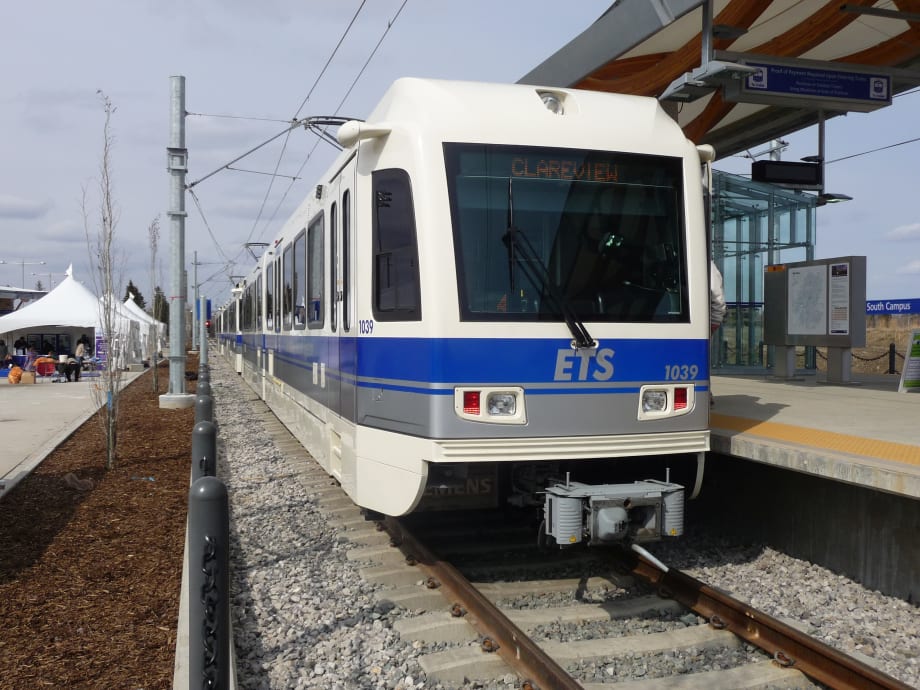
A Siemens SD-160 Light Rail Vehicle, owned and operated by Edmonton Transit System (ETS), waiting at South Campus Station. Photo: Wikimedia Commons/Jakub Limanowka
2 min to read

University of Alberta mechanical engineering professors Pierre Mertiny and Marc Secanell are looking to make an old technology new again and save some money for transit train operators, such as the Edmonton light rail transit system while they do it.
“The flywheel is an old technology, but that’s partly what makes it so sensible,” says Mertiny. “Fundamentally, it’s a really simple technology. We already have everything we need.”
The two recently calculated that the use of flywheel technology to assist light rail transit in Edmonton, Alberta, would produce energy savings of 31% and cost savings of 11%.
A flywheel is a disk, also known as the rotor, that rotates and increases its rotational speed as it is fed electricity. This rotational energy can then be turned back into electrical energy whenever it is needed. It is, in a sense, a mechanical battery. The system loses very little energy to heat or friction because it operates in a vacuum and may even use magnetic bearings to levitate the rotor.
In North America, high-capacity flywheels are also used in areas of high population density, such as New York, Massachusetts and Pennsylvania, to buffer electricity to prevent power outages.
Secanell and Mertiny examined the possibility of using flywheel technology to store energy generated when the city’s LRT trains decelerate and stop. Trains such as the LRT are designed with so-called dynamic braking, using traction motors on the train’s wheels, for smooth stops. But the deceleration generates energy, which needs to go somewhere.
“Electric and fuel-cell vehicles already implement regenerative braking to store the energy produced during braking for start-up, so why would trains not be able to do so?” says Secanell, whose research also focuses on fuel cell vehicle technologies.
Currently that electricity is considered “dirty” electricity because it is intermittent, and therefore, difficult to use. Conventional systems simply send the braking electric power to resistors on the train, which convert the electrical energy to heat that is then released into the air. A flywheel system would take the electrical energy and store it as mechanical energy. This mechanical energy could then be converted back to electrical energy when the train is ready to leave the station again.
More Rail
Amtrak Board Advances Plan to Restructure Organization, Seeks Public Input
The proposal, developed by Amtrak management and approved by the board for further consideration, is intended to modernize the organization's structure while improving accountability, operational efficiency, and customer service.
Read More →
Biz Briefs: STV teams with Amtrak, Motorcoach Operators Boost Fleet and Land Contracts, and More
From manufacturers and suppliers to transit agencies and motorcoach operators, these updates offer a snapshot of the projects, partnerships and business moves driving the industry forward.
Read More →
Metra Celebrates 100 Years of Electric Rail, Looks to the Future
The event was also a celebration of recent reforms to public transportation in the Chicago area, changes that could be as transformative in the future as the major civic achievement a century ago, said officials.
Read More →
LA Metro Marks Banner Year, Sets Ambitious Goals for New Fiscal Year
Incoming LA Metro Board Chair and Los Angeles Mayor Karen Bass joined outgoing Board Chair Fernando Dutra and LA Metro CEO Stephanie Wiggins to review accomplishments from fiscal year 2026, which included the opening of new rail extensions, advancement of major transit projects, expanded safety programs, and new rider amenities.
Read More →
DART Taps Nathaniel P. Ford Sr. as Next President/CEO
Since 2012, Ford has served as the CEO of the Jacksonville Transportation Authority
Read More →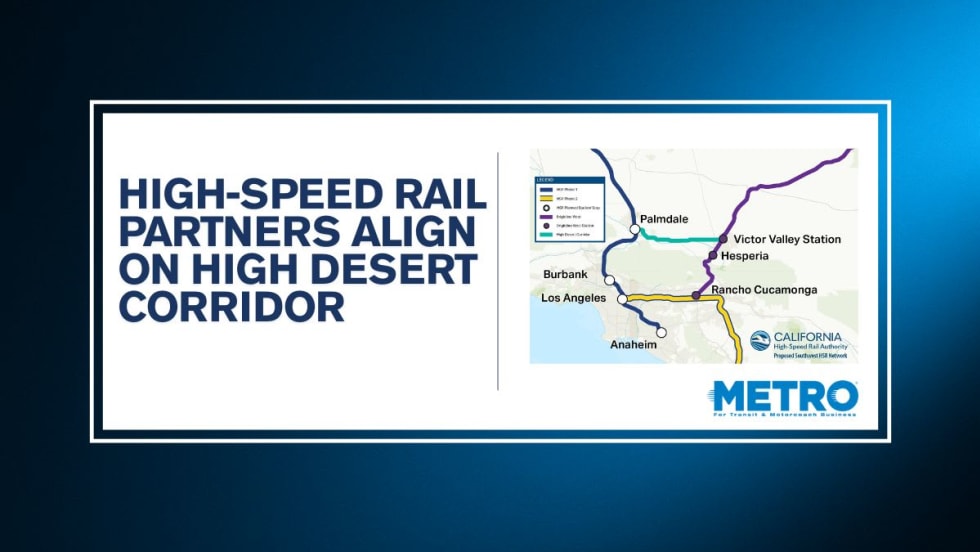
California High-Speed Rail Authority Signs MOU to Advance High Desert Corridor
The agreement deepens collaboration between the California High-Speed Rail Authority and the High Desert Corridor Joint Powers Agency, supporting design integration, cost savings, and faster delivery of a key Southern California rail link.
Read More →
Building the Next Generation of Transit Technology
In this edition of METROspectives, Luminator CEO Magnus Friberg discusses the company's transformation, the growing role of AI and software, and what's next for transit technology.
Read More →
How Data, Strategy, and Community Engagement Are Reshaping Transit
In this edition of METROspectives, strada360 CEO Steve Lassey discusses how transit agencies can better align planning with operations, leverage data to improve decision-making, and build public trust as they prepare for the future of mobility.
Read More →
TTC Launches Camera Pilot to Curb Illegal Passing of Streetcars
During the pilot, the cameras will measure how often illegal streetcar passing occurs and test the technology's reliability for future automated enforcement.
Read More →
NJ TRANSIT Secures Capital Funding, Adopts FY2027 Budget
The budgets continue investments in infrastructure and equipment to maintain the system in a state of good repair and enhance the overall customer experience.
Read More →