




RELATED: [Video] Mcity test facility for automated and connected vehicles
Ford unveils plans for driverless car fleet by 2021
The SAE-rated level 4-capable vehicle will not have a steering wheel or gas and brake pedals. It is being specifically designed for commercial mobility services, such as ride sharing and ride hailing, and will be available in high volumes.
August 18, 2016
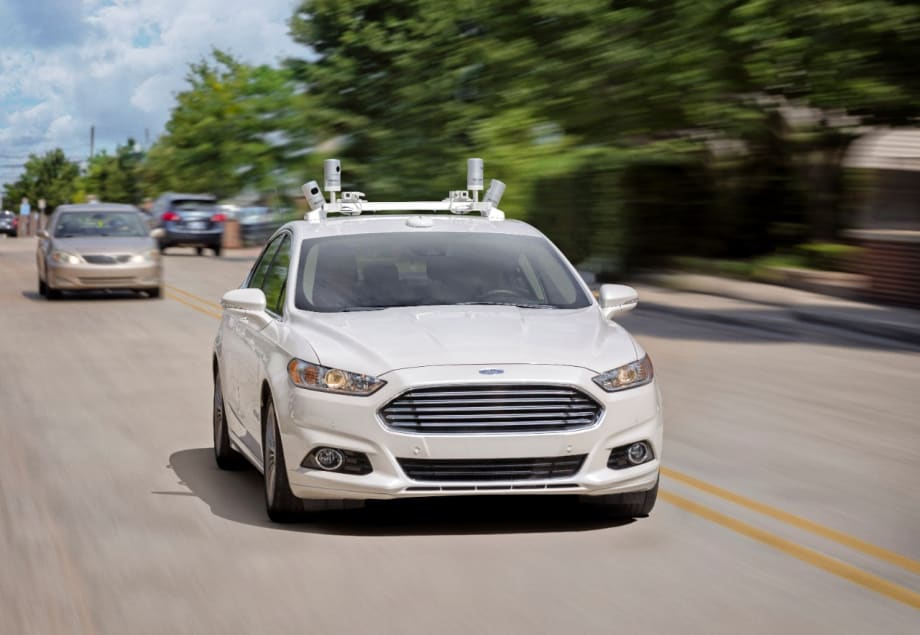
Image via Ford
2 min to read
Image via Ford
Ford announced plans to have fully autonomous, driverless ride-sharing vehicles in commercial operation by 2021.
The vehicle will be a Society of Automotive Engineers-rated level 4-capable vehicle without a steering wheel or gas and brake pedals. It is being specifically designed for commercial mobility services, such as ride sharing and ride hailing, and will be available in high volumes.
To get there, the company is investing in or collaborating with four startups (see below) to enhance its autonomous vehicle development in the areas of advanced algorithms, 3D mapping, LiDAR, and radar and camera sensors.
Velodyne is the Silicon Valley-based developer of light detection and ranging (LiDAR) sensors, which are used for high-resolution mapping — key for autonomous vehicle technology.
SAIPS: The Israel-based computer vision and machine learning company's expertise will help Ford autonomous vehicles learn and adapt to the surroundings of their environment.
Nirenberg Neuroscience LLC: Ford’s partnership with Nirenberg Neuroscience, a machine vision company, will help bring humanlike intelligence to the machine learning modules of its autonomous vehicle virtual driver system
Civil Maps: Ford has invested in Berkeley, California-based Civil Maps to further develop high-resolution 3D-mapping capabilities.
This year, Ford will triple its autonomous vehicle test fleet to be the largest test fleet of any automaker — bringing the number to about 30 self-driving Fusion Hybrid sedans on the roads in California, Arizona and Michigan, with plans to triple it again next year. The automaker is also is expanding its Silicon Valley operations, creating a dedicated campus in Palo Alto by the end of 2017.
More New Mobility

From Hardware to Digital Partner: Luminator Charts Its Next Chapter
CEO Magnus Friberg discusses Luminator’s shift toward becoming a digital partner, the growing importance of software and interoperability, and how AI can help agencies improve operations and passenger experience.
Read More →
Biz Briefs: Alstom Lands Canadian Contract, LYT to Supply California TSP, and More
In METRO's latest installment, we take a look at recent news from Complete Coach Works, Beep, FlixBus, and more partnerships making headlines across the transportation sector.
Read More →
CharterUP’s Armir Harris on Technology, AI, and the Future of Group Mobility
In a recent episode of METROspectives, CharterUP Founder/CEO Armir Harris discussed the company’s evolution from an online charter bus marketplace into a technology platform supporting public- and private-sector mobility and much more.
Read More →
Jacksonville’s NAVI Project Charts a New Course for Autonomous Public Transportation
Through its NAVI program, JTA is showing how autonomous vehicles, intelligent infrastructure, and coordinated operations can work together to deliver everyday public transportation.
Read More →
Biz Briefs: Luminator Marks Milestone and More
From manufacturers and suppliers to transit agencies and motorcoach operators, these updates offer a snapshot of the projects, partnerships and business moves driving the industry forward.
Read More →
New Tricks for Old Bureaucracies: Joshua Schank on Making Transit Innovation Stick
Former LA Metro Chief Innovation Officer Joshua Schank discusses why good ideas aren't enough, how transit agencies can overcome resistance to change, and why today's challenges demand more innovation.
Read More →
How DART's GoPass Is Redefining Regional Mobility
Serving 14 transit agencies, GoPass simplifies multimodal travel by allowing riders to plan, pay for, and manage an entire trip through one app.
Read More →
Biz Briefs: OCTA Taps Clean Energy for Hydrogen Station, Stadler to Supply Via Rail Vehicles, and More
From manufacturers and suppliers to transit agencies and motorcoach operators, these updates offer a snapshot of the projects, partnerships and business moves driving the industry forward.
Read More →CharterUP Expands Into New Mobility and Autonomous Transportation
Vice President of New Mobility Stephen Joos discusses how CharterUP is leveraging its nationwide transportation network, technology platform, and autonomous vehicle partnerships to expand into workforce mobility, campus shuttles, and transit solutions.
Read More →
METRO Magazine Announces 2026 Innovative Solutions Awards Winners
Projects Recognized for Advancing Mobility Through Technology, Accessibility, Workforce Innovation, and Operational Excellence
Read More →