



High CEO pay linked to lower approval ratings, study says
The study, conducted by Glassdoor, a jobs and recruitment marketplace, looks at large, publicly traded companies in the U.S. and reveals the factors that ultimately drive employee perception of CEOs.

Glassdoor
Glassdoor
Highly paid CEOs have significantly lower CEO approval ratings, according to a new study of publicly traded companies. And, interestingly, low employee ratings around work-life balance tend to correlate to higher CEO approval ratings. While employee sentiment around culture, senior leadership, career advancement, and compensation and benefits have some statistical significance around higher CEO approval, other characteristics like gender, age, education and job tenure do not.
The study, What Makes a Great CEO?, conducted by Glassdoor, a jobs and recruitment marketplace, looks at large, publicly traded companies in the U.S. and reveals the factors that ultimately drive employee perception of CEOs.
Key findings include:
CEO pay matters:Higher CEO compensation is statistically linked to lower CEO approval ratings on average. However, that effect is lessened when company culture is better.
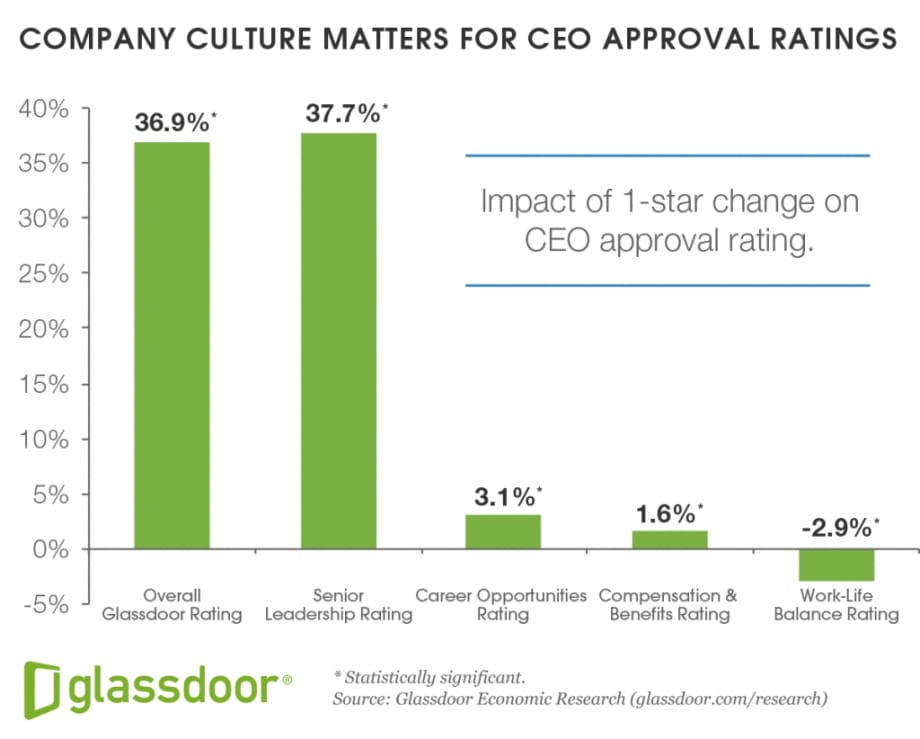
Company culture matters: A satisfied workforce is an essential driver of CEO approval ratings on Glassdoor. Three aspects of company culture matter most:
Opinion of senior leadership;
View of career opportunities; and
Quality of compensation and benefits packages.
Work-life balance is an exception: Surprisingly, one aspect of company culture is negatively related to CEO approval ratings: Work-life balance. Low satisfaction with work-life balance predicts high CEO approval. Although many workers value work-life balance, they appear willing to sacrifice it in exchange for great CEO leadership.
Founders matter: CEOs who are also their company’s founder predicts significantly higher CEO approval ratings than being an externally hired or internally promoted CEO.
Performance matters: CEOs of more profitable companies receive higher approval ratings on Glassdoor, even after statistically controlling for the impact of other factors such as industry and company size.
Gender and other personal characteristics matter less: Gender, age and education of CEOs have little effect on CEO approval ratings once other factors are accounted for.
“Employee opinion of the CEO can be very telling about a company, and Glassdoor data confirms there is a direct link between how employees view their CEO and how they feel about their company culture. CEOs and leaders who cultivate a strong company culture, offering career advancement opportunities for employees and management training for strong senior leaders, will typically gain more approval from their employees,” said Dr. Andrew Chamberlain, chief economist of Glassdoor Inc. “And there’s no doubt about it — employees who are more satisfied are going to be more productive, impacting the bottom line.”
More Management

LIT Marks 10-Year Milestone at Annual Summit
Hosted by the COTA from September 10 to 13, the Summit carried the theme “Celebrating 10 Years of Excellence, Leadership, and Impact,” with every part of the program honoring the people, agencies, and partners who built LIT over its first decade.
Read More →
People Movement: Dan Dipert Coaches Adds Third-Generation Leader, Keolis Names New Valley Metro VP/GM, and More
In this edition, we also cover recent appointments and announcements at the Wabtec, SilverRide, HNTB, and more, showcasing the individuals helping to shape the future of transportation.
Read More →
METRO Opens Submissions for 2026 Motorcoach Awards
Nominations are now being accepted for METRO Magazine’s Operator of the Year and Innovative Operator of the Year awards.
Read More →

New York MTA Advances Final Contract for Second Avenue Subway Expansion
Contract Four is the largest in the Second Avenue Subway Phase 2 project and includes construction of station infrastructure, tracks, and signals for the subway expansion, MTA officials said. Work on Contract Four will begin in 2027.
Read More →
Transit Agencies Highlight Safety Gains at National Summit
Leaders from 15 major transit systems shared crime-reduction results and safety initiatives while discussing the role of continued federal support.
Read More →
NITA Names New Leadership, Expands Reduced-Fare Program at First Board Meeting
The new regional transit authority appointed its first board chair and interim executive director while extending reduced fares across CTA, Metra, and Pace for eligible riders.
Read More →
Beyond the Checklist: A Structured Approach to Transit Maintenance
Reliability-Centered Maintenance helps transit agencies move beyond routine checklists to focus limited resources on the assets and failures that have the greatest impact on safety, reliability, and service.
Read More →
APTA 2026 Nominating Committee Selects Leadership Slate, Names Chair and Vice Chair Nominees
Leadership changes will help shape the association’s priorities and its representation of the transportation industry during the 2026–2027 term.
Read More →
DART Launches Major Security, Fare Enforcement Initiative
The 90-day demonstration will deploy coordinated security teams at five light rail stations while testing controlled access and gathering data to guide future investments.
Read More →
Advancing Fare Collection Through Technology and Innovation
Learn about delivering 1300 gates at 91 stations while managing fare evasion. Explore the large scale deployment, solution customization and real-world results that affect the region. Prepare for deployment in your region now.
Read More →