




RELATED: Funding issue may force agency to temporarily shut down
Ill. agency reduces night service to deal with lack of state funding
The roughly $180,000 in cost savings from the night service reductions for the Springfield Mass Transit District are less than one third of what is already being done while SMTD awaits delayed payments and a clearer budget picture from the state.
November 29, 2016
SMTD
2 min to read
SMTD
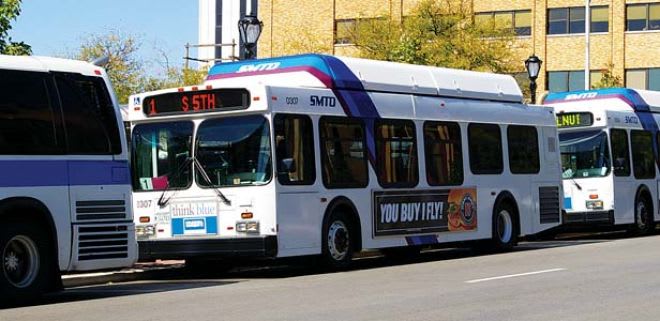
Ill.’s Springfield Mass Transit District (SMTD) board of trustees, responding to delays in state payments and continued uncertainty in the state budget moving forward, approved reductions in night service hours proposed in the previous board meeting, with one exception — weeknight night service will be reduced by only one hour rather than two hours, as was previously proposed.
“Dozens of passengers commented either at one of our three meetings or online, and, as is always the case, those comments were presented to the board for their review and consideration,” said Steve Schoeffel, SMTD’s service planning & marketing specialist. “While no one wants service reductions, the vast majority of public comment dealt with hardships that would be caused by the 40% reduction in weeknight service hours.”
He added SMTD is taking other steps to reduce cost outside of service reductions.
“Some perceive these cuts as SMTD reducing costs solely by reducing service,” Schoeffel explained. “In fact, these service reductions are just one of several avenues we are exploring to reduce costs.”
Over $600,000 in savings from everything from administrative contracts for items, such as office cleaning to millions in capital projects requiring hundreds of thousands in matching local funds being put on hold, are being considered. The roughly $180,000 in cost savings from the night service reductions are less than one third of what is already being done while SMTD awaits delayed payments and a clearer budget picture from the state.
In addition, technology improvements already approved have been scaled back to still allow for the project to move forward without risking loss of the federal grant funding already committed, but on a longer implementation schedule to allow SMTD more financial flexibility.
“All of these measures add up to a significant amount, and, hopefully, this will get us through for a while without further, more substantial cuts,” Schoeffel added. “We believe this is the least-painful way we can reduce costs and still maintain core services moving forward.”
Should the district’s funding stabilize in the next few months, SMTD plans to re-evaluate these reductions and would consider re-starting services. However, the changes are scheduled to be implemented early in January 2017, and the situation is not likely to be resolved before then, according to the agency.
More Management

METRO Opens Submissions for 2026 Motorcoach Awards
Nominations are now being accepted for METRO Magazine’s Operator of the Year and Innovative Operator of the Year awards.
Read More →
New York MTA Advances Final Contract for Second Avenue Subway Expansion
Contract Four is the largest in the Second Avenue Subway Phase 2 project and includes construction of station infrastructure, tracks, and signals for the subway expansion, MTA officials said. Work on Contract Four will begin in 2027.
Read More →
Transit Agencies Highlight Safety Gains at National Summit
Leaders from 15 major transit systems shared crime-reduction results and safety initiatives while discussing the role of continued federal support.
Read More →

NITA Names New Leadership, Expands Reduced-Fare Program at First Board Meeting
The new regional transit authority appointed its first board chair and interim executive director while extending reduced fares across CTA, Metra, and Pace for eligible riders.
Read More →
Beyond the Checklist: A Structured Approach to Transit Maintenance
Reliability-Centered Maintenance helps transit agencies move beyond routine checklists to focus limited resources on the assets and failures that have the greatest impact on safety, reliability, and service.
Read More →
APTA 2026 Nominating Committee Selects Leadership Slate, Names Chair and Vice Chair Nominees
Leadership changes will help shape the association’s priorities and its representation of the transportation industry during the 2026–2027 term.
Read More →
DART Launches Major Security, Fare Enforcement Initiative
The 90-day demonstration will deploy coordinated security teams at five light rail stations while testing controlled access and gathering data to guide future investments.
Read More →
Sponsored•September 9, 2026
Advancing Fare Collection Through Technology and Innovation
Learn about delivering 1300 gates at 91 stations while managing fare evasion. Explore the large scale deployment, solution customization and real-world results that affect the region. Prepare for deployment in your region now.
Read More →
Game Day in Motion: Moving Millions During the 2026 World Cup
Between packed transit stations and team motorcoaches, see how agencies and operators across North America tackled the transportation demands of the 2026 FIFA World Cup.
Read More →
Surface Transportation Extension Averts Shutdown, Leaves Transit Funding Gap
The stopgap keeps federal transportation programs moving, but missing advance funding could complicate the transit and rail projects agencies are planning next.
Read More →