



JTA, Beep, and NAVYA AVs help transport Mayo Clinic COVID-19 tests
On Monday, up to four autonomous vehicles began operating along an initial route, in full autonomous mode without attendants or other people onboard.


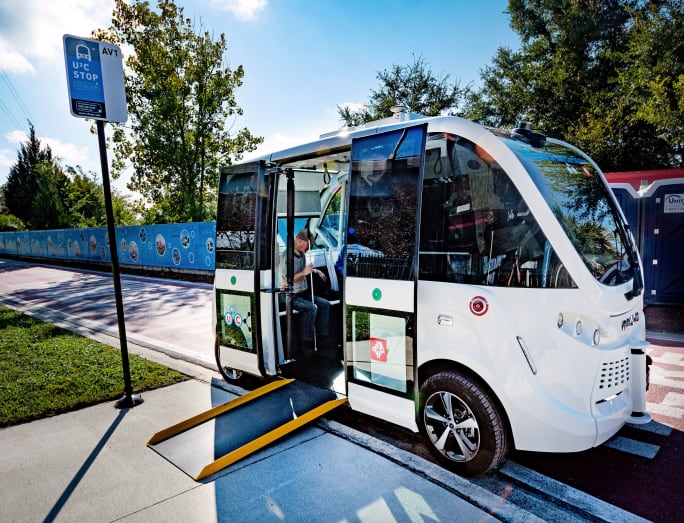
The JTA has actively tested AV technology since 2017 to prepare for a conversion and expansion of its Skyway automated people mover in Downtown Jacksonville into a network powered by autonomous vehicles. JTA
At a time when healthcare resources and personnel are stretched thin, the Jacksonville Transportation Authority (JTA) has partnered with Beep and NAVYA to use autonomous vehicles to facilitate the safe transport of COVID-19 tests collected at a drive-thru testing location at Mayo Clinic in Florida.
“This deployment is a historic moment for the Jacksonville Transportation Authority,” said JTA CEO Nathaniel P. Ford Sr. “Along with our partners Beep, NAVYA, and Mayo Clinic, we are leveraging our learnings from three years of testing autonomous vehicles through our Ultimate Urban Circulator program. Our innovative team saw this as an opportunity to use technology to respond to this crisis in Northeast Florida and increase the safety of COVID-19 testing.”
On Monday, up to four autonomous vehicles began operating along an initial route, in full autonomous mode without attendants or other people onboard, to transport COVID-19 tests from a drive-thru testing site to a processing laboratory on Mayo Clinic’s campus. The COVID-19 test samples are placed in secure containers prior to Mayo Clinic healthcare professionals loading the samples onto the shuttle.
The JTA, Beep, NAVYA, and Bestmile teams partnered to create, test, and deploy the routes for the autonomous vehicles at Mayo Clinic in Florida to address the fluid developments of the COVID-19 pandemic. The routes are isolated from pedestrians, traffic, and staff. Beep, Mayo Clinic, and the JTA will closely monitor the service from a mobile command center to maintain safe operation.
Beep, an autonomous shuttle fleet service provider, transported the shuttles through Eagle Express Inc. from Lake Nona, Fla., an innovation hub 150 miles away where the company is headquartered in Orlando. An additional shuttle is being utilized from the JTA’s Ultimate Urban Circulator (U2C) program. The JTA has actively tested AV technology since 2017 to prepare for a conversion and expansion of its Skyway automated people mover in Downtown Jacksonville into a network powered by autonomous vehicles.
More New Mobility

From Hardware to Digital Partner: Luminator Charts Its Next Chapter
CEO Magnus Friberg discusses Luminator’s shift toward becoming a digital partner, the growing importance of software and interoperability, and how AI can help agencies improve operations and passenger experience.
Read More →
Biz Briefs: Alstom Lands Canadian Contract, LYT to Supply California TSP, and More
In METRO's latest installment, we take a look at recent news from Complete Coach Works, Beep, FlixBus, and more partnerships making headlines across the transportation sector.
Read More →
CharterUP’s Armir Harris on Technology, AI, and the Future of Group Mobility
In a recent episode of METROspectives, CharterUP Founder/CEO Armir Harris discussed the company’s evolution from an online charter bus marketplace into a technology platform supporting public- and private-sector mobility and much more.
Read More →
Jacksonville’s NAVI Project Charts a New Course for Autonomous Public Transportation
Through its NAVI program, JTA is showing how autonomous vehicles, intelligent infrastructure, and coordinated operations can work together to deliver everyday public transportation.
Read More →
Biz Briefs: Luminator Marks Milestone and More
From manufacturers and suppliers to transit agencies and motorcoach operators, these updates offer a snapshot of the projects, partnerships and business moves driving the industry forward.
Read More →
New Tricks for Old Bureaucracies: Joshua Schank on Making Transit Innovation Stick
Former LA Metro Chief Innovation Officer Joshua Schank discusses why good ideas aren't enough, how transit agencies can overcome resistance to change, and why today's challenges demand more innovation.
Read More →
How DART's GoPass Is Redefining Regional Mobility
Serving 14 transit agencies, GoPass simplifies multimodal travel by allowing riders to plan, pay for, and manage an entire trip through one app.
Read More →
Biz Briefs: OCTA Taps Clean Energy for Hydrogen Station, Stadler to Supply Via Rail Vehicles, and More
From manufacturers and suppliers to transit agencies and motorcoach operators, these updates offer a snapshot of the projects, partnerships and business moves driving the industry forward.
Read More →CharterUP Expands Into New Mobility and Autonomous Transportation
Vice President of New Mobility Stephen Joos discusses how CharterUP is leveraging its nationwide transportation network, technology platform, and autonomous vehicle partnerships to expand into workforce mobility, campus shuttles, and transit solutions.
Read More →
METRO Magazine Announces 2026 Innovative Solutions Awards Winners
Projects Recognized for Advancing Mobility Through Technology, Accessibility, Workforce Innovation, and Operational Excellence
Read More →