



Keolis begins operating MBTA's commuter rail lines
Passengers will begin to see changes designed to improve their travel experience almost immediately, among them the launch of a staffed customer service center that will be open seven days a week to provide assistance to customers.

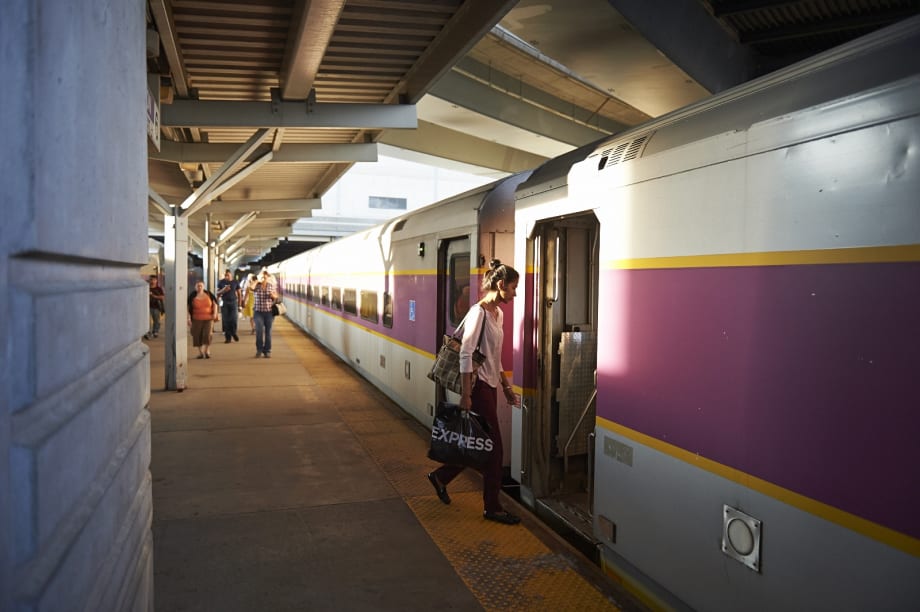
At the stroke of midnight, Keolis Commuter Services officially began operating the Massachusetts Bay Transportation Authority's 14 commuter rail lines with a pledge to increase on-time performance and improve safety, cleanliness and customer service.
In January 2014, Keolis Commuter Services, part of Keolis North America, won a highly competitive bid for the $2.6 billion, eight-year contract to operate and maintain MBTA's commuter rail service, which is the fifth busiest in the nation, serving 127,000 passengers daily.
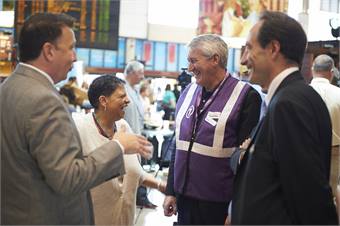
MBTA CEO/GM Beverly Scott pictured with Eric Asselin, executive VP/GM for Keolis North America to her left.
"This is a momentous day for Keolis, our passengers and the communities we will serve,” said Eric Asselin, executive VP/GM for Keolis North America. "From customer service to on-time performance, we pride ourselves in how we are always ‘thinking like a passenger’ in everything we do. With the commitment of our employees and the input of our passengers, we are dedicated to making one of the nation’s preeminent commuter rail services even better.”
RELATED:Keolis names new MBTA safety compliance officer
Keolis officials said passengers will begin to see changes designed to improve their travel experience almost immediately, among them the launch of a staffed customer service center that will be open seven days a week to provide assistance to customers. Passengers will also be encouraged to share suggestions or concerns via a dedicated customer service Twitter account @MBTA_CR and on Facebook.
Other improvements will include freshly cleaned trains and stations, new signage, and repairs to damaged seats. New pocket timetables, featuring larger, easier-to-read system maps, are distributing today at the major stations.
Keolis will also be introducing the first official MBTA Commuter Rail app which is designed to make it easier for passengers to plan their journey. The first version of the app was released today and is free and available for download for both Apple and Android devices. An enhanced version will be released this fall, providing real-time information about commuter rail travel times, a place to register lost or found items in trains and stations and other features designed to enhance the passenger experience.
More Management

LIT Marks 10-Year Milestone at Annual Summit
Hosted by the COTA from September 10 to 13, the Summit carried the theme “Celebrating 10 Years of Excellence, Leadership, and Impact,” with every part of the program honoring the people, agencies, and partners who built LIT over its first decade.
Read More →
People Movement: Dan Dipert Coaches Adds Third-Generation Leader, Keolis Names New Valley Metro VP/GM, and More
In this edition, we also cover recent appointments and announcements at the Wabtec, SilverRide, HNTB, and more, showcasing the individuals helping to shape the future of transportation.
Read More →
METRO Opens Submissions for 2026 Motorcoach Awards
Nominations are now being accepted for METRO Magazine’s Operator of the Year and Innovative Operator of the Year awards.
Read More →

New York MTA Advances Final Contract for Second Avenue Subway Expansion
Contract Four is the largest in the Second Avenue Subway Phase 2 project and includes construction of station infrastructure, tracks, and signals for the subway expansion, MTA officials said. Work on Contract Four will begin in 2027.
Read More →
Transit Agencies Highlight Safety Gains at National Summit
Leaders from 15 major transit systems shared crime-reduction results and safety initiatives while discussing the role of continued federal support.
Read More →
NITA Names New Leadership, Expands Reduced-Fare Program at First Board Meeting
The new regional transit authority appointed its first board chair and interim executive director while extending reduced fares across CTA, Metra, and Pace for eligible riders.
Read More →
Beyond the Checklist: A Structured Approach to Transit Maintenance
Reliability-Centered Maintenance helps transit agencies move beyond routine checklists to focus limited resources on the assets and failures that have the greatest impact on safety, reliability, and service.
Read More →
APTA 2026 Nominating Committee Selects Leadership Slate, Names Chair and Vice Chair Nominees
Leadership changes will help shape the association’s priorities and its representation of the transportation industry during the 2026–2027 term.
Read More →
DART Launches Major Security, Fare Enforcement Initiative
The 90-day demonstration will deploy coordinated security teams at five light rail stations while testing controlled access and gathering data to guide future investments.
Read More →
Advancing Fare Collection Through Technology and Innovation
Learn about delivering 1300 gates at 91 stations while managing fare evasion. Explore the large scale deployment, solution customization and real-world results that affect the region. Prepare for deployment in your region now.
Read More →