




RELATED: Former GM to return to MBTA
Keolis, MBTA tap special equipment to manage 'slippery-rail season'
Commuter rail operator utilizing power washers and drones to reduce impact of slippery rail created by leaves, debris on tracks.
September 28, 2017

Specifically-designed MBTA train cars equipped with special rail power washers are used to clear leaves, debris and the resulting film from heavily-wooded routes along the network. Photo: Keolis/MBTA
2 min to read
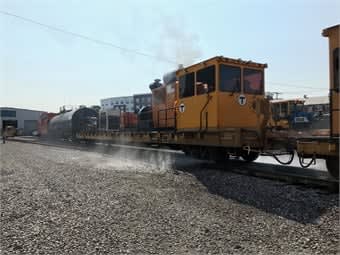
Specifically-designed MBTA train cars equipped with special rail power washers are used to clear leaves, debris and the resulting film from heavily-wooded routes along the network. Photo: Keolis/MBTA
Keolis Commuter Services (KCS), the MBTA’s partner that operates the commuter rail, is working to ensure that when leaves begin to fall, the railroad is prepared to reduce the impact of what is known as slippery rail. Slippery rail occurs when leaves and debris fall onto the track. As trains pass, these transform into a thin and slick film that accumulates on the tracks.
When fall arrives New England residents typically think of the scenic foliage. However, commuter rail team members think about the important preventive maintenance required to help ensure service for the network’s 127,000 daily passengers.
In these fall conditions, trains are required to begin slowing for stops sooner and take more time to re-gain speed when departing a station. As a result, a train needs more time to travel its route, which can create delays. Occasionally more wheel maintenance is also required, and this can impact coach or locomotive availability.
“For the past several weeks, our teams have been planning and working on initiatives to reduce the impact slippery rail can have on our service," said David Scorey, CEO/GM, KCS. "Special equipment clears this film off the track and applies a railroad-specific gel and sand mixture that helps to reduce the service risk that slippery rail creates.”
Specifically-designed MBTA train cars equipped with special rail power washers are used to clear leaves, debris and the resulting film from heavily-wooded routes along the network. These high-pressure rail washers are powered by a locomotive and require 15,000 pounds per square inch of pressure to spray 50 gallons of water per minute.
After the power washer cleans the rail, gels and specialized sand solutions are applied to the rails to help improve train traction. To help identify areas in need of clearing, Keolis deploys drones to view track with over-grown foliage or a build-up of leaves and debris.
“We introduced drones to the commuter rail two years ago because this technology helps us make improvements to the network, and in turn passenger service, much more quickly than in the past,” Scorey added. “This preparation, combined with other recent network enhancements, such as increasing the locomotive fleet size as an example, should help us deliver the high level of service our customers expect. There is more work to do, but we believe these are positive steps in the right direction.”
Year-to-date on-time performance on the commuter rail is 89.3%, only slightly behind the company’s target of 90%.
More Security and Safety

Transit Agencies Highlight Safety Gains at National Summit
Leaders from 15 major transit systems shared crime-reduction results and safety initiatives while discussing the role of continued federal support.
Read More →
DART Launches Major Security, Fare Enforcement Initiative
The 90-day demonstration will deploy coordinated security teams at five light rail stations while testing controlled access and gathering data to guide future investments.
Read More →
RTD Launches NextRide App to Consolidate Trip Planning, Fares, Security Reporting
The app expands on RTD’s existing NextRide web application and allows customers to view real-time vehicle locations and service alerts, purchase and store digital fares, and access customer support.
Read More →

TAPTCO Updates OSHA Compliance Training for Transit Maintenance Operations
The revamped program addresses 26 OSHA standards for maintenance facilities, with TAPTCO pointing to training, documentation, and everyday shop hazards as continuing challenges for transit operations.
Read More →
Sponsored•August 18, 2026
How VaporVision Adds Value to Transit Door Systems
Wabtec engineers explain how the system improves doorway detection, strengthens diagnostics and gives transit agencies and OEMs greater operating flexibility.
Read More →
FRA Announces $5.3B in Rail Investments, Including $2B for Amtrak
Funding will support grade-crossing improvements, infrastructure upgrades, and new Amtrak equipment in 23 states.
Read More →
Chicago, Maryland Expand Non-Law-Enforcement Safety, Rider Support
The CTA and MTA are launching new programs aimed at de-escalation, crisis response, rider assistance, and greater transparency.
Read More →
LA Metro, City of West Hollywood, and Partners Advance Smarter Bus Lane Enforcement
The award-winning partnership combines AI-powered detection with human oversight to improve bus reliability, accessibility, and enforcement efficiency.
Read More →
LA Metro Reports 57% Decline in Homelessness on Transit System Since 2024
The agency's latest homelessness count offers new data on how care-based services and cross-sector partnerships can complement traditional transit security strategies.
Read More →
FTA Launches 'Transit Moves America' Dashboard to Highlight Agency Safety and Performance
The online dashboard transforms National Transit Database information into a public-facing resource that allows users to compare transit agencies on key operational and safety metrics.
Read More →